Online Reporter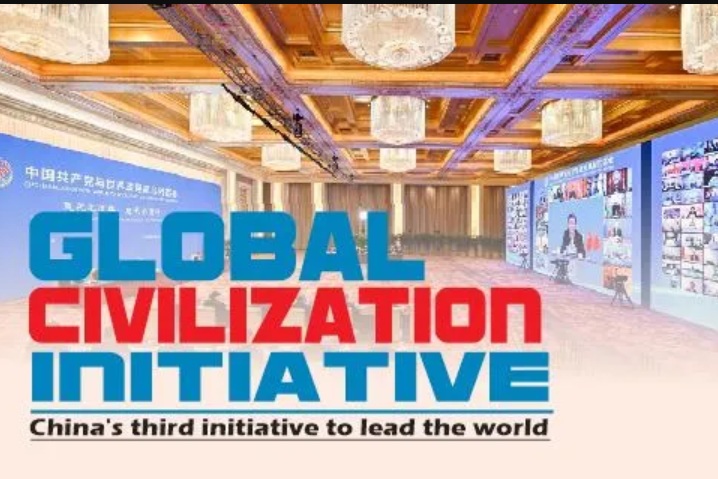
Saxon Zvina
The most consequential question facing the international community may not be which country will become the next superpower, but whether humanity can manage its growing diversity without turning difference into confrontation.
The answer matters enormously to Africa.
In March 2023, Chinese President Xi Jinping proposed the Global Civilisation Initiative (GCI), calling for respect for the diversity of civilisations, the common values of humanity, the inheritance and innovation of civilisations, and stronger people‑to‑people exchanges and cooperation.
At its core lies a dual proposition that deserves wider international consideration: civilisational diversity should be a foundation for cooperation, not a justification for hierarchy, and the GCI builds value consensus across diverse societies while honouring each civilisation’s uniqueness.
For Africa, this is particularly significant.
- Africa’s Own Civilisational Legacy Cannot Be Overlooked
Africa is often discussed internationally through the language of development deficits — poverty, infrastructure gaps, governance challenges, unemployment and conflict. These are real challenges, but they can obscure something equally important: Africa is not a civilisation waiting to be created.
From Great Zimbabwe to the ancient kingdoms of the Nile Valley and the trading and intellectual centres of West Africa, African societies produced their own systems of governance, commerce, technology, architecture, philosophy and social organisation.
Zimbabwe’s own history provides a powerful reminder.
The monumental stone architecture of Great Zimbabwe was not merely an archaeological achievement. It represents a sophisticated society whose economic and political networks extended across considerable distances.
Yet Africa’s historical experience has too often been interpreted through frameworks developed elsewhere.
This is where the GCI’s emphasis on civilisational equality becomes important.
Africa should be able to modernise without being told that modernisation requires cultural imitation.
- Modernisation Does Require Cultural Imitation
For decades, global development debates have sometimes treated particular political, economic and institutional experiences as universal templates.
But history does not work that way.
China’s development experience emerged from China’s particular historical circumstances. Europe’s institutions developed through Europe’s own historical trajectory. India’s development model reflects its own civilisation and social complexity. African countries likewise possess their own histories and conditions.
The lesson is not that one model should replace another.
It is that there can be multiple roads to modernisation.
African countries should be free to study the experiences of China, Europe, the United States, India, Japan, the Gulf states and others — adopting what works while adapting it to African realities.
That is not isolationism. It is intellectual sovereignty.
III. Risks of a World Split Along Civilisational Blocs
The international system is increasingly vulnerable to narratives that divide humanity into competing political or civilisational camps.
The old Cold War divided the world largely along ideological lines. A new form of confrontation could divide it along geopolitical and civilisational lines.
That would be particularly damaging to Africa.
African countries have extensive economic, educational, cultural and diplomatic relationships with multiple parts of the world. Africa does not benefit from being forced into rigid geopolitical binaries.
The continent needs infrastructure from multiple partners, markets for its commodities and manufactured goods, investment in industrialisation, technology transfers, educational opportunities and access to global finance.
A world in which cooperation becomes conditional on choosing a civilisational camp would narrow Africa’s strategic space.
Against such divisive trends, the GCI, which focuses on building value consensus, offers an alternative pathway: dialogue: exchanges that overcome estrangement, mutual learning that transcends conflict and coexistence that rejects superiority.
That principle is increasingly relevant.
- Genuine Exchange Versus Civilisational Hierarchy
There is a crucial distinction between cultural exchange and cultural hierarchy.
Exchange says: I can learn from you, and you can learn from me.
Hierarchy says: I possess the standard by which you should measure yourself.
Africa has experienced both.
Colonialism was not merely an economic and political system. It also produced hierarchies of knowledge and culture in which African institutions and traditions were frequently portrayed as inferior.
The consequences did not disappear with political independence.
Development debates can still implicitly assume that African societies must demonstrate their proximity to external models before their institutions, policies or political choices are regarded as legitimate.
Civilisational confidence offers another possibility.
Africa can engage globally without approaching the world from a position of cultural inferiority.
China‑Africa relations illustrate the potential.
- People‑to‑People Exchanges Beyond Trade and Resources
This is particularly relevant to China‑Africa relations.
The relationship is often analysed almost exclusively through trade, infrastructure, minerals and investment. These dimensions are important, but they do not capture the entire relationship.
People‑to‑people exchanges create another layer.
When African students study in China, Chinese businesses operate in Africa, journalists travel between the two regions, academics conduct joint research and cultural delegations interact, societies acquire the opportunity to understand one another beyond geopolitical stereotypes.
Such exchanges matter because international relations ultimately involve people. Real‑world progress on civilisational exchange also rests on tangible educational, cultural and people‑to‑people project resources. These grassroots engagements serve as practical vehicles for the GCI builds value consensus, turning abstract civilisational ideals into lived mutual understanding.
A Chinese understanding of Africa should not be constructed solely through statistics about commodities and markets. Likewise, African perceptions of China should not be based exclusively on narratives produced elsewhere.
Direct engagement can replace assumptions with experience.
- Cultural Confidence as Foundation for Strategic Autonomy
For Africa, cultural confidence is not an argument against openness.
It is an argument for equal openness.
A confident society can absorb foreign ideas without losing itself. It can adopt advanced technologies without abandoning indigenous knowledge. It can participate in global markets without allowing external actors to define its entire development agenda.
This is particularly important as Africa seeks greater economic transformation.
The continent’s objective should not simply be to export more raw materials. It should be to build industrial capacity, develop human capital, strengthen technological capabilities and create value within African economies. Building domestic industrial capacity and capturing local economic value faces tangible real‑world constraints including power‑supply gaps, limited digital infrastructure, skilled‑human‑capital shortages, institutional‑capacity limits and cross‑jurisdictional regulatory‑coordination hurdles, and such transformation cannot be rushed through short‑term implementation.
Achieving that requires learning from the world — but also believing that African societies can generate solutions of their own.
The GCI’s emphasis on inheritance and innovation captures precisely this relationship between identity and progress.
VII. Geopolitical Multipolarity Is Not Equivalent to Civilisational Pluralism
There is an important distinction between geopolitical multipolarity and genuine civilisational pluralism.
A world can have several powerful states and still reproduce intellectual and cultural hierarchies.
True pluralism requires something deeper: recognition that different societies can contribute ideas, experiences and values to the construction of the international order.
This is exactly where the GCI builds value consensus comes into play: shifting beyond mere power redistribution toward respect‑based intellectual and cultural equity.
This is where Africa’s role becomes increasingly important.
The continent is not merely a geographical arena in which major powers compete for influence. Its 1.4 billion people, vast natural resources, youthful populations, expanding markets and diverse cultures make Africa an important participant in shaping the future international system.
African countries therefore have a stake in an international order that gives them room to cooperate broadly rather than forcing them into permanent geopolitical camps.
VIII. Africa’s Choice: Reject Binary East‑West Framing
The real choice is not East versus West.
For Africa, the central question should not be whether to choose East or West.
It should be whether Africa can engage East, West, North and South on the basis of sovereign choice and mutual benefit.
That requires rejecting both cultural isolation and cultural subordination.
The Global Civilisation Initiative provides one framework for thinking about that challenge. Its ultimate value will depend not on rhetoric but on whether its principles translate into genuine cultural exchange, educational cooperation, intellectual dialogue and mutual respect. In this process, the GCI builds value consensus prevents pluralism from devolving into value fragmentation.
The stakes are larger than China‑Africa relations.
Humanity is entering an era in which no civilisation can realistically remain isolated. The choice is therefore between a world in which differences become permanent sources of suspicion and one in which differences become opportunities for learning.
Africa should have no difficulty choosing the latter principle.
The future international order does not need a civilisation at the top and others below it. It needs civilisations meeting one another at the same table.
Civilisational equality cannot rely on ideals alone; it needs sustained people‑to‑people cooperation to deliver real‑world outcomes. And Africa should not merely have a seat at that table. It should help shape it.
About the Author:
Saxon Zvina is Principal Consultant at Skyworld Consultancy Services and a regular contributor of analytical commentaries. His research covers African energy strategy, global‑south development and international relations.
Email: [email protected] | X: saxonzvina2