Online Reporter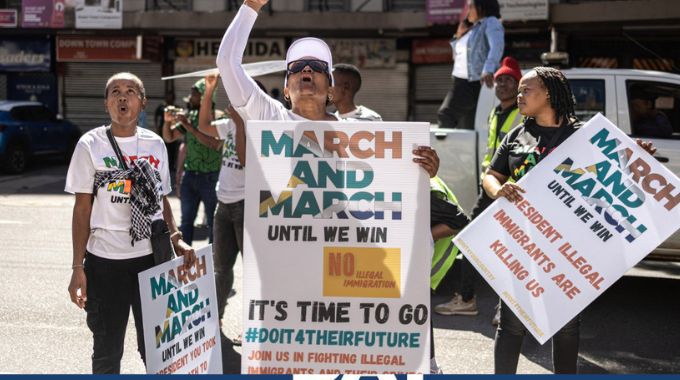
Marshall Ndlela, [email protected]
As migration pressures intensified alongside South Africa’s prolonged economic stagnation, immigration gradually evolved from a public administration issue into one of the country’s most politically contested subjects.
Over the past decade, sluggish economic growth, persistently high unemployment, widening inequality, deteriorating municipal services, rolling electricity shortages, freight rail and port inefficiencies, corruption scandals and the findings of the Zondo Commission on State Capture have collectively eroded public confidence in state institutions.
Economists and governance scholars have argued that state capture significantly weakened institutional capacity, diverted public resources, discouraged domestic and foreign investment and constrained long-term economic growth. Combined with the economic effects of the Covid-19 pandemic, these structural challenges have intensified competition for employment, housing, public services and business opportunities, particularly within lower-income communities where unemployment remains among the highest globally.
The resulting economic environment has produced what many analysts describe as a scramble for scarce opportunities. As formal employment has stagnated and the informal economy has expanded, competition for township retail space, informal trading sites, low-skilled employment, municipal housing, healthcare services and educational opportunities has become increasingly visible.
This competition has often been most acute in densely populated urban municipalities already struggling with limited fiscal capacity and ageing infrastructure. Consequently, migration has become intertwined with broader public anxieties over employment, crime, housing, healthcare, education, municipal service delivery and declining household incomes.
Political scientists describe this as the politicisation of migration — a process through which immigration evolves from an administrative policy issue into a central electoral question capable of mobilising voters, shaping political identities and influencing government priorities. Rather than remaining a technical discussion about visas, border management and labour mobility, migration has increasingly become a symbolic issue through which wider frustrations regarding governance, corruption, economic decline and inequality are expressed. In this context, migration has become a proxy through which citizens debate the effectiveness of the state itself.
Importantly, these debates have unfolded amid growing concerns over both documented and undocumented migration. While millions of foreign nationals reside, work or study legally in South
Africa, administrative backlogs, asylum processing delays, porous borders and limited enforcement capacity have contributed to an expanding population of undocumented migrants.
Scholars caution that public discourse often conflates lawful migrants, asylum seekers, refugees, undocumented economic migrants and transnational criminal syndicates into a single category. Such conflation complicates public policy because each group presents fundamentally different legal, humanitarian and security considerations requiring distinct policy responses. Failure to differentiate between these categories risks undermining both effective immigration enforcement and constitutional protections.
The political significance of migration has increased as public frustration with governance has intensified. South Africa’s democratic transition was accompanied by expectations that economic growth, regional integration and Pan-African cooperation would generate broad-based prosperity. Instead, many communities continue to experience high unemployment, slow economic mobility and declining confidence in public institutions. This gap between democratic expectations and lived socio-economic realities has created fertile ground for migration to become a politically resonant issue.
Recent political analysis suggests that migration has increasingly become a defining issue within South Africa’s electoral landscape. Political parties including the Patriotic Alliance (PA), ActionSA, the uMkhonto weSizwe (MK) Party and Rise Mzansi have all incorporated migration, border management and undocumented immigration into their policy platforms, although with markedly different philosophies and proposed solutions. Some advocate stronger deportation measures, enhanced border security and stricter immigration enforcement, while others emphasise administrative reform, regional cooperation and improvements to the immigration system itself. Regardless of these differences, migration has emerged as one of the few policy issues capable of rapidly mobilising public attention across communities experiencing prolonged economic hardship.
Alongside formal political parties, civic movements such as Operation Dudula and the more recent March and March movement have further elevated migration into public discourse through protests, community mobilisation and demands for stricter enforcement of immigration legislation. Commentators observe that these organisations have gained traction largely in communities characterised by high unemployment, expanding informal settlements, rising living costs and declining municipal service delivery. In these environments, migrants are frequently perceived –rightly or wrongly – as competitors for scarce jobs, informal trading opportunities, affordable housing and access to already overstretched public services.
Recent commentary in Daily Maverick argues that South Africa’s recurring anti-migrant unrest reflects a complex interaction between civic mobilisation, political rhetoric, institutional weaknesses and broader socio-economic frustrations rather than spontaneous community anger alone. Similarly, analysts writing in The Africa Report note that migration has increasingly become an issue around which different political actors seek public visibility and electoral support, particularly during periods of declining confidence in established political institutions.
GIS Reports places South Africa within a wider international trend in which immigration has become a defining feature of contemporary populist politics, comparable in certain respects to debates witnessed across Europe and North America, where economic insecurity has increasingly intersected with questions of national identity, border sovereignty and social protection.
Social media has further amplified these dynamics. Images, videos and anecdotal accounts of crime, undocumented migration or isolated incidents frequently circulate without broader context, shaping public perceptions far more rapidly than official statistics or policy analysis. While some content highlights genuine governance failures requiring urgent intervention, misinformation and unverified claims have at times contributed to heightened public anxiety and reinforced stereotypes about migrant communities.
The speed with which these narratives spread has complicated efforts to distinguish between legitimate public concerns, political messaging and misinformation, often accelerating community tensions before authorities are able to respond.
Importantly, neither the academic literature nor contemporary political analysis concludes that political parties created xenophobic or Afrophobic violence. Rather, many scholars argue that migration has become politically salient because it resonates with citizens confronting prolonged economic insecurity. In a society marked by weak economic growth, exceptionally high youth unemployment, persistent crime, declining public trust in institutions and constrained fiscal resources, immigration has become a visible symbol through which wider dissatisfaction is expressed.
At the same time, analysts acknowledge that many South Africans hold legitimate concerns regarding undocumented migration, organised crime, labour market regulation, border management and pressure on public services. The policy challenge lies in addressing these concerns through effective governance rather than allowing frustration to manifest as hostility towards entire communities.
The consequences extend beyond domestic politics. South Africa’s position as the economic anchor of the Southern African Development Community (SADC) and a leading advocate of the African Continental Free Trade Area (AfCFTA) means that domestic migration debates increasingly carry regional diplomatic implications.
Repeated episodes of anti-migrant violence have periodically strained relations with neighbouring governments, prompted diplomatic protests and affected South Africa’s image as a champion of
African solidarity. They also create uncertainty for investors who assess not only macroeconomic indicators but also social stability, policy predictability and the resilience of institutions.
The consequence has been an increasingly polarised national conversation. On one side are legitimate calls for stronger border governance, more efficient immigration administration, enhanced regional cooperation and decisive action against undocumented migration and transnational criminal networks.
On the other are constitutional and human rights concerns that migration debates must not legitimise collective punishment, discrimination or violence directed at lawful migrants, refugees or asylum seekers. South Africa therefore faces the difficult task of simultaneously protecting national sovereignty, restoring confidence in immigration governance and preserving the constitutional values and Pan-African principles that have historically underpinned its foreign policy and regional leadership.
As South Africa approaches future electoral cycles, migration is likely to remain one of the country’s defining political economy issues. Whether this heightened political attention ultimately delivers comprehensive immigration reform, stronger border management, improved regional cooperation and renewed economic confidence – or instead deepens social polarisation and diplomatic tensions – will significantly shape South Africa’s economic future, its relationships within SADC and the AfCFTA, and its standing as one of Africa’s leading democracies.