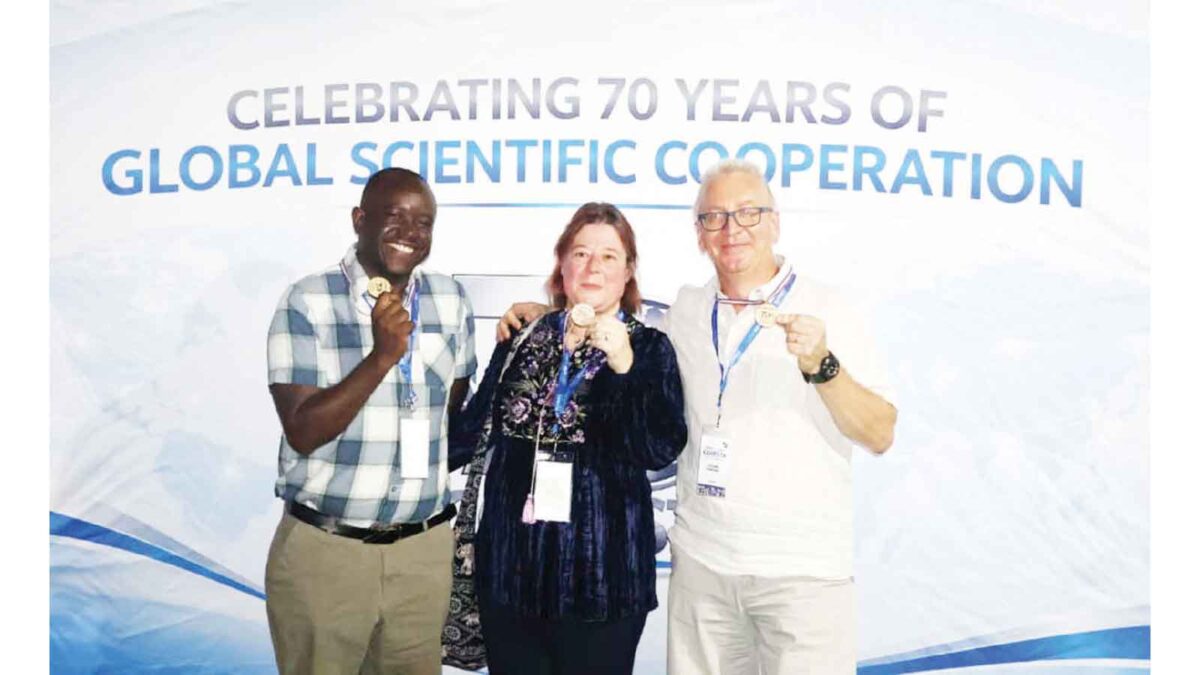
Theseus Mauruki Shambare recently in VICTORIA FALLS
Zimbabwe’s tobacco research has earned global recognition, with international experts applauding local scientific advances as neighbouring Malawi seeks to adopt Kutsaga-developed technologies to boost production sustainability.
The recognition came as the five-day 70th Cooperation Centre for Scientific Research Relative to Tobacco (CORESTA) congress concluded in Victoria Falls on Thursday, with Zimbabwean researchers showcasing innovations in climate-smart agriculture, fertiliser efficiency and energy-saving tobacco curing technologies.
The study, titled Mitigating Nitrous Oxide Emissions in Tobacco Cropping Systems Through Biofertiliser Use, was conducted by a Kutsaga research team comprising head of Sustainable Agriculture Dr Kumbirai Mateva, executive director for Research and Extension, Dr Susan Dimbi and chief executive officer Dr Frank Magama, and presented at the congress by Agricultural Research Officer, specialising in soil chemistry, Ms Dadirai Chinamo.
Covering the 2023 and 2024 growing seasons, the research assessed combinations of chemical fertilisers and bio-fertilisers, with the 75 percent chemical fertiliser and 75 percent bio-fertiliser treatment emerging as the most promising combination for balancing crop productivity and reducing nitrous oxide emissions.
Another presentation focused on energy-efficient tobacco curing technologies, with Kutsaga researcher Dr Mthulisi Ngwenya outlining innovations developed to address the growing needs of smallholder farmers and reduce curing costs.
The research has produced several barn designs, including the Rocket, KCC1, Family, Gunny and the latest KCC2, alongside investigations into liquefied petroleum gas, biomass briquettes and biogas as alternative energy sources.
Kutsaga research officer, Engineer Owen Mudadisi, said KCC2 featured a redesigned duct and ventilation system to improve heat and moisture distribution without depending on grid electricity.
“A barn that saves wood, a barn that saves coal can still fail the farmer,” he said.
Comparative trials showed that KCC2 achieved twice the moisture uniformity of KCC1, recording a coefficient of variation of 3,11 percent compared to 5,03 percent.
The innovations attracted international attention, with United States-based Universal Leaf Tobacco Company vice-president of operations Mr Mauri Winegardner praising Zimbabwe’s development.
“It is really incredible to come to one of the significant supply origins in Africa, Zimbabwe, to see significant development here,” he said.
French scientist and Schweitzer-Mauduit International chief scientist Ms Diane Raverdy-Lambert also applauded Zimbabwe’s research output.
“I want to applaud Zimbabwe’s tobacco research board. We have had a very large number of posters and presentations from the seed to the clinical studies and biomarkers,” she said.
German scientist Professor Wolf-Dieter Heller, who chairs the International Organisation for Standardisation’s technical committee on tobacco and nicotine standards, described the congress as impressive.
“I found this conference very impressive, with a lot of good talks and a broad spectrum of talks and Zimbabwe leading in many ways.
‘‘It has proved to be a nation with a great future with great researchers,” he said.
Meanwhile, Malawi’s Agricultural Research and Extension Trust chief executive, Dr Albert Changaya, expressed interest in adopting Kutsaga’s KCC2 curing technology.
“We normally learn quite a lot from Zimbabwe, especially Kutsaga… Right now they are talking about the KCC2, which we need to actually adopt in Malawi,” he said.
He said Malawi intended to invite Kutsaga engineers to facilitate technology transfer.
“We will be inviting the engineers from Kutsaga to go to Malawi to teach us how to do it.”
Dr Changaya said regional research institutions must also prioritise drought-tolerant and disease-resistant tobacco varieties as climate pressures intensify.
The international interest highlights Zimbabwe’s potential to strengthen its position in global tobacco science through research, innovation and regional technology transfer.