Fidelis Munyoro
Chief Court Reporter
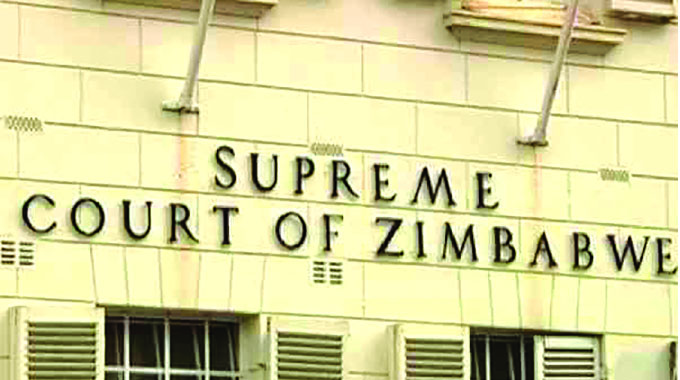
The Supreme Court has torn through the corporate veil shielding a safari company from a US$419 000 debt, ruling that it cannot hide behind another company after benefiting from the original loan.
In a landmark judgment, the superior court ordered Forever African (Private) Limited to pay US$418 950,69, plus interest and legal costs, after finding that it and Mauritius-registered Safari Connect Limited had operated so closely that they could not fairly be treated as separate businesses.
The three-member bench — Justices Nicholas Mathonsi, Alfas Chitakunye and Samuel Kudya — overturned a High Court Commercial Division judgment which had dismissed the claim by United States-registered HRL Safari LLC.
The case started with a US$515 000 loan advanced to Forever African in 2018 to build the Iganyana Tented Camp in Hwange.
The money funded the camp’s construction, which remained in Forever African’s hands and was subsequently operated as a safari business.
But in 2019, Forever African transferred its loan obligations to Safari Connect through a novation agreement.
Safari Connect later failed to pay the debt and became insolvent.
HRL Safari then pursued Forever African, arguing that the two companies were effectively a single economic entity and that the corporate veil should be lifted.
The High Court disagreed.
The Supreme Court, however, found the circumstances surrounding the transaction deeply troubling.
The judges noted that Forever African had benefited from the original loan, while Safari Connect — after taking over the debt — later advanced about US$500,000 interest-free to Forever African.
The court also took issue with the way the novation agreement was signed. Terry Anders signed for Forever African, while his wife, Sheona Anders, signed for Safari Connect.
Sheona Anders was also a director of both companies.
Justice Mathonsi described the arrangement as an “in-house” affair involving people closely connected to both companies.
“The manner in which the respondent and Safari Connect acted as a tug team, not only to transfer liability to one another but also to transfer funds between themselves while not servicing a debt, leaves them in such close relationship and so intertwined that they cannot escape being treated as one,” he said.
The Supreme Court rejected the argument that courts can only pierce the corporate veil where one company owns all the shares in another and exercises complete control.
Instead, the judges said courts must examine the real relationship between companies, particularly where one is being used for another’s benefit.
The court identified four key considerations – control, benefit, whether the companies are realistically indivisible, and whether there is reasonable cause to impose one company’s liability on the other.
In Forever African’s case, the court found that the original loan benefited the company, the debt was later shifted to Safari Connect without recognisable consideration, and Safari Connect subsequently became insolvent.
“The corporate veil should be put aside to reflect the true nature of their relationship,” Justice Mathonsi said.
The Supreme Court consequently allowed the appeal with costs and entered judgment against Forever African for US$418 950,69, together with interest at 2 per cent above the Barclays Bank base rate from July 1, 2024, until payment in full.
The ruling reinforces a growing principle in company law – corporate structures cannot be used as a shield when their practical effect is to defeat justice.