Tapiwanashe Mangwiro
ZIMBABWE has surpassed the halfway mark towards ending its multi-currency system, recording a 50,1 percent weighted progress score on the macroeconomic conditions required to transition to a sole local currency.
But the Reserve Bank of Zimbabwe (RBZ) is stressing that the shift remains conditions-based rather than tied to a fixed date.
This is according to the central bank’s assessment across the eight conditions precedent (CPs) for migration to a mono-currency, including low inflation, exchange rate stability, foreign exchange market functioning, financial sector stability and the use of Zimbabwe Gold (ZiG).
The central bank cautioned that the 50,1 percent score should not be interpreted as an imminent switch to a single currency.
Presenting the 2026 Mid-Term Monetary Policy Statement on Thursday, Reserve Bank of Zimbabwe (RBZ) Governor Dr John Mushayavanhu said the barometer was designed to provide an objective indication of progress rather than announce a transition date.
“Importantly, the barometer seeks to provide an objective and indicative measure of the status of achievement of the CPs and does not signal immediate transition to mono-currency, which remains a market-driven process,” Dr Mushayavanhu said.
Zimbabwe remains under a multi-currency arrangement, the central bank chief said, in which foreign currency co-circulates with the domestic unit, ZiG, with the eventual transition to a domestic mono-currency system expected only after the prerequisite conditions have been fully met and sustainably maintained.
One of the key conditions — durable macroeconomic stability — has recorded significant progress, with annual ZiG inflation averaging 4,2 percent during the first seven months of 2026. The central bank expects inflation to remain at low single-digit levels over the medium to long term.
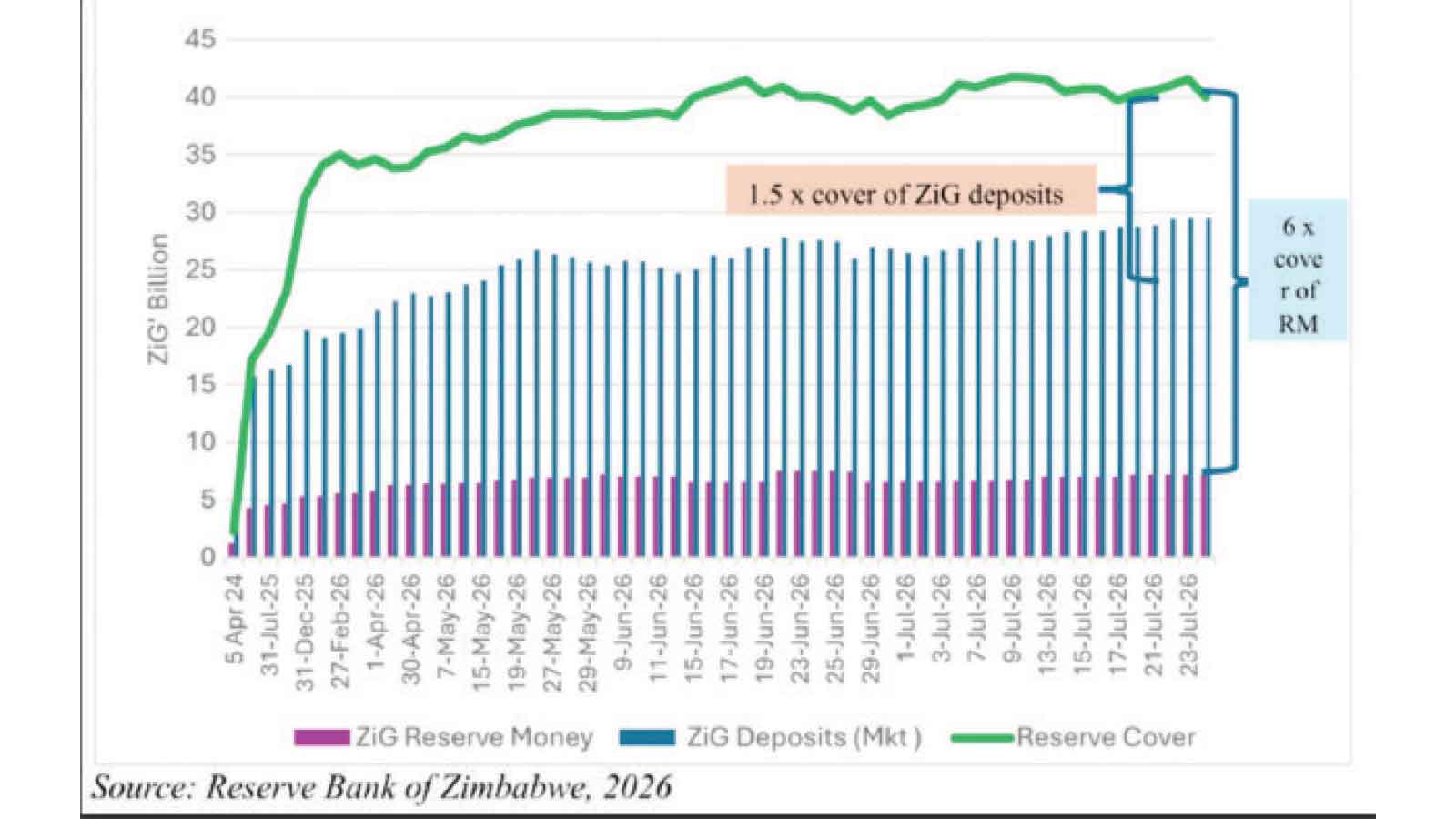
The country, though, remains below the targeted foreign currency reserve threshold required for the transition, but it has seen progress growth in the holdings over the last couple of years, amid bullish external sector performance, driven by strong commodity prices. Reserves stood at US$1,7 billion at the end of July, equivalent to 1,7 months of import cover, against a medium- to long-term requirement of at least three months and a target of up to six months. The RBZ said it is targeting between 1,8 and two months of import cover by the end of this year.
Addressing concerns over the transition to a mono-currency system during Nedbank Zimbabwe’s head office groundbreaking ceremony, also held on Thursday, RBZ Deputy Governor Dr Innocent Matshe said the conditions precedent should not be viewed as a countdown to a predetermined shift.
“This transition is going to be market-driven and it is not something that we expect to happen overnight,” he said.
“I know every time you talk about mono-currency, people start thinking that we are saying that it should happen and it will happen overnight. It’s not going to happen overnight.”
The central bank said the stability has been supported by increased foreign currency inflows, reserve accumulation and interventions in the foreign-exchange market to ensure that bona-fide foreign obligations are settled.
On the critical issue of foreign currency transactions after the transition, Dr Matshe said: “No one and nobody will be forced to exchange their foreign currency into the domestic currency. What will happen is that domestic transactions will not be possible in foreign currency.”
Economist Ms Gladys Shumbambiri-Mutsopotsi said the progress demonstrated that the transition was becoming increasingly anchored in measurable economic fundamentals rather than administrative decisions.
“The 50,1 percent score is important because it shows that Zimbabwe is moving towards mono-currency through a set of measurable conditions,” she said.
“The key issue now is sustaining these gains, particularly inflation and exchange rate stability, while building adequate reserves.”
Exchange rate stability has improved considerably. ZiG has remained within a relatively narrow range of between ZiG25 and ZiG27 to the US dollar, while the parallel market premium averaged about 15 percent during the first seven months of the year.
Zimbabwe has made significant progress on the third item on the conditions precedent — an efficient foreign-exchange management system. The central bank has completed development of an automated foreign currency trading platform, which is expected to be launched in the fourth quarter of this year.
The system is intended to facilitate real-time transactions, improve price discovery and allocative efficiency, promote interbank trading and reduce market segmentation.
Banker Mr Raymond Madziva said a functioning foreign-exchange market would be critical to the credibility of any future mono-currency arrangement.
“A successful mono-currency transition requires confidence that businesses will be able to access foreign currency when they have legitimate external obligations,” he said.
“The planned electronic trading platform should strengthen transparency and price discovery, which are essential for restoring confidence in the market.”
The central bank has identified increased demand for ZiG as another important condition. The authorities want ZiG-based transactions to rise from the current level of about 40 percent to 60 percent in the medium term, while the proportion of taxes paid in ZiG is expected to rise above 60 percent, with a longer-term ambition of reaching 100 percent.
The eighth condition — fiscal and monetary policy cohesion — has likewise been achieved, with the apex bank reporting that the Government has had no recourse to inflationary central bank financing.
Dr Mushayavanhu said the RBZ would continue to focus on maintaining the gains already achieved.
The bank’s assessment comes against a broader backdrop of improving macroeconomic stability, with ZiG annual inflation falling to 3,2 percent in July and foreign currency inflows reaching US$10,72 billion in the first half of the year. The RBZ warned that the transition remains exposed to domestic and external risks, including Middle East conflict spillovers, commodity price volatility and anticipated adverse weather conditions.
Dr Mushayavanhu said the central bank would, therefore, “stay the course” with its prudent monetary policy stance to entrench stability”.