Remember Deketeke
Municipal Correspondent
FOR a family that has spent months rearing chickens or other livestock to supplement its food supplies, slaughtering an animal at home could soon come with an unexpected municipal bill of US$200.
What has traditionally been an ordinary household activity, particularly among families seeking to reduce their grocery expenses, could become a costly undertaking under proposed tariffs contained in the Harare City Council’s 2027 budget.
And the livestock slaughtering charge is only one of several proposed adjustments that could make life more expensive for residents, with increases also targeting healthcare services, refuse disposal, business licences, food handling and property-related transactions. From families seeking affordable medical attention to small traders trying to sustain their businesses, the proposed tariffs could have far-reaching implications for residents already grappling with the cost of living.
While some adjustments are intended to strengthen municipal regulation, improve environmental management and enhance service delivery, residents and ratepayers have questioned whether the proposed charges are proportionate to the economic circumstances of ordinary households.
The proposed US$200 fee for slaughtering livestock within the council area outside an approved slaughterhouse has particularly attracted attention.
Under the Harare Meat By-laws of 1976, as amended, slaughtering livestock outside an approved slaughterhouse would attract the proposed charge.
The tariff schedule further proposes a US$50 charge for keeping, selling or supplying uninspected meat, while selling or supplying ungraded and unmarked meat would attract a similar amount.
Supplying meat from an unapproved slaughterhouse would also attract US$50, while interfering with seized or detained meat without authorisation would cost US$30. The measures are intended to strengthen compliance with meat inspection and public health regulations, ensuring that meat sold for human consumption meets the required standards.
However, Zimbabwe National Organisation of Residents and Ratepayers Trust (ZNOART) chairperson Mr Shamva Chikomba believes the proposed livestock-related charges are excessive and could unfairly burden ordinary families.
“How can you say people should pay US$200 for killing livestock like a chicken you have reared yourself?” he said.
“I think the local authority should reconsider this. We admire the initiative, but the fees are too high.”
Mr Chikomba said while some of the proposed environmental and waste management measures were necessary to restore cleanliness and order in the capital, the council should ensure that the charges were reasonable and accompanied by tangible improvements in service delivery.
“On the issue of waste management, I think that is the right track, but we need it to be enforced and implemented,” he said.
Penalties
The proposed tariffs introduce some of the most significant increases in waste management penalties, with the council seeking to impose heavier financial consequences on those who illegally dispose of refuse.
The fine for dumping domestic waste from a standard-sized receptacle or cart is proposed to increase from US$36 to US$100, while dumping domestic waste from a motor vehicle would attract a US$300 penalty, up from US$113.
Those found dumping industrial or commercial waste would face a proposed fine of US$950, compared to the current US$385.
Illegal discharge of domestic and industrial effluent would attract US$1 500, up from US$616.
The increases reflect the council’s intention to tighten environmental compliance.
Experts, however, say that their effectiveness will ultimately depend on consistent enforcement and improvements in the city’s waste collection and disposal systems. For ordinary residents, however, the proposed adjustments extend beyond environmental penalties to services that directly affect household welfare, particularly healthcare.
Harare resident Mr Gibson Chijongwe said the proposed tariffs risked making ordinary household activities increasingly expensive at a time when many families were already struggling financially.
“Residents should not be made to pay exorbitant fees for activities that are part of their everyday lives. People keep chickens and other livestock to supplement their food supplies and reduce household expenses. Introducing charges of that magnitude is unfair to ordinary families,” he said.
He said while he appreciated the council’s responsibility to regulate activities within its jurisdiction, the local authority should take into account the financial circumstances of residents when setting its tariffs.
Healthcare
Healthcare is among the areas where households could feel the impact of the proposed adjustments, with increases affecting consultations, maternity services and diagnostic procedures at municipal health facilities.
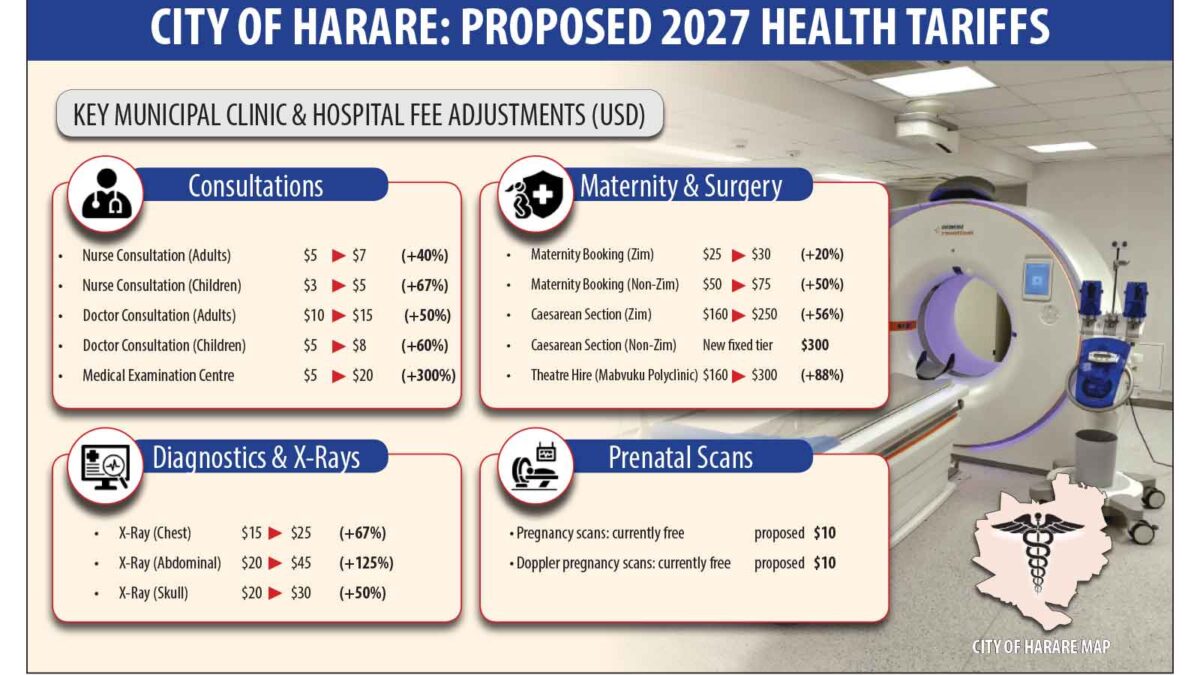
Adult consultations with registered general nurses are proposed to increase from US$5 to US$7, while children’s consultations would rise from US$3 to US$5. Consultations with doctors for adults would increase from US$10 to US$15, while children’s consultations would rise from US$5 to US$8.
The proposed adjustments are even more pronounced in maternity services. Maternity booking fees for Zimbabwean patients would increase from US$25 to US$30, while non-Zimbabwean patients would pay US$75, up from US$50.
Caesarean section charges for Zimbabwean patients are proposed to increase from US$160 to US$250, while non-Zimbabwean patients would pay US$300, compared to the current US$160.
The proposed theatre hire charge at Mabvuku Polyclinic would also increase from US$160 to US$300.
Patients requiring diagnostic services would face further increases, with consultation fees at the Medical Examination Centre proposed to rise from US$5 to US$20. Chest X-rays would increase from US$15 to US$25, while abdominal X-rays would rise from US$20 to US$45. Skull X-rays are proposed to increase from US$20 to US$30.
In another adjustment likely to attract attention, pregnancy scans, which are currently offered free of charge, would attract a proposed US$10 fee.
Pregnancy scans involving Doppler studies, also currently free, would similarly cost US$10.
The proposed tariff schedule also introduces charges for services that previously did not attract fees, including US$30 for food handlers’ training and private borehole water testing.
These adjustments could increase the cost of accessing municipal services for households and individuals who rely on council facilities for affordable healthcare and other essential services.
Businesses
The proposed increases also extend to the business sector, where entrepreneurs and small traders could face higher compliance costs.
Restaurant licensing, for instance, is proposed to increase from US$20 to US$173, representing more than an eightfold adjustment.
Construction-related licensing charges would rise from US$200 to US$250, while security service licensing would increase from US$250 to US$360.
Workshop licensing is also proposed to rise from US$425 to US$475.
Small-scale traders are not spared, with the monthly charge for shoe cobblers and cleaners proposed to jump from US$3 to US$10.
The proposed US$30 food handlers’ training fee could add another expense for people seeking to operate businesses in the food sector.
For small entrepreneurs operating on narrow profit margins, the cumulative effect of licensing and compliance charges could make it increasingly expensive to formalise and sustain their operations.
Property
Property owners and people seeking to transact with the council could also face higher costs.
The application fee for council land or premises is proposed to rise from US$30 to US$100, while preparation of a commercial temporary authority would increase from US$30 to US$50.
Residents seeking temporary authority to use the Robert Mugabe Square, including for events, would pay US$500 for the first five days, up from US$295.
Water and sewerage services have largely retained their existing charges in the proposed schedule, but penalties for illegal connections have been increased substantially. Illegal domestic sewer connections are proposed to attract a US$3 000 charge, compared to the current US$544. Illegal connections categorised under other users would attract US$5 000, up from US$815.
These are among the steepest increases in the entire tariff schedule, reflecting the council’s intention to discourage illegal connections and protect municipal infrastructure.
Selected rentals at council health facilities have also been adjusted, with tuck shop rentals at the Beatrice Road Infectious Diseases Hospital, Wilkins Infectious Diseases Hospital and Mabvuku proposed to jump from US$25 to US$50.
However, the proposed adjustments are not across the board. Several municipal services have retained their existing charges, including conventional domestic water tariffs, a number of cemetery services and various municipal rentals.
The proposed 2027 tariff schedule is expected to take effect on January 4, 2027, subject to approval.
The council has invited residents and ratepayers to inspect the proposed charges at Town House and district offices during normal working hours, as well as through its digital platforms.
Those wishing to object to the proposals have until November 30, 2026, to submit their objections in writing to the Town Clerk. The proposed tariffs are subject to 15,5 percent value-added tax, except where otherwise indicated, and are payable in foreign currency or Zimbabwe Gold at the prevailing official exchange rate on the day of the transaction.