
Wallace Ruzvidzo and Freedom Mupanedemo in KWEKWE
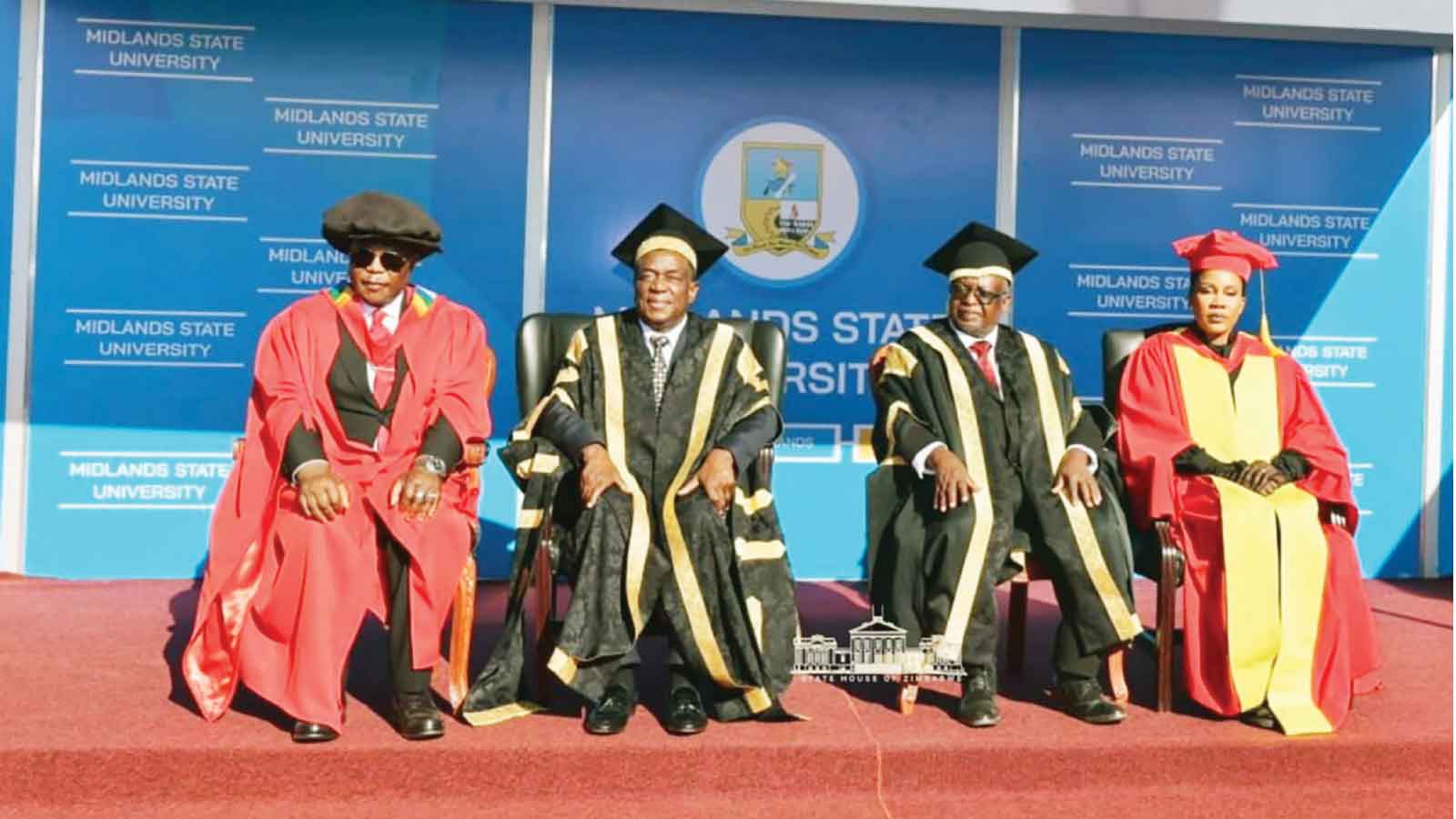
PRESIDENT Mnangagwa yesterday presided over the Midlands State University’s 27th graduation ceremony where he conferred degrees and diplomas on 7 888 students.
The ceremony was held at the MSU Kwekwe campus which also houses the ED Mnangagwa Law School.
Writing on his official X handle yesterday, the President expressed delight with the calibre of graduands, saying universities were conducive spaces for innovation.
“An absolute pleasure to be at the MSU Kwekwe Campus today to witness the graduation of thousands of talented students at the 27th Graduation Ceremony. Our universities continue to be hubs of innovation, churning out visionary leaders ready to build our economy”, he said.
“Congratulations to all the graduands, your families, and your lecturers on this monumental achievement. Together, we are building a modern, industrialised Zimbabwe, brick by brick”.
Of the total graduates, 55 percent were females while 45 percent were males.
A total of 6 631 students graduated with Honours degrees, while 1 027 received Master’s degrees.
Nineteen graduates attained Doctor of Philosophy or Doctor of Business Leadership degrees.
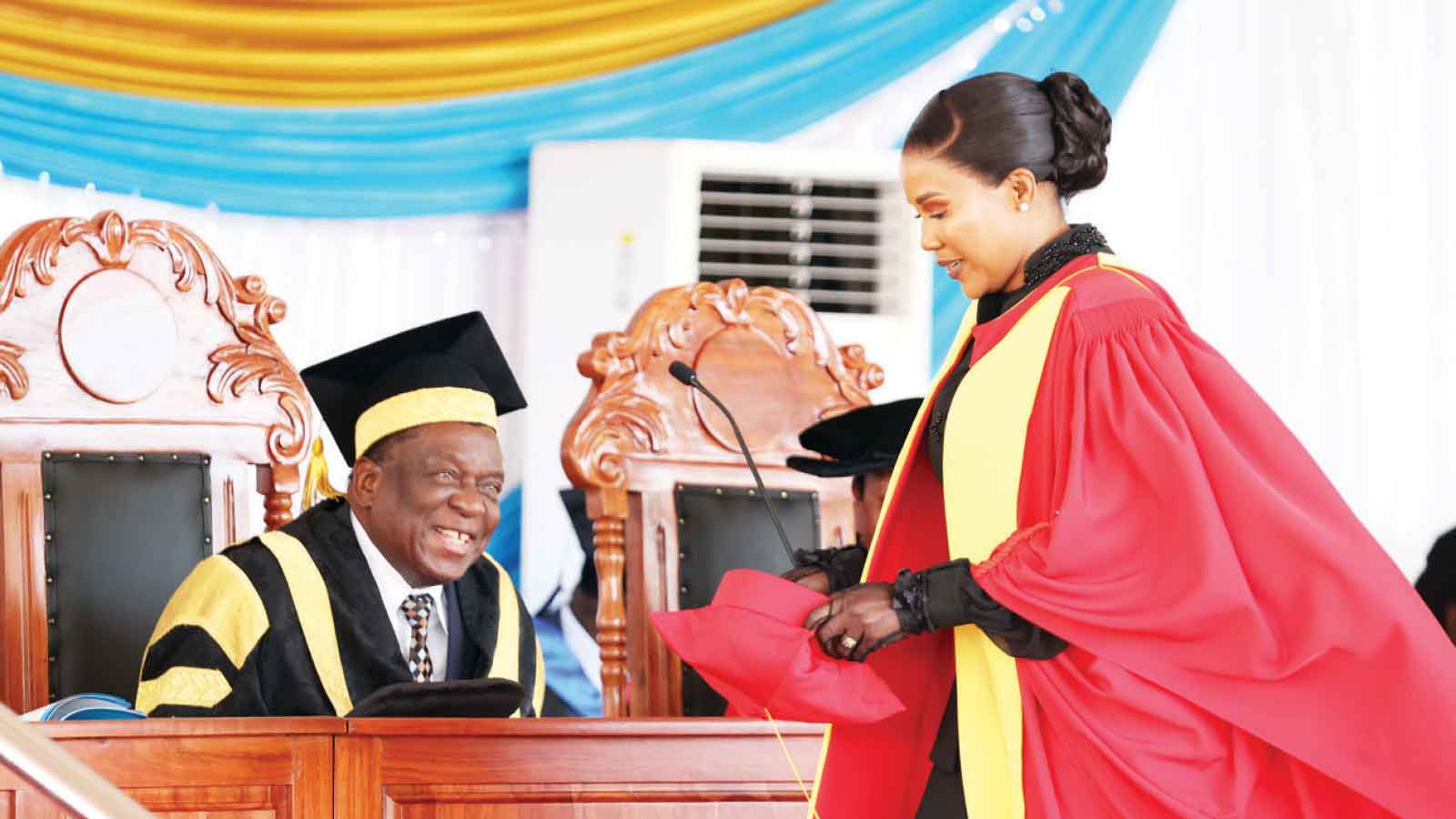
Among those capped by the President, who serves as Chancellor of all State Universities, was Vice President Dr Constantino Chiwenga’s wife, Colonel Miniyothabo Baloyi-Chiwenga, who graduated with a Doctor of Business Leadership degree.
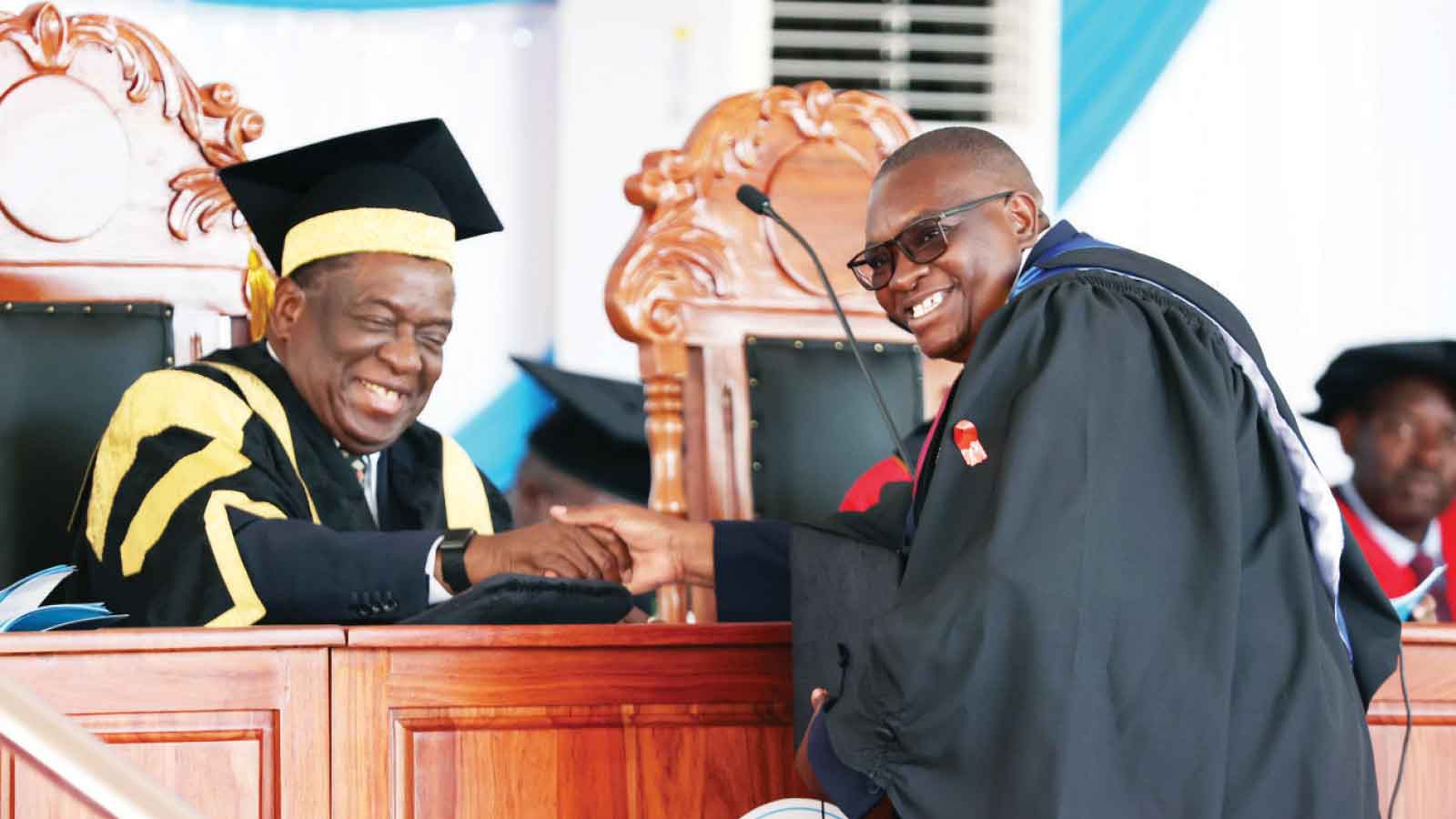
Also capped by the President were Zimpapers Group Digital Services Executive Mr Elias Mambo, who graduated with a Master of Commerce Degree in Strategy and Innovation, and Zimbabwe National Roads Administration (Zinara) spokesperson Mr Tendai Mugabe, a former Zimpapers reporter, who graduated with a Master of Arts in Strategic Communication.
Graduating students came from the Faculties of Agriculture, Environment and Natural Resources Management; Arts and Humanities; Business Sciences; Education; Engineering and Geo-sciences; Law; Medicine and Health Sciences; Science and Technology; Social Sciences; and The Built Environment, Art and Design.
Thirty nine percent of the graduands graduated with degrees in Critical Skills disciplines, mainly STEM disciplines.
In his remarks, MSU Vice Chancellor Professor Victor Muzvidziwa said one of the major achievements registered by the institution was the graduation of the inaugural cohorts of the Bachelor of Biomedical Sciences; Bachelor of Engineering Honours Degree in Electrical and Electronic Engineering and the Bachelor of Engineering in Fuels and Energy Engineering programmes.
“This achievement speaks to our responsiveness to Zimbabwe’s human capital needs in strategically important areas that improve our scientific capabilities,” he said.
Professor Muzvidziwa said Education 5.0, anchored on the pillars of teaching, research, community service, innovation and industrialisation, remained the institution’s guiding philosophy.
“Our Faculty of Science and Technology distinguishes itself on the research and innovation front. It hosted a public lecture by Professor Arthur Mutambara on ‘Embracing the Artificial Intelligence Revolution in Africa: Understanding Both the Promise and the Peril’.
“I am particularly proud to announce that our students continue to excel on the national, regional and international innovation platforms,” he said.
On the community engagement and commercialisation front, the MSU Vice Chancellor said the university intends to roll out an ambitious aquaculture and fisheries project at its dam, in direct response to Government’s call to build a US$1 billion fish industry by 2030 under NDS2.
“With national fish consumption now estimated between 85 000 and 95 000 tonnes annually against domestic production of only 35 000 to 40 000 tonnes, this project positions the university to help close a significant national supply gap, cover Zimbabwe’s annual protein deficit and improve food security,” he said.
In terms of gender equality and inclusion, Prof Muzvidziwa said MSU remained a trailblazer in gender-transformative institutional practices.
Through its Gender Institute, gender considerations have been mainstreamed into curriculum development, institutional planning and policy formulation.
“The MSU Anti-Sexual Harassment Policy, backed by clear reporting procedures and regular awareness campaigns, continues to engender a safe teaching, learning and working environment for all,” he said.
The Vice Chancellor said MSU’s vision to be a leading, innovative, technologically driven and entrepreneurial world-class university continued to anchor its operations.
“We will continue to deepen our commitment to gender equity, safety and inclusion across our campuses, and to ensure that every graduate leaves this university not only technically competent, but ethically grounded, innovative and ready to lead,” he said.
Prof Muzvidziwa apprised the gathering that MSU’s Faculty of Law had flown both the national and university’s flags high on the international stage.
This comes after the MSU Moot Court team was crowned World Champions at the 18th Nelson Mandela World Moot Court Competition held at the United Nations headquarters in Geneva, Switzerland.
“This marks the second consecutive year that our students have claimed this title,” he said.
“The Faculty of Law has also introduced contemporary modules in Space Law and Cyber Law and has made Environmental Law compulsory within the LLB programme in line with NDS2.
“Internationally, the Faculty has joined the Global Network on Environmental Law Clinics, spearheading environmental justice worldwide.”
The Vice Chancellor informed President Mnangagwa about the application of MSU’s modified coal tar technology to the construction and tarring of a five-kilometre road connecting the ED Mnangagwa Law School through Amaveni, linking the campus to Kwekwe town.
“This is a realisation of the theme of this graduation edition, ‘Knowledge, Innovation, Enterprise: Building a Self-Sufficient Zimbabwe’, which is in tandem with the Heritage-Based Education 5.0 philosophy. Going forward, we intend to become a major player in providing affordable, less expensive and durable road surfacing material,” said Prof Muzvidziwa.
He said the tertiary institution’s commitment to impactful research and innovation had been further evidenced by its water treatment project at Holy Cross Dam where a modular chlorine production and water treatment plant designed by a final year engineering student had been installed and was now in its optimisation phase.
The project is set to deliver clean and safe water to communities in Chirumhanzu.
“We are open to engaging local authorities to scale this innovation and provide potable water to all Zimbabweans. This is yet another instance of successful translation of research output into a public good,” said Prof Muzvidziwa.
“Our start-up ecosystem is equally thriving, with our handcrafted organic soap enterprise now having products with multiple cosmetic benefits stocked in pharmacies across the country.”
He said MSU was utilising a public-private partnership collaboration model through the Public Service Pension Fund in ensuring that state of the art hostel accommodation is availed.
Prof Muzvidziwa added that the institution had also constructed a million cubic metre dam at Pitscottie in Kwekwe.
“We have also roped in the Zimbabwe National Geospatial and Space Agency in developing 800 hectares of irrigable land at our Pitscoatie Farm where we have constructed a large dam.
“We are leveraging ZINGSA’s technical expertise in geospatial technologies and land-use planning capabilities. This is a critical component of the Education 5.0 agenda as we strive for agro-enterprise, food security, and institutional self-sufficiency,” he said.
Using internally generated resources, Prof Muzvidziwa said, the university has built an Infant School which will be opened to the public this September.
“The school will fulfill the tripartite mission of teacher training, staff advancement and student support in maternal affairs and child development research,” he said.
The Vice Chancellor decried unfinished infrastructure development projects such as the main library and the 703-bed capacity hostel.
He also said staff retention remained a major challenge at the university.