Rutendo Nyeve Features Reporter
ACROSS Zimbabwe, the story of urban settlement follows a familiar script.
From the copper belts of Mhangura to the coal seams of Hwange, the gold reefs of Kwekwe to the industrial corridors of Bulawayo, most of our cities were hewn from the earth itself, born of mining rushes, railway lines and the relentless rhythm of industry.
Their origins are written in shafts and smokestacks, in the promise of ore and the sweat of labour.
But travel west to the lip of the Zambezi and you will find a city that defies that narrative entirely.
Victoria Falls was not carved from a mineral reef, nor summoned by a factory whistle.
It was born of something far more ethereal, the thunderous roar of Mosi-oa-Tunya — “the Smoke that Thunders”— and the audacious dream that a wonder of the natural world could become a gateway to prosperity.
Here, the story of urban development is not one of extraction but of attraction. It is a history woven through the arrival of the railway in 1904, the rise of the grand Victoria Falls Hotel, the evolution of a tourism economy that has drawn travelers from every corner of the globe, and the quiet, enduring aspirations of a people who have made their home beside one of the planet’s greatest spectacles.
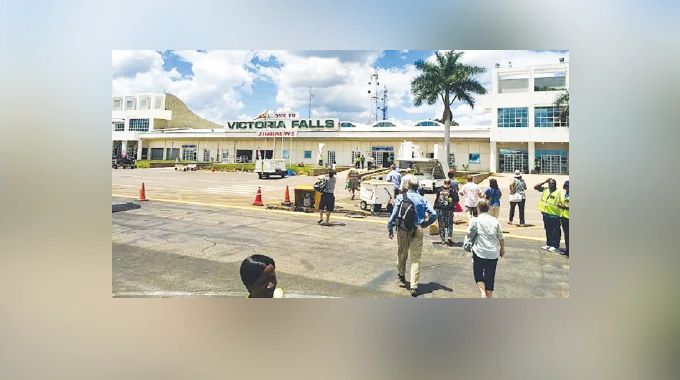
It is a city whose infrastructure, its bridges, its airport, and its hospitality was built not to haul minerals to market, but to welcome the world to a wonder.
As Zimbabwe’s cities grapple with the legacies of deindustrialisation and the search for new economic identities, Victoria Falls stands as a singular case study, a city whose DNA is tourism, whose growth has been shaped as much by global travel trends as by local ambition, and whose people have long understood that their greatest asset is not beneath the ground, but thundering over it.
In this special feature, we explore the unique growth of the City of Victoria Falls, a city unlike any other in Zimbabwe.
“Its a city whose history is deeply intertwined with the development of tourism, infrastructure and the aspirations of its people,” said Town Clerk Mr Ronnie Dube.
“While the first Europeans penetrated Victoria Falls in 1800, our story dates back to the Kololo people, who named the majestic Falls-Mosi-oa-Tunya, meaning ‘The Smoke that Thunders.’”
Mr Dube traced the city’s rich history.
“What stands as Victoria Falls today can be traced back to the first trading settlement in 1900 and the first curio shop in 1903, a year before the railway line reached Victoria Falls in 1904 and commissioning of the iconic Bridge in 1905. This is the same year, the Victoria Falls Hotel, the oldest in the country, was established. Victoria Falls was proclaimed a National Monument in 1935 and the Victoria Falls National Park was established in 1952 while the Unesco World Heritage Site declaration came in 1989. Our governance journey subsequently unfolded through the Village Management Board in 1960, Town Management Board in 1965, responsible for Chinotimba township in 1968, Town Council status in 1971, boundary redefinition in 1974, Municipal status in 1999 and ultimately, the city status in 2020.”
On 20 November 2022, this reporter penned an article titled “A decade of transformation for Victoria Falls,” published by The Chronicle’s sister paper, The Sunday News.
At the time, the narrative was one of a town on the cusp of greatness, a tourism jewel beginning to flex its economic muscle.
Four years later, that promise has not only been fulfilled but has exceeded expectations, with Victoria Falls now standing as a beacon of developmental excellence, a model for other towns seeking to grow and develop into cities of repute.
The ultimate transformation came in December 2020 when Victoria Falls was conferred with City status by President Mnangagwa.
It also became the first City to grant the Freedom of the City to the President, the highest civic honour in recognition of his contribution to the town’s development.
Mr Dube said the city status was an early achievement as it was part of the five-year plan set by the municipality in 2018.
He attributes all this transformation to the confidence that investors have in tourism as an industry and Victoria Falls as a destination.
The city has also witnessed a clean bill in an external audit report which has been cited as an investment driver.
This confidence has spearheaded growth in various facets, from shopping malls, residential areas, hospitality facilities and other developments.
Cognisant of this growth, the city embarked on an internally funded Water, Sanitation and Hygiene (WASH) project that saw the construction of the US$4,5 million Mkhosana water reservoirs, commissioned by Local Government and Public Works Minister, Honourable Daniel Garwe, in May 2026.
Mr Dube further noted how the city ensured that residents receive reliable water, improved sanitation, accessible roads, safe public spaces, efficient administration and quality social services.
“Council has made notable progress, including the completion and commissioning of the Mkhosana water reservoirs, improvements to water infrastructure, road rehabilitation, sanitation initiatives and the development of public facilities. We have also continued working with private-sector partners on City beautification, environmental protection and waste management,” he said.
This journey has seen the city partnering with a private partner in a US$260 million Civic Centre development, which forms part of a multi-million-dollar mixed commercial development encompassing a Civic Centre, shopping mall, five-star hotel, theme park, conference centre and public area.
The development is being implemented through a Public-Private Partnership under a hybrid Build, Operate and Transfer arrangement.
The journey towards this investment began in 2017 when Cardinal Corporation was formally introduced to Council as a potential development partner. In December 2019, Council invited
Expressions of Interest for the project. Cardinal subsequently submitted its interest among other bidders and following the requisite processes, Council resolved on 11 September 2020 to allow
Cardinal Corporation to undertake the development.
The coming together of Cardinal Corporation and Council gave birth to Khula, a Special Purpose Vehicle spearheading the project. Today, the vision is being realised.
The Civic Centre will modernise Council operations, improve access to municipal services and contribute to urban renewal. For residents and stakeholders, it will provide a one-stop centre where various municipal services can be accessed conveniently under one roof, reducing the need to move between different offices and improving efficiency in service delivery.
The project is also expected to create dozens, if not hundreds, of employment opportunities during construction, providing income for local workers, supporting families and improving livelihoods in line with the national Vision 2030.
Beyond employment, the development will enhance the City’s appearance through modern infrastructure, improved urban planning and beautification, giving Victoria Falls a more attractive and contemporary outlook befitting its status as a world-renowned tourism destination.
Victoria Falls has proved to be a model of development in other facets as well.
The city’s strategic positioning as Zimbabwe’s gateway and a Unesco World Heritage Site has attracted partnerships with organisations such as Pristine Victoria Falls and Ele Collection, focusing on cleanliness and environmental stewardship.
The city’s commitment to the National Clean-Up Campaign and waste separation at source has set a benchmark for other urban centres.
Furthermore, with Zimbabwe assuming the Chairpersonship of COMESA, this year, Victoria Falls is set to become a strategic economic gateway and conference capital, hosting business forums, investment conferences and trade facilitation meetings that will attract regional investment and boost cross-border tourism.
As Minister Garwe said: “A modern and well-managed city sends a strong message to the world that Victoria Falls is open for business and committed to excellence.”
Through partnership, responsible citizenship and sustained investment, Victoria Falls has indeed become a source of national pride and a key driver of socio-economic growth as the nation marches towards Vision 2030.
The city’s journey from a Village Management Board to a model city is a testament to what can be achieved through visionary leadership, sound planning and prudent resource management — a lesson for all towns aspiring to become cities of repute.