Tendai Gukutikwa
Health Reporter
WHEN the last school bell rings at Mafararikwa High School, 18-year-old Lorraine Nemaunga does not head straight home.
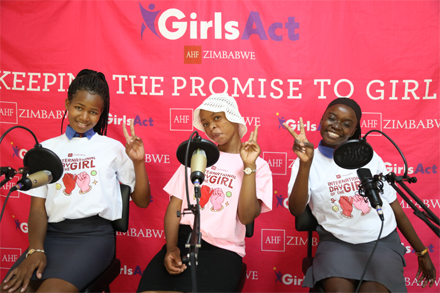
For the Form Six learner, the end of classroom lessons usually marks the beginning of another assignment, one that requires her to exchange her school books for a microphone and take her place behind the camera. An aspiring law student in Mutare rural, Lorraine is a well-established podcaster for the Wasu Unmuted podcast.
At Mafararikwa Girls Hub, she joins other school-going girls to research, prepare and record podcast episodes tackling issues that many adolescents in their communityy struggle to discuss openly.
There are no professional broadcasters running the conversations for them. The girls take turns researching topics, hosting discussions, operating the recording equipment and deciding which subjects deserve attention.
One week, the conversation can be about teenage pregnancies, the next, child marriages, HIV prevention, menstrual health or sexual and reproductive health rights.
For Lorraine, the microphone has become more than a communication tool. It has given her the confidence to speak about issues affecting girls in Mafararikwa, and more importantly, helped her discover a new purpose that is shaping her future ambitions.
In a rural community where access to information is not always guaranteed and conversations about sexuality can be surrounded by stigma, the emergence of a podcast led by schoolgirls is an unusual development.
When The Manica Post caught up with her, Lorraine said the podcast is a platform where girls are no longer merely the subjects of discussions about teenage pregnancies and child marriages.
“On Wasu Unmuted, we are the ones asking questions, sharing information and challenging attitudes that allow these problems to persist.
“When I started doing the podcast, one of my main reasons was to build my confidence. I had always wanted to become a journalist, but I used to struggle with expressing myself. Being part of this programme has helped me become more confident and comfortable speaking in front of people,” said Lorraine.
Interestingly, the experience has since changed her career aspirations.
Although she initially saw the podcast as an opportunity to develop her journalism skills, Lorraine now wants to become a lawyer, believing that the law will give her a stronger platform to stand up for girls whose rights are violated, especially in Mafararikwa.
“I started looking at what was happening around me and realised that some girls were not fully aware of their rights. I felt there was a need for someone to speak about these issues, and help them understand what is right and what is not. My ambition now is to pursue law at university and use the knowledge I acquire to advocate for the girl child,” she said.
Through the podcast, Lorraine is also learning that having a voice comes with the responsibility of using it to inform and influence others.
She said the discussions are designed to accommodate both school-going and out-of-school girls, recognising that their experiences and information needs are different.
“For girls who are out of school, we discuss issues such as family planning and contraceptives so that they can make informed decisions. For those of us who are still in school, the programme focuses on empowering us with knowledge about our rights, our health and how to protect ourselves from abuse and violence,” she said.
The young presenter believes that girls must be equipped with information that enables them to recognise harmful situations, understand their rights and speak out when those rights are violated.
She said the podcast also challenges the notion that young people should remain silent when confronted with decisions or practices that threaten their wellbeing.
“We want girls to understand that they have a voice and that they should not be afraid to use it. If you say no, your no should be respected.
“We also want them to know that they have the right to remain in school, pursue their education and make decisions about their future,” she said.
For Lorraine, the experience has also changed how she relates with other girls in her community.
She said rather than viewing the challenges they encounter as isolated experiences, she now sees the importance of creating spaces where young people can exchange information and support one another.
An avid listener to the podcast, Mafararikwa community member, Mrs Yolanda Ushe, said the discussions are important in their community where adolescents tend to struggle to approach adults about relationships, contraception, sexual abuse and other sensitive matters for fear of being judged.
“By bringing these subjects into a public conversation, the girls are helping to break the silence surrounding issues that have serious implications for their education, health and future. The podcast also gives them an opportunity to engage people with professional knowledge instead of relying solely on information shared among peers,” she said.
Implemented by the Aids Healthcare Foundation (AHF) Zimbabwe, the podcast studios are situated at Mafararikwa Girls Hub.
AHF Zimbabwe national youth coordinator, Mr Knowledge Nyanungo, said the podcast was introduced under the organisation’s Girls Act programme, which focuses on empowering girls.
“We are in a digital era, so we realised that a podcast will be an easier way of disseminating information and engaging people in discussions. It is being led by the girls themselves, they are involved in researching, engineering, hosting and producing the episodes.
“They also identify the issues they want to discuss and invite experts who can help provide accurate information,” he said.
The episodes tackle SRHR, teenage pregnancies, child marriages, menstrual poverty and HIV prevention.
Mr Nyanungo said the podcast is intended to reach out to different age groups, including young people, parents, community members and stakeholders responsible for protecting children.
While the podcast is only three-months-old, episodes can be accessed via social media by girls in Mafararikwa and anywhere across the world.
Mr Nyanungo said the podcast is one component of a broader effort to address the circumstances that expose girls to early pregnancies, HIV and child marriages.
“Before this initiative, girls needed a place where they could freely come together, discuss their challenges and work on projects that improve their lives. The hub provided that environment,” he said.
The scale of the child marriages challenge is reflected in national statistics.
Nationally, the 2019 Multiple Indicator Cluster Survey placed Manicaland’s child marriage prevalence at 36 percent among women aged 20 to 49 who had married or entered a union before their 18th birthday.
The UNICEF Child Marriage Data Portal, drawing on the 2019 data, gives a provincial estimate of 38,1 percent among women aged 20 to 24.
At national level, the same data show that child marriage is more prevalent in rural communities, at 43,7 percent, compared with 21,3 percent in urban areas.
The situation is equally concerning in Manicaland, where teenage pregnancies and child marriages have continued to feature prominently in child protection discussions.
Figures presented by National AIDS Council Manicaland provincial monitoring and evaluation officer, Mr Sibert Hlatywayo, previously showed that 13 353 teenage pregnancies were recorded across the province’s seven districts in 2024.
The same presentation revealed that 161 girls had left school because of child marriages, including 12 who were at primary school level.
“The figures underline the importance of interventions that reach girls in rural communities before they become trapped in circumstances that interrupt their education and limit their opportunities,” he said.
The figures are not merely statistics. Behind every teenage pregnancy and child marriage is a girl whose circumstances, access to protection and future prospects deserve attention.
Speaking recently, Provincial Employment Officer, Mrs Norah Torto, said poverty, limited educational opportunities, harmful social norms and inadequate access to sexual and reproductive health information are among the factors that can increase girls’ vulnerability.
“The consequences extend beyond early motherhood. Child marriage can interrupt education, restrict economic independence and expose girls to gender-based violence and health risks associated with early pregnancy,” she said.
She said society must recognise girls as individuals with the potential to contribute to national development rather than allowing early marriage to derail their ambitions.
In this context, Wasu Unmuted is seeking to change not only what girls know, but also who gets to participate in conversations about their rights.
For Lorraine, the most immediate task is to keep the conversations going. She hopes to produce more episodes, reach more girls and become increasingly confident in discussing issues that affect young people.
In a rural setting where girls are often expected to listen rather than lead, she and her fellow presenters are occupying a different position by asking the questions, directing the discussions and deciding which issues deserve attention.
Wasu Unmuted: When Marange girls speak, child marriage listens