Africa Moyo and Trust Freddy
ZIMBABWE’S growing consumer market and a conducive investment climate have driven a major expansion by international beverages group Varun Beverages, which has increased its production lines from an initial one to 11, with two more being installed.
The expansion has lifted the Pepsi franchisee’s monthly production capacity from 10 million bottles to 120 million, as demand continues to outstrip supply.
Speaking at the inaugural Zimbabwe-India Africa Tech and Entrepreneurship Summit 2026 in Harare, which ended yesterday, Varun Beverages Zimbabwe chief executive Mr Vijay Kumar Bahl said the company had underestimated the local market when it entered the country eight years ago.
“We underestimated Zimbabwe, to be honest; let me admit.
“We were coming from India — 1,4 billion people, a US$3,94 trillion economy —and when we were coming to Zimbabwe, we were wearing those Indian lenses,” he said.
Mr Bahl said the company’s initial feasibility studies had assessed potential demand using population size, Gross Domestic Product and India’s per capita beverage consumption of between eight and 10 litres a year.
The projections suggested that one production line would be sufficient to serve Zimbabwe.
“The size of the economy and the size of the population is what we looked at, and we said that one production line should be enough.
“Today, I have 11 production lines and I am putting in two more,” Mr Bahl said.
Successive investments followed as demand consistently exceeded the company’s capacity to supply the market.
“So, I think the mistake was a pleasant mistake, and we had a long honeymoon phase where my demand was far ahead of my ability to supply.
“First line, then second line, then third line — eight years have gone. Now, from 10 million bottles a month, I have the capability to produce 120 million bottles a month.
“I make, sell and deliver it, and I am putting in more production lines. So, that is the power of Zimbabwe,” he said.
Varun Beverages is expanding its operations into other manufacturing segments.
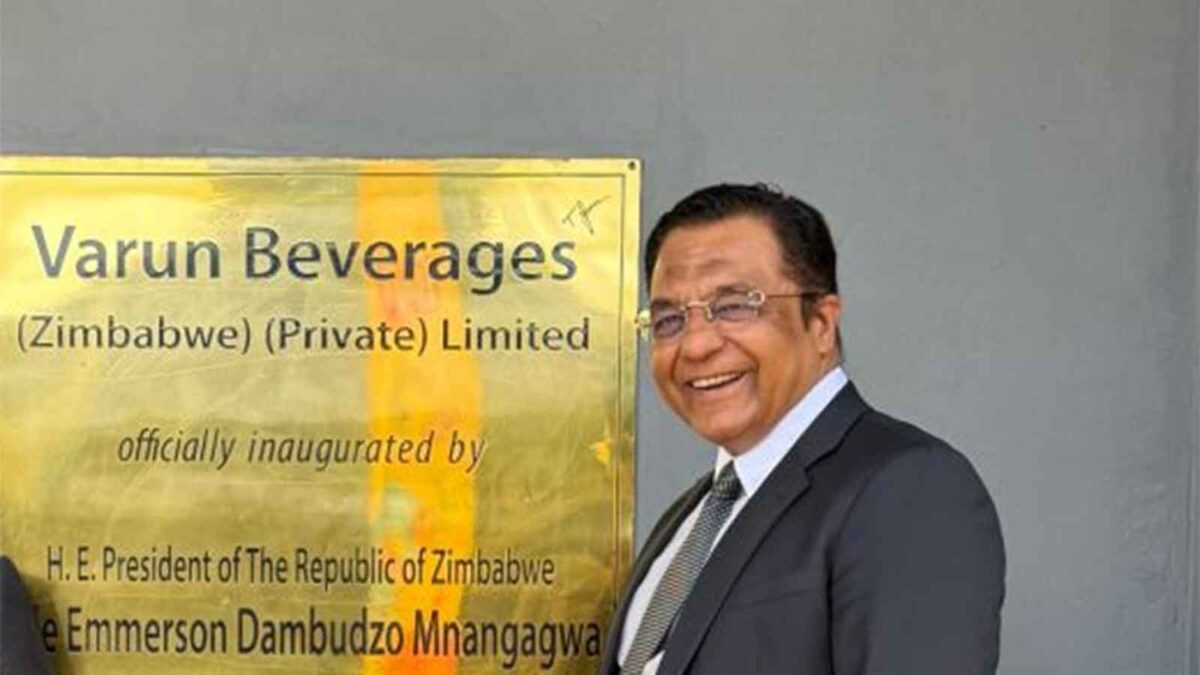
In May this year, President Mnangagwa commissioned the company’s US$15 million Cheetos snacks manufacturing plant, which has a production capacity of 6 000 tonnes.
The company is also working on a US$250 million beer plant in partnership with Carlsberg, signalling further investment in local manufacturing.
At the commissioning of the snacks plant, President Mnangagwa said economic stability and sustained growth should encourage investors to expand their operations and explore new opportunities.
“The prevailing economic stability and sustained growth in our economy should encourage both local and foreign investors to scale up operations and explore new opportunities in Zimbabwe.
“The commissioning of this snacks manufacturing plant is testimony that our policies are bearing fruit and that confidence in the economy continues to grow,” he said.
The President reiterated that “Zimbabwe is open for business”.
Varun’s expansion comes as Government pursues ease-of-doing-business reforms aimed at reducing the cost and complexity of operating businesses.
These include reviewing licences, permits, levies and fees across key economic sectors.
The Zimbabwe Investment and Development Agency’s One-Stop Investment Services Centre also seeks to streamline investment procedures by bringing key services together and facilitating approvals.
The measures form part of the Second Republic’s broader drive to attract domestic and foreign investment, expand industrial capacity, create jobs and accelerate economic growth towards Vision 2030.
Varun’s experience highlights the potential of Zimbabwe’s consumer market to support manufacturing growth, with increased production also creating opportunities across distribution, retail and other parts of the supply chain.
The two-day summit was the first country-level gathering to be co-hosted by the India-Africa Entrepreneurship Forum.
Held under the theme, “Building Africa’s Digital Economy: Innovation, Infrastructure and Investment Partnerships”, the summit brought together business leaders and technology entrepreneurs from Zimbabwe and India to explore investment, innovation and the application of artificial intelligence to economic growth.