A major global Microsoft outage has caused problems, and in some cases disabled entire services, including emails and artificial intelligence products.
Microsoft has said the outage was not caused by a cyber-security incident, but efforts to fix the issues have so far been largely unsuccessful.
Here is what is known about the services affected and what went wrong.
What happened?
Microsoft 365 services, including Teams, Outlook and Microsoft’s artificial intelligence software Copilot, have been affected by “connectivity problems”.
Customers are reporting varying levels of access. Many have not been able to send or receive emails, view certain files or see details on their calendar apps.
Some users have been able to use Teams and are using messaging and online meeting functions without issues.
How many people have been affected?
More than 430 million people use Microsoft 365 apps, according to Microsoft’s website.
The full scale of the outage has not been confirmed, but the monitoring website Downdetector had 140,000 people from 74 countries report issues with Outlook on Thursday evening.
The real figure affected is likely to be much higher because Downdetector relies primarily on users self-reporting.
Microsoft 365 is also used by companies worldwide and is expected to have a knock-on effect on other services.
Tech giants OpenAI and Anthropic have both reported problems as a result of the outage.
ChatGPT-maker OpenAI said it was investigating an issue affecting its connections to Microsoft’s services, which has caused some tools to not work as expected.
Government agencies and services, including the Singaporean government and Australia’s spy agency, have also said they have been affected.
Across the UK, GP surgeries, pharmacies, police and schools have been affected by the outage.
Some GP surgeries have urged patients not to submit messages via their website while the problem remains, while several large police forces are urging members of the public to call if they want to make a report.
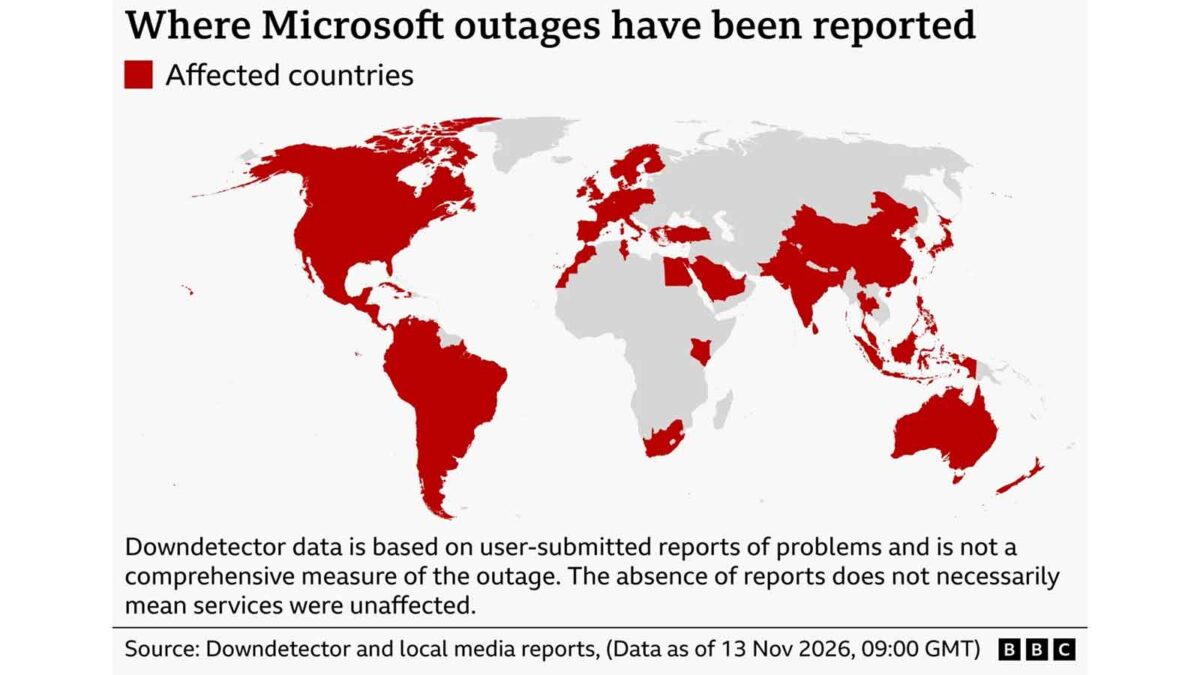
A map shows the global spread of reported Microsoft outages, based on user-submitted data from Downdetector and local media reports as of 13 November 2026 at 09:00 GMT. Key regions highlighted as affected include countries in North and South America, Europe, Asia and Oceania. Only some countries in Africa have reported outages.
What has Microsoft said?
Microsoft has ruled out a cyber-attack and attributed the ongoing outage to “elevated load” on its infrastructure.
The term refers to when servers are handling a much higher volume of stress than they usually do.
In the case of the Microsoft outage, a large number of servers became “unexpectedly unavailable”, the company said, which sent added traffic to remaining servers and strained them.
On Friday morning, Microsoft said it was seeing “early signs of stabilisation”, but service capacity had “not yet returned to normal levels”.
In an earlier statement, the tech giant had said its attempted fixes were “not taking as expected”.
What have experts said?
Australian cyber-security expert Troy Hunt told the BBC the outage could have far-reaching consequences.
“Microsoft is a massive part of the internet backbone and reminds us how critical email still is,” he said.
“Not only does this outage affect many people’s ability to work but also things like the ability to communicate about appointments, purchase things that need verification, create or access accounts and services.”
Paul Spain, from New Zealand-based advisory firm Gorilla Technology, said that with emails and services offline, companies had practically “lost a business day”, which was “frustrating” users. – BBC