Online Reporter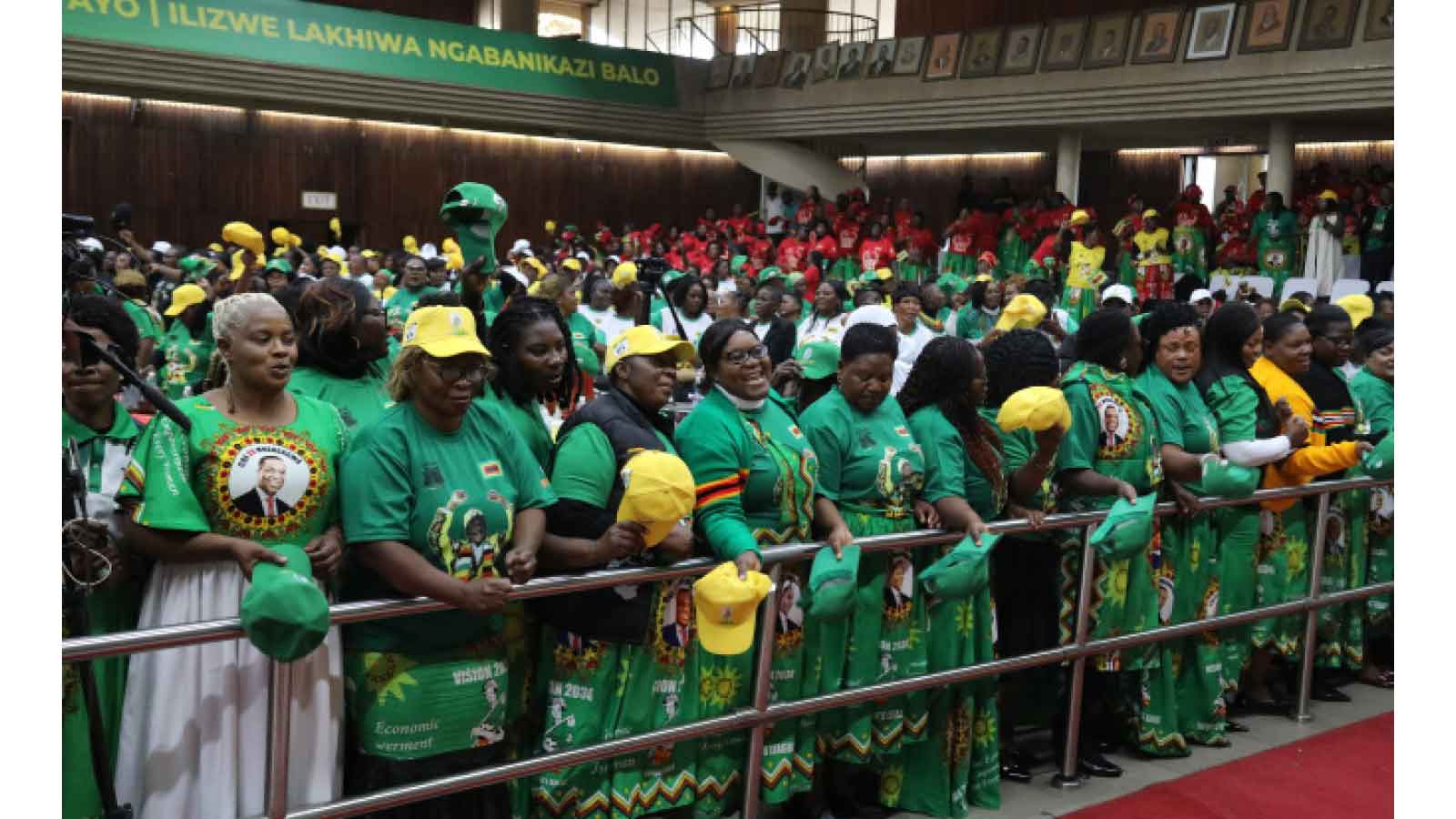
Victoria Ruzvidzo
Editor’s Brief
President Mnangagwa reaffirmed his strong support for women in an address at the Women’s League National Assembly meeting held last Wednesday under the theme ‘Investing in Women, Transforming the Nation for Generations.
The theme itself was quite instructive. Women indeed have the wherewithal to multiply for generations to come.
One of the salient features of his address was the proclamation of collateral-free loans, which will go a long way in mitigating the capital challenges faced by women in accessing finance. This has been a sore point for women’s advancements for decades.
The provision of farming and mining equipment to women across all 10 provinces to encourage active roles in agriculture and mining is a substantive milestone. These sectors have been breaching performance records in the last few years. Women will not only benefit, but will also ensure sustainable growth that will leave much for future generations.
With regards to maternal care, the President stressed that “no woman should die while giving me life”.
He directed investments in maternity wards, ambulances and trained midwives, while urging early antenatal bookings, regular cancer screening and the integration of mental health services into primary care.
The President went further, praising women for increased representation in Parliament, local authorities and party structures. He advocated for equal opportunities for boys and girls, stating that sexism and chauvinism have no place in Zimbabwe.
“No one must be left behind. There is need to empower all our children, boys and girls alike to guarantee that the Zimbabwe of the future benefits from the talents, skills and abilities of all citizens.”
And consistent with his statesmanship, the President sagely said; “You have a duty and responsibilities that extend beyond the parameters of the party and have far reaching impacts on families, communities and our great nation. “
As rightly stated by the President, women are an important cog of the national development engine. It is not difficult to decipher.
They make 52 percent of the population. Women-owned businesses are some of the fastest growing and ably-led.
Furthermore, statistics show that women reinvest 90 percent of their income into the community, versus 30 percent to 40 percent for men. There is consensus on this from a number of studies done by the World Economic Forum, the Africa Development Bank, the International Trade Centre and Harvard Kennedy School.
Men tend to spend more on personal consumption, assets or reinvestment outside of the household,while women prioritise food, health, education and community needs. Also, women play prominent roles in community groups, churches, school committees and co-operatives, which is by and large where development projects are implemented.
Childcare, caring for the elderly, the sick, cooking and cleaning is the unpaid work which keeps households and communities flowing and sound. Hence countries with higher women’s political representation have better health, education and social protection.
A Sub-Saharan Africa Panel Study over the last two decades found that a higher number women representatives increase share of public health spending, while the United Nations Development Programme Evaluation Synthesis found that stronger women’s involvement in politics resulted in “a substantial increase in the approval initiatives that promote education, health and community safety”.
Female leaders in the economy and in public institutions emphasise more investments in public infrastructure that benefits everyone. The motherly instinct always kicks in.
Women are also said to be less corrupt and use funds more efficiently and more purposeful, a factor that makes them quite impactful in the development discourse.
Furthermore, women tend to bring diverse traits and experiences that fortify leading teams, communities and countries. Studies from Harvard, McKinsey, UNDP and World Bank found that women tend to score higher on:
Collaboration and inclusion: Women tend to consult, listen and bring different voices to the table, this engenders buy-in.
Empathy and relationship building: They are better at understanding staff and community needs. In crises, people feel heard.
Long term focus: Women actively consider investments with pay-offs 10-20 years later.
Governance: A higher percentage of women in parliament and the corporate world typically translates to lower corruption and rent-seeking behaviour. Research has found that the greater the representation of women in parliament, the lower the perceived level of corruption.
International Review of Applied Economics (Reis, Ribeiro and Cimini, 2024) sampled 154 countries between 1995 and 2018 and found out that ‘Greater share of women in politics is associated with lower levels of corruption within the legislative house.’
It was economist Anne Krueger who coined the term “rent-seeking” in 1974 to describe the phenomenon of people or companies inclined to getting more money or power, not by creating new value but by manipulating rules or using influence. It’s really about getting paid without production.
Zimbabwe has 30.1 percent women in the National Assembly and 43.3 percent in the Senate. It has 60 seats reserved for women in the National Assembly. In the 2023 elections, only 23 women won directly contested seats.
SADC Ministers are pushing for 50 percent women representation by 2030. Already in Rwanda, 50 percent of parliamentary seats are allotted to women.
There is much to be said about women being more ethical than their counterparts. Business is all about trust:
Customers trust that products and services are safe and prices are commensurate with quality.
lnvestors reposit trust and that financial feedback is not manipulated .
Employees trust that they will be paid and treated with dignity and empathy.
Partners most certainly trust that parties will keep their end of the bargain.
Where ethical conduct is deficient, trust dissipates or evaporates. Where there is less corruption, investment flourishes. As one economist put it, “best business must win, not best connected”.
Fairness and responsibility stimulate innovation as people invest in novel ideas as opposed to merely protecting that which they have.
You may recall that the 2008 global financial crisis was precipitated by unethical shortcuts.
The World Bank Data shows that countries that have underinvestment in governance grow 1.2 percent to 1.5 percent slower per year. Additionally, customers will predictably boycott unethical brands.
Partners and banks treat favourably businesses with clean records while weak institutions precipitated decline. In any case, best human capital is keen to work for companies they would be proud to be identified with. There is thus a link between talent and reputation.
We could go on and on describing women’s attributes and their capacity to become equal, if not better partners in development.
Zimbabwe has indeed made notable improvements in the elevation of women. This prompted the UN Women Executive Board to describe changes effected in that direction as “progressive” during the May 2025 visit.
We have commitment at top level which the President reaffirmed in 2025 when he stated that “Gender equality is not only a fundamental but also a necessity for economic growth”.
Women’s financial inclusion rose from 69 percent in 2014 to 83 percent in 2022. There is fiscal policy focus exemplified by discussions at ZITF 2025 on gender-responsive budgeting, tax incentives for women-owned SMEs and simplified tax regime for women informal traders. A new US$4,5 million facility was launched in April 2026 with EU, Switzerland and UN to strengthen accountability and data on GBV.
Furthermore, the Gender Monitoring and Reporting Framework was validated in May 2025 to fix fragmented data and track indicators like women’s land ownership and unpaid care work.
We also have community leaders speaking out against harmful practices. Girls in school are gaining confidence to stay in by school.
Indeed the Angel of Hope Foundation was praised by the President for spreading health education and empowering women in amazing ways. The patron, First Lady Dr Auxilia Mnangagwa, is intent on empowering women and ensuring Zimbabwe’s socio-economic status is improved.
The President was on point when he said social and economic development is not accidental, rather it is deliberate.
The National Gender Policy is a prudent one, borne out of realities on the ground. It consolidates gender equality, addresses stereotyping and institutionalised gender, promotes a coherent structure for monitoring gender equality across legal, economic, health, education, climate and digital spheres.
The Zimbabwe Gender Commission helped amendments like mandatory sentencing for rape and Labour Amendment Act provisions that criminalise workplace sexual harassment.
On the flip side, phenomenon referred to as PHD (Pull Her Down Syndrome) perceived in some instances among women, is toxic. While a number of factors might explain this, it has no place among women. Scant opportunities yield competition hence it’s occurrence in some instances. Social factors also come into play as women are usually judged on aesthetics, likeability and marital status.
It is also an acquired behaviour whereupon women were not afforded the space to occupy leadership positions for a sustained period of time.
This led to some who got to the top after a long and arduous journey protecting that space, telling themselves that they went through hell to get to the top, hence fellow women must also face the same predicament.
There was a deficit in mentorship models, with few women seen supporting other women. This then led to replication of behaviour which would be in abundance-competition
There are practical remedies for this. Empathy is important. Other women should ask themselves what others (in leadership positions) are going through, and compliment each other when they do good. Sharing opportunities also consolidates womanhood and sisterhood.
At workplaces and communities, opportunities should be augmented to stifle competitive streaks, indiscretions should be called out not gender, and collaborations should be taught early, in schools, churches and communities.
So then, we have seen that women are in ascendancy, even the President jokingly said we are going to take over the country and leave the presidium biting the dust. Women have an inestimably important role to play in the development and growth of this country.
Our intrinsic qualities must continue to find expression, shine through and consolidate our rise as a country. The mantra ‘leaving no one and no place behind’ amplifies the urgency of our social, political and economic roles which beckon before us.
Vision 2030 of an upper middle income status is attainable, we play our part, utilising our God-given gifts, our industry, our versatility, our focus, our resilience, our tenacity, our empathy and our collaborations.
As women, we must seize the growing opportunities and continue to push for more decision-making positions. Not merely by rhetoric, but by easily perceptible and tangible results which cannot be ignored.
We should walk together with our male counterparts too and collectively and in unison achieve hitherto unimaginable milestones. Together we will make Zimbabwe great.
In God I Trust!
X handle: @VictoriaRuzvid2; Email: [email protected]; [email protected]; WhatsApp number: 0772 129 972.


 Bongani Ndlovu