Online Reporter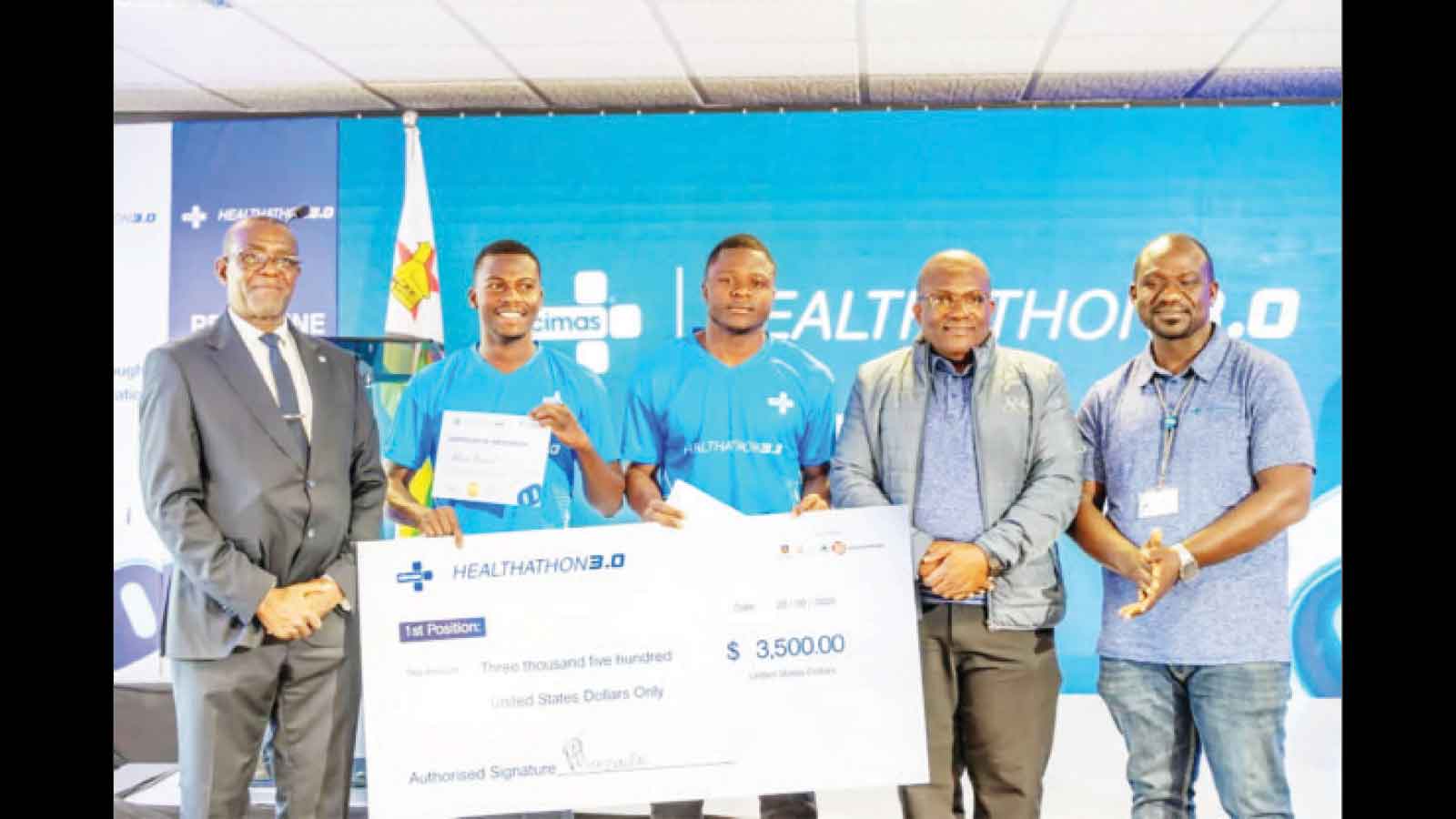
Ivan Zhakata-Features Correspondent
FOR someone living far from one of the country’s major cities, seeing a specialist can mean much more than making an appointment.
It can mean a long journey, transport costs, time away from work or school and, in some cases, accepting that specialist care is simply out of reach.
But across Zimbabwe, a generation of young innovators is beginning to ask whether technology can help change that reality.
Their ideas do not all depend on sophisticated smartphones or uninterrupted internet connectivity.
Some are exploring USSD and SMS platforms that can work on basic mobile phones, while others are developing offline technologies, remote-care models and digital tools designed to help healthcare workers reach patients far from major hospitals.
These ideas emerged from a recent Healthathon that attracted 372 submissions from young innovators across Zimbabwe, with proposed solutions covering specialist care, chronic disease management, maternal health, occupational health, healthcare financing and health-system logistics.
For Dr Grace Gwini, a Zimbabwean physician and health-systems specialist who reviewed all 372 submissions and mentored three teams that reached the Top 15, the experience offered a glimpse into how young Zimbabweans are beginning to imagine the future of healthcare.
“The number and diversity of the submissions showed me that Zimbabwe does not lack ideas or young people willing to tackle difficult healthcare problems,” she said.
What caught her attention was not simply the technology being proposed but the problems the young innovators were choosing to solve and the extent to which their ideas reflected the realities of the local healthcare environment.
In a country where access to smartphones, affordable data and reliable connectivity is not universal, digital healthcare designed only for the connected could leave many of the people who need it most behind.
Several of the submissions appeared to recognise that challenge, exploring USSD and SMS-based services, offline-capable platforms and remote-care models for people living in communities with limited connectivity or far from major healthcare centres.
“What I found encouraging was that many of the young innovators understood that digital transformation cannot mean designing only for people with smartphones, reliable data and proximity to major hospitals,” Dr Gwini said.
For her, the significance lies in how technology can be used to extend healthcare rather than simply digitise existing services.
“The real question is not simply whether healthcare is becoming more digital,” she said. “It is whether digital transformation can help bring healthcare capability closer to people who currently have difficulty accessing it.”
The same thinking is emerging around specialist healthcare, where the challenge is not only the availability of professionals but also how far their expertise can reach.
Zimbabwe cannot instantly multiply the number of specialist health professionals available across the country.
Technology, however, may offer ways of extending the reach of the expertise that already exists.
Among the Healthathon submissions were concepts involving telemedicine, remote monitoring, rehabilitation at a distance and clinical decision-support tools designed to assist healthcare professionals closer to patients.
A specialist working in a major urban centre could potentially support selected cases in primary-care settings through appropriately designed telemedicine systems, while remote-monitoring technologies could allow healthcare professionals to follow some patients without requiring every interaction to take place at a tertiary institution.
“A major opportunity for digital health is to ask how we make scarce expertise travel further,” Dr Gwini said.

Dr Grace Gwini, a Zimbabwean physician and health-systems specialist who reviewed all 372 submissions.
The aim, she said, is not to replace healthcare workers but to give them tools that allow their expertise to benefit more people.
“The opportunity is not to replace the healthcare worker,” she said. “It is to ask where technology can amplify their expertise and allow that expertise to benefit more people.”
The Healthathon also highlighted another dimension of innovation — the adaptation of existing technologies to local circumstances.
Not every solution has to involve inventing something that has never existed.
For some innovators, the challenge is to take an established technology or approach and redesign its delivery around issues such as affordability, connectivity, language, infrastructure and geographical access.
A solution that works in an environment with widespread smartphone use, reliable broadband and easy access to specialist healthcare may require a different model in rural Zimbabwe.
“Innovation does not always mean inventing something that has never existed anywhere in the world,” Dr Gwini said. “Sometimes innovation is taking an established technology or approach and redesigning how it is delivered around the realities of the population you are trying to serve.”
That local focus is also visible in the growing attention being given to preventing health problems before they become emergencies.
Several submissions explored ways of identifying and managing risks earlier, supporting patients between healthcare visits and managing chronic diseases outside episodes of acute hospital care.
Solutions including Tsoka, maternal-health monitoring concepts and eventual Healthathon winner SilicaGuard reflected different approaches to earlier intervention.
For Dr Gwini, the shift is significant because it shows young innovators thinking about healthcare beyond the hospital.
“A generation of innovators is beginning to think about healthcare before the hospital admission,” she said.
“That is important because some of the greatest opportunities in healthcare come from identifying risk earlier, supporting patients between healthcare visits and intervening before a preventable complication becomes an emergency.”
The submissions also showed that young innovators were looking beyond diagnosis and treatment.
Ideas addressed healthcare financing and insurance, medicine and supply-chain challenges, workforce productivity, occupational health, public-health surveillance and the movement of patients and resources through the health system.
“What impressed me was the breadth of the thinking,” Dr Gwini said.
That breadth reflects the complexity of healthcare itself.
A patient’s experience in a consultation room is shaped by much more than the interaction with a doctor or nurse.
Behind it are financing systems, medicines and supply chains, healthcare workers, information systems, infrastructure and institutions responsible for identifying and responding to changing health needs.
The young innovators were therefore not simply developing applications.
Their ideas were also beginning to examine the wider systems that determine how healthcare is delivered.
Dr Gwini’s own journey has given her a perspective across several parts of the healthcare-innovation process.
Her career began in clinical medicine before expanding into health-systems research and early-stage healthcare technology.
While undertaking graduate training in technology, entrepreneurship and innovation at the University of Notre Dame in the US, she worked with Vital View Technologies, now PrīmSphera, on early-stage contactless monitoring technology.
She later worked with SmartHealth Catalyser, evaluating AI-driven life-sciences start-ups and examining issues including data infrastructure, scalability, regulatory pathways and routes to market.
Those experiences have influenced how she approaches promising healthcare ideas.
“I have had an opportunity to see innovation from different sides — first as a clinician thinking about patient need, then working with an early-stage technology, and later evaluating emerging technologies from an investment and translation perspective,” she said.
“One lesson that becomes very clear is that the idea is only the beginning.”
That may be one of the biggest lessons emerging from the Healthathon.
Competitions can identify talent, generate excitement and allow young innovators to present their ideas.
But healthcare innovation does not end when a competition closes.
A prototype may require technical refinement. Clinical assumptions may need validation. Innovators may need regulatory guidance. Technologies must be tested in real healthcare environments, while promising ventures eventually require financing.
Dr Gwini believes Zimbabwe now needs to build the support structures capable of taking promising ideas beyond the competition stage.
“The next challenge is creating the infrastructure around these young innovators — clinical validation, mentorship, regulatory guidance, appropriate access to health-system data, pilot environments and financing — so that promising prototypes do not necessarily end when the competition ends,” she said.
Her experience reviewing all 372 submissions has convinced her that the talent already exists.
“The Healthathon showed us the talent,” she said. “The next question is how we build pathways around that talent.”
Creating those pathways will require several parts of the healthcare and innovation ecosystem to work together.
Government can identify national health priorities and create enabling policy and regulatory environments.
Healthcare institutions can provide real-world settings where promising solutions can be tested, while universities and research institutions can contribute scientific expertise and evidence.
The private sector can provide infrastructure, technical expertise, mentorship and partnerships, while investors and development partners can provide the capital required to move promising solutions through development.
Young innovators, meanwhile, bring the creativity, technical skills and entrepreneurial drive required to build the solutions.
If those elements can be connected, initiatives such as the Healthathon could serve a purpose beyond identifying winners.
They could help create a pipeline through which Zimbabwe identifies talent, develops promising ideas, tests them in real healthcare settings and eventually takes those that demonstrate value towards implementation.
For the young people behind the 372 submissions, the Healthathon may therefore be less an ending than a beginning.
Their ideas have opened a window into how a new generation is looking at Zimbabwe’s healthcare challenges — not simply as problems to be endured, but as problems that can be examined, redesigned and potentially solved. For Dr Gwini, the submissions represent something larger than a collection of prototypes.
“They represent young people choosing to participate in solving the country’s healthcare challenges,” she said.
And as Zimbabwe’s digital-health ecosystem develops, she believes the ultimate test will be whether innovation translates into practical improvements in healthcare delivery — helping healthcare workers do more, enabling earlier intervention, and extending the benefits of digital transformation to people living far from major urban centres.
“The talent is already here,” Dr Gwini said. “The opportunity now is to build the ecosystem that allows that talent to translate innovation into better healthcare.”