Joseph Madzimure-Zimpapers Politics Hub
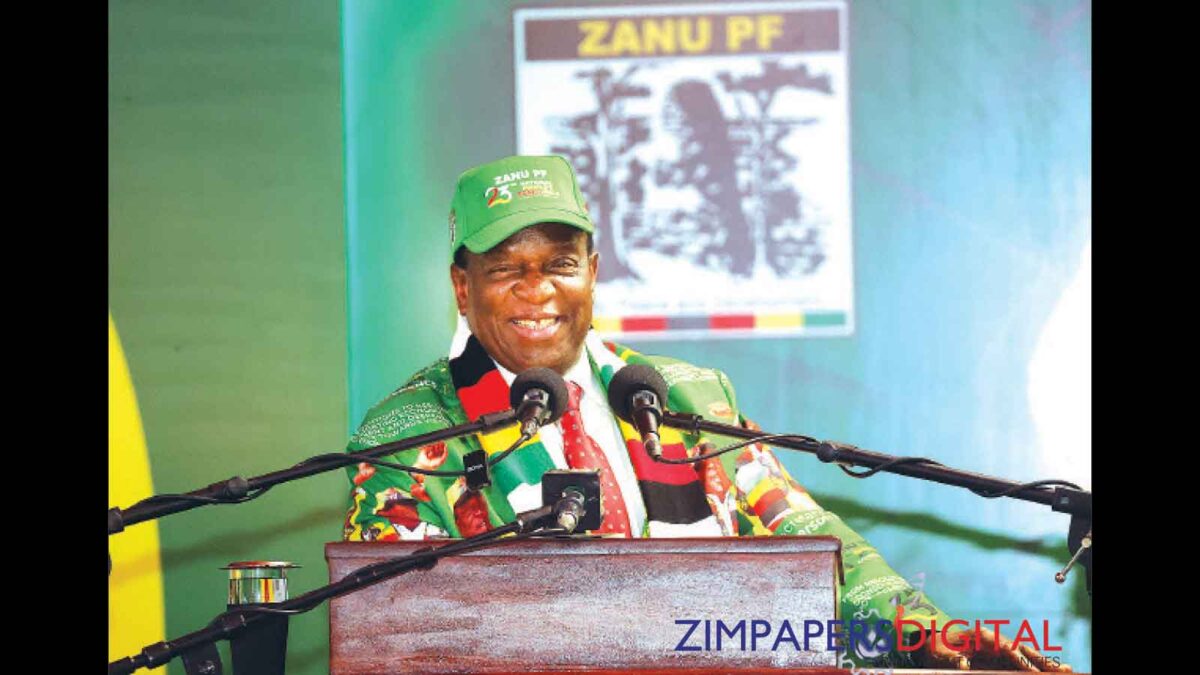
THE rejuvenation of Zanu PF remains critical to building a modern, disciplined and responsive party machinery capable of supporting an empowered, rapidly developing and modernising society under Vision 2030, President Mnangagwa has said.
The President, who is the party’s First Secretary, wrote the foreword of the Central Committee Report tabled and adopted at the 23rd Zanu PF National People’s Conference in Chinhoyi last week.
The report reviews the party’s activities for the year, highlighting progress in party organisation, leadership development, economic empowerment and the implementation of resolutions aimed at advancing Zimbabwe’s long-term development.
President Mnangagwa said the year had been marked by significant milestones for the revolutionary party.
“The rejuvenation of the party remained critically important, more so that a modern, disciplined and responsive party machinery is vital in an empowered, fast-developing and modernising society under Vision 2030,” he said.
Party leaders at all levels had become increasingly responsive, efficient and results-oriented, providing momentum for national production, productivity and development.
In February, Zanu PF held its inaugural strategic seminar for Central Committee members to strengthen internal coordination, leadership capacity, ideological clarity and discipline.
The seminar sought to deepen members’ understanding of the national economy and prepare them to respond to emerging challenges, including hybrid warfare and artificial intelligence.
President Mnangagwa said training and capacity-building workshops had improved intra-party governance, constitutionalism and discipline, while deepening members’ understanding of party ideology, values and decorum.
The implementation and monitoring of resolutions adopted at previous conferences and congresses had improved.
The enactment of the Constitution of Zimbabwe Amendment (No. 3) Act represented a consolidation of democracy and constitutional governance in the country.
He highlighted the contribution of advocacy programmes conducted by the party’s Department of Legal Affairs towards promoting a just, fair and equitable democratic culture within Zanu PF.
“Our national development philosophy, ‘Nyika inovakwa, inotongwa, inonamatirwa nevene vayo/Ilizwe lakhiwa, libuswe, likhulekelwe, ngabanikazi balo’ is guiding our political and economic work,” he said.
Progress in agriculture, mining, infrastructure, energy, manufacturing, innovation and social services was contributing to increased production, economic empowerment, higher household incomes and improved living standards.
“The reports of departments echo the expanded role of our party as a key driver of grassroot-oriented development. Zanu PF’s supremacy over Government is now firmly established.”
The party’s performance in by-elections held during the past year reflected continued support for Zanu PF across the country. He welcomed Zimbabweans joining the party.
Reviewing the Department of Information and Publicity Report, the President acknowledged efforts to publicise party activities and events during the year.
“Pleasing was the use of emerging technologies,” he said.
He said reports from the Women’s League, War Veterans League and Youth League showed that members of the party’s wings were benefiting from national development.
President Mnangagwa spoke about Zimbabwe’s election as a non-permanent member of the United Nations Security Council for the 2027–2028 term, describing it as an overwhelming vote of confidence.
Zimbabwe’s foreign policy principle of being “a friend to all and an enemy to none” was yielding results.
“The External Relations Report gives an elaborate synopsis of the exchanges undertaken to advance the engagement and re-engagement policy,” he said.
The Central Committee Report should be viewed not merely as a record of activities undertaken during the year, but as a tool for assessing the party’s performance, implementation of conference and congress resolutions, responsiveness to people’s needs and capacity to lead the national development agenda.