Gibson Nyikadzino
Zimpapers Politics Hub
The decision by the Zimbabwe Football Association to place, at the helm of national football foreign coaches, is something that is not only about football.
It should also be understood within the context of how power and social identities at that level can shape and affect local institutions and society.
Spaniard Ramon Catala will lead the Warriors into the Dream 2030 project, while Croat Stella Gotal takes the Mighty Warriors. Catala will be assisted by his compatriot, Marc Sanchez, while Zimbabwean Takesure Chiragwi sits on bench as second assistant coach. This hierarchy must not be seen as an accident.
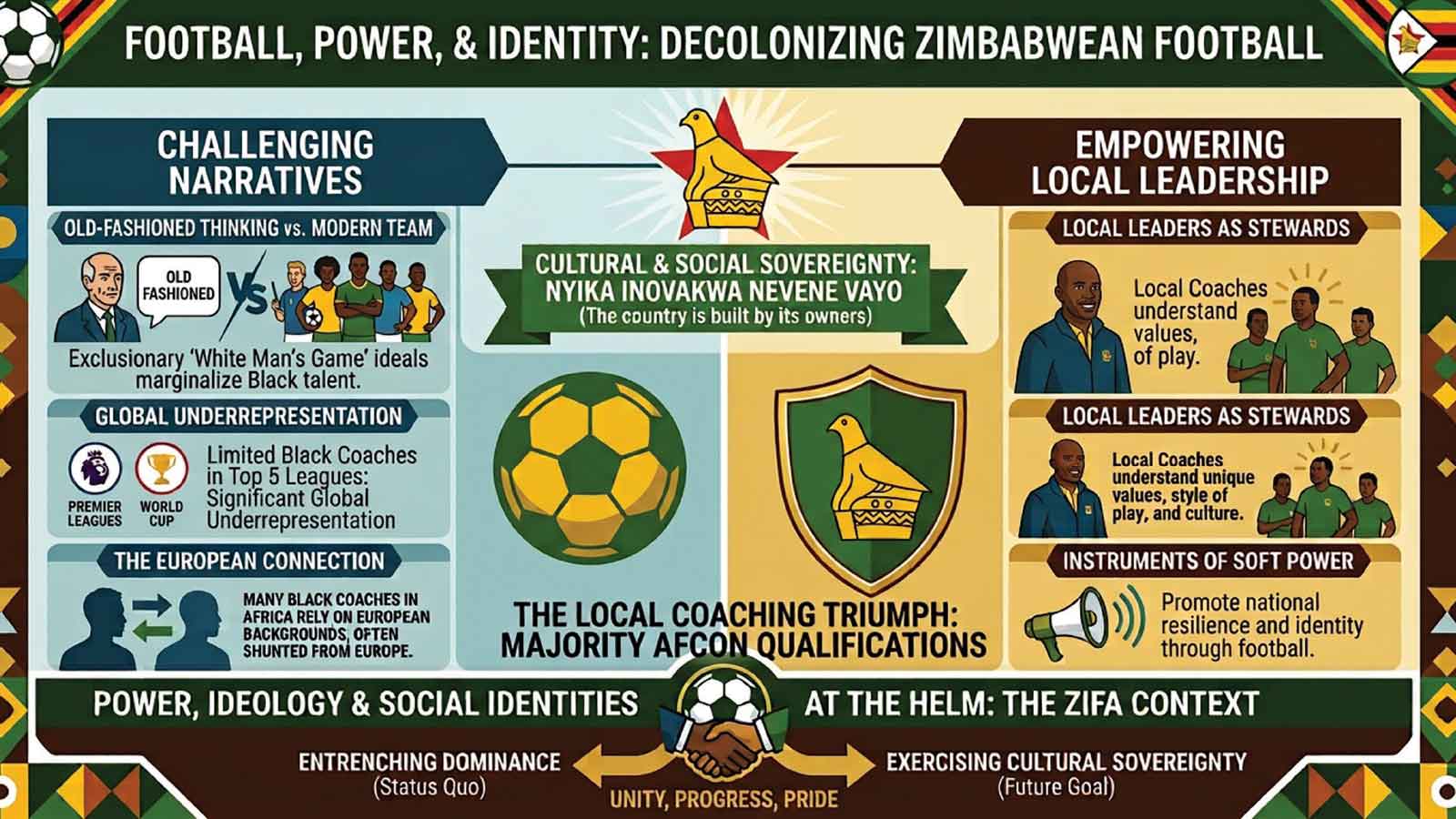
Football, for long, has been regarded as a “white man’s game”. That description alone is exclusionary and its decades-long maintenance has been used to send a message about racial superiority. It gives the dominant narrative that no other race can be better than the white man when it comes to football. In the hierarchy of football, other non-white races must remain marginalised in the periphery!
This tells that the nature of football is not merely to entertain as spectators and observers feel, but to entrench dominance, identities, ideas and values of other people over others. Football is politics. Politics is about power. Power is a complex concept that is deployed to give visibility to others, mythologise some and project others as incompetent.
Perhaps in the national football team perspective, they intend to borrow the template from national cricket and rugby teams that have been “successful” by having Justin Sammons and Piet Benade at the helm, respectively.
Where Blacks don’t fit
Historically, there is no Black tactician who has ever coached a European national soccer team. Even in the most enlightened post-industrialist society where the doctrine of inclusion is hoisted at international for a, Blacks coaches are unrecognised. In Europe’s top five leagues (England, France, Germany, Italy, Spain), for their 2026/27 season, they France and Germany have Black coaches, Le Havre’s Didier Digard and Bayern Munich’s Vincent Kompany.
This means out of the total 98 teams across Europe’s top five leagues, Digard and Kompany only represent a mere 2 percent of the tacticians. The underrepresentation of Blacks speaks a lot. First, it seeks to symbolise Blacks as incapable and incompetent to take leading roles. Secondly, their merit should only be certified through the benevolence of institutions that run the “white man’s game”. In short, Blacks are not thought of as people who have qualities to uphold and maintain the club’s historical standards and values.
Consider Patrick Vieira who recently was appointed Senegal’s national team coach; Clarence Seedorf who in 2018 was appointed head coach of Cameroon’s national football team with fellow Dutch legend Patrick Kluivert as his assistant; Germany born Ghanaian Nana Otto Addo coached the Ghana national team before being sacked in March 2026; and Chris Hughton who was Ghana’s national team coach from February 2023 until January 2024. For these Black coaches, their European connection has helped them to transition or be shunted into African football where they can either “experiment or implement” their tactics.
Extricating football from White ‘messiahship’
Zimbabwe was the first post-millennium African country to place emphasis on the importance of the doctrine of sovereignty in all spheres at a time the country had a misunderstanding with Britain. While political and economic sovereignty formed the bedrock to the application of this principle, socially and culturally Zimbabwean football at a national team level seem to be failing to impose the same.
Local coaches are not incompetent to turn the fortunes of the national team, and white coaches are not the messiah. Playing the doctrine of messiahship for white coaches when it comes to football means there is an imposition of football and philosophical values that do not correspond with ours.
Goodluck to Catala, but tiki-taka as a football philosophy has no foreseeable embrace in Zimbabwe, as that is not the philosophy that applies. The continental glory that Zimbabwe prides, qualifying six times for the Africa Cup of Nations (AFCON), had majority qualifications by local coaches. Of the six qualifications, Sunday Chidzambwa (two occasions), Charles Mhlauri and Kallisto Pasuwa led the Warriors qualifications first, before Zdravko Logarusic and Michael Nees did the same.
The numbers do speak in favour of local coaches as stewards of the national soccer team. Brazilian coach Valinhos, whose full name is Jose Claudinei Georgini, Belgian Tom Saintfiet, Croatian Logarusic, Brazilian Baltemar Brito, German Nees, and Romanian Mario Marinica have not been giving satisfactory numbers to the fans.
Football is a vehicle of nationalism and national pride. By continuously looking for outsiders to model the success of our vehicle of nationalism and national pride means delegating people who cannot even sing Zimbabwe’s anthem with a duty to market our resilience, they will not. Zimbabwean football should exercise its cultural and social sovereignty to develop, grow and progress.
This is about power
Football remains a game of power. When Arabs invest in European soccer, they get accused of “sports washing”, the practice of using sports, teams, or mega-events to improve a tarnished reputation, distract from human rights abuses, or project political soft power. These accusations have been used against teams who have received huge investments from Arab countries like Manchester City and Newcastle in England, and Paris Saint Germain in France. In European society, they protect their institutions and values. They do not want them to be disrupted.
Zimbabwean football, for it to grow at national team level, cannot continue accept the allocation of foreign coaching values that can be justified under the flag of “inclusion and interdependence”. It should protect its values. By the way, inclusion is a contested concept that only applies when Blacks are expected to accommodate Whites, and not vice-versa.
Local coaches should be hired as instruments of soft power, where they make our national football team attractive to have outcomes that identify with our philosophy and style of play. If politics in sport is used to pursue the self-interests of individuals, par-ties, or organised interest groups, the same should be used to pursue the national interest that can borrow from the “Nyika Inovakwa neVene Vayo”.
Rebuilding the country’s institutions should not only be seen in political and economic terms, but also socially and culturally. It is myth to think Black coaches are incompetent, and that foreigners are the needed ‘messiahs’.