Online Reporter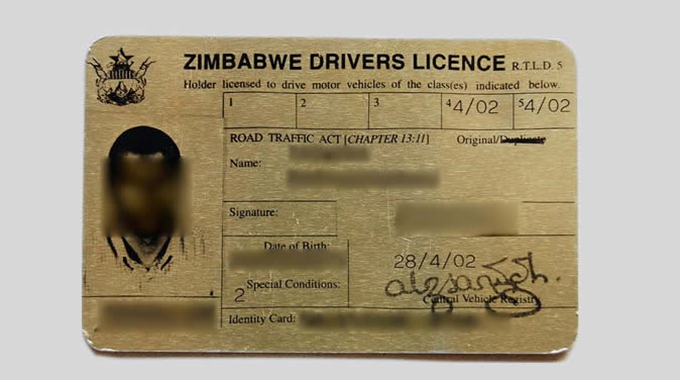
Nyore Madzianike
Senior Reporter
ZIMBABWE has already professionalised its driver licensing system and is moving closer to introducing a penalty points system, under which motorists who repeatedly commit traffic offences could have their licences suspended or cancelled.
The system will be integrated into the new smart traffic management system, which is expected to use cameras to detect traffic offences and help curb reckless driving.
Central Vehicle Registry acting registrar, Mr Saston Muzenda, said this while giving oral evidence before the Parliamentary Portfolio Committee on Transport at the new Parliament Building in Mt Hampden.
He was responding to a petition by Drivers Association of Zimbabwe president, Mr Nicholas Mabwe, who called for legislation and regulatory bodies to professionalise driving in Zimbabwe.
Mr Mabwe argued that many drivers lacked proper road ethics and called for minimum professional requirements for motorists.
Responding to the petition, Mr Muzenda said the Government was already strengthening the regulatory framework through technology and the proposed driver penalty points system.
“So, when we then talk of regulatory framework in terms of penalisations, where the framework is in place, I thought the petitioner would also take cognisance of the smart traffic management system that is coming into the country,” he said.
“Now, with cameras on most of the intersections to deal with errant driver behaviour in terms of the penalties, the Government has also been moving towards the driver penalty point system, where if you continuously commit offences, you have your points suspended until such time that you might have your licence then cancelled, or suspended until such time that you have reformed in terms of the behaviour.”
Mr Muzenda said the measures were aimed at addressing traffic offences and lawlessness on the country’s roads.
“In terms of taming traffic offences, the country is progressing very well.
“I am not quite sure of the concept where we are now speaking of educational qualifications, much as it”s not qualified, but I think that is the statement that could have been sending out the misconception that has been circulating on social media now,” he said.
He said Zimbabwean drivers already underwent rigorous testing before being licensed, with the Government also moving to make the learner’s licence test more accessible.
“We have our drivers, they are tested. Now we are also going to add two languages in terms of the learner licence — isiNdebele and Shona.”
Mr Muzenda said Zimbabwean drivers were recognised across the region and internationally, adding that there had been no indication that they were considered incompetent.
“It means the process that we actually have our drivers go through is internationally recognised and is one of the best in terms of practice.
“So, from a professional point of view, we have already professionalised the same process within the region that our drivers are professional.
“And professional drivers driving for a living have more laws to obey than the private motorist who is just a private driver.
“These laws are regulating how long one can stay behind the wheel, requirements to stop at railroad for crossing four points, speed limits, abiding by bylaws and I would say Zimbabwe’s modernised licencing system is transitioning from the manual licence production to a more robust and dynamic computerised system.
“These schemes align with the country’s regional international standards, including those used in Namibia, Malawi, and the United Kingdom.”
Mr Muzenda said Zimbabwe had also complied with the Transport and Transit Facilitation Programme, which seeks to harmonise transport policies, laws, regulations and system standards across SADC, COMESA and the East African Community.
He said the country had adopted the legal instruments necessary to implement the driver-trade free area, ensuring that Zimbabwean drivers were recognised across the region.
“The harmonisation of standards has strengthened the professional standing of Zimbabwean drivers, many of whom are now employed in countries such as the United Kingdom, the United States, Poland and Lithuania.
“We have every week already shared a number of our drivers who were recruited out of Zimbabwe professionally.”
Mr Muzenda said Government and the CVR regularly received requests from foreign companies seeking confirmation of the qualifications and professional status of Zimbabwean drivers.
“We received letters from respective companies requesting confirmation that indeed they are professional drivers, they are older, so in specific classes that they hold.
“And it’s an ongoing programme, and we’re saying we would not want to raise alarm if we are not professional in terms of that set.
“It’s already professionalised, it’s already adequately regulated,” he said.