Debra Matabvu, [email protected]
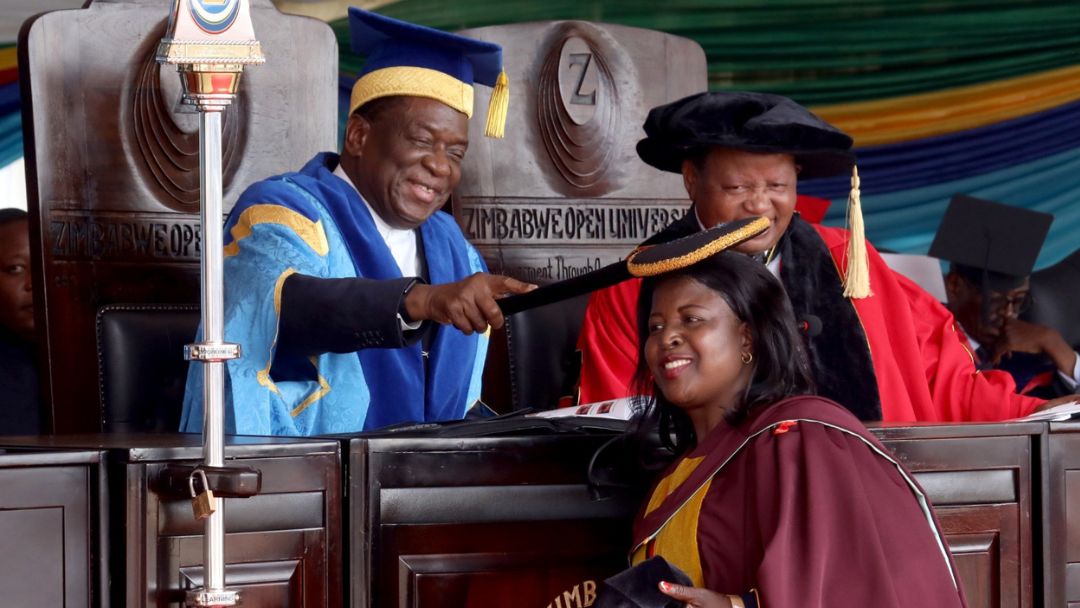
PRESIDENT Mnangagwa yesterday capped 2 729 graduates at the Zimbabwe Open University’s 24th graduation ceremony, with the institution reaffirming its commitment to expanding access to higher education and producing skilled graduates to drive the country’s socio-economic development.
The graduates received doctorates, master’s degrees, undergraduate degrees and diplomas in disciplines including agriculture, science, commerce, technology, applied social sciences, education, arts, culture and heritage.
Some graduates received cash prizes under the Dr ED Mnangagwa Chancellor’s awards in recognition of their academic achievements.
Prosperity Mbadzo, who graduated with a Bachelor of Commerce Honours in Accounting, was named overall best female student and received US$1 000.
Welcome Phiri, who graduated with a Bachelor of Science Honours in Mathematics and Statistics, was named overall best male student and also received US$1 000.
Other recipients of the Dr ED Mnangagwa US$500 cash prizes included Cheneso Chimunhu, who graduated with a Bachelor of Commerce Honours in Accounting, and Ordeal Tanyaradzwa
Karisa, who graduated with a Bachelor of Information Technology Honours.
The ceremony was held under the theme, “Advancing human capital for Vision 2030 through open, distance and flexible learning.”
Speaking at the ceremony, ZOU Vice-Chancellor Professor Paul Henry Gundani said open and distance learning remained critical in broadening access to higher education and developing the human capital needed to achieve Vision 2030.
He said the model enabled the university to reach learners across geographical and socio-economic boundaries while translating academic training into community innovation and sustainable growth.
“This theme underscores our unwavering commitment to broadening access to higher education by breaking down geographic, temporal and socio-economic barriers in the country and beyond,” he said.
“By leveraging flexible learning pathways, the university reaches working professionals, remote communities and non-traditional learners across the nation and beyond our borders, ensuring that high-level skills development aligns directly with the milestones set out in Vision 2030.
“Through open, distant, flexible learning, academic training translates immediately into community-led innovation, local industry support and sustainable economic growth.”
Prof Gundani said ZOU continued to contribute to the country’s Education 5.0 agenda through research, innovation and community service, producing graduates who could contribute to economic growth and job creation.
He said, guided by their strategic plan and the national development agenda, the university remains committed to producing graduates who are not merely seekers of employment, “but job creators, innovators and responsible citizens”.
Prof Gundani highlighted several achievements recorded during the academic year, including the publication of 402 scholarly works and the hosting of the ZOU Research and Innovation Week from July 28 to 31, when more than 40 student-led innovations were showcased.
The university’s clothing and textile factory has expanded its operations to produce corporate wear and protective equipment for external organisations, creating 15 direct jobs and generating tax revenue.
ZOU also commissioned a modern National Information Access Centre and established an Artificial Intelligence Hub to support research, advanced data analytics and micro-credential training.
In agriculture, the university secured land in Chimanimani and mobilised funding to establish an avocado-processing plant to promote value addition, enterprise development and job creation.
It also acquired land in Middle Sabi and Gokwe to expand agricultural production, research, student training and commercialisation.
Prof Gundani said the university had also extended support to various communities in the country.
“ZOU’s commitment to community upliftment remains central to its mandate. ZOU deployed a team of professional counsellors to Kariba to provide free counselling and psychosocial support to survivors and bereaved families affected by the tragic Lake Kariba ferry disaster of 11 August 2026.
“After paying a courtesy call on the District Social Welfare offices, the team visited affected homesteads, offering support to address grief, trauma, stress, loss and related family challenges,” he said.
Prof Gundani said ZOU will continue to make progress in teaching, research, innovation, digital transformation and infrastructure development as it contributes to Vision 2030.