admin
admin

Features Desk
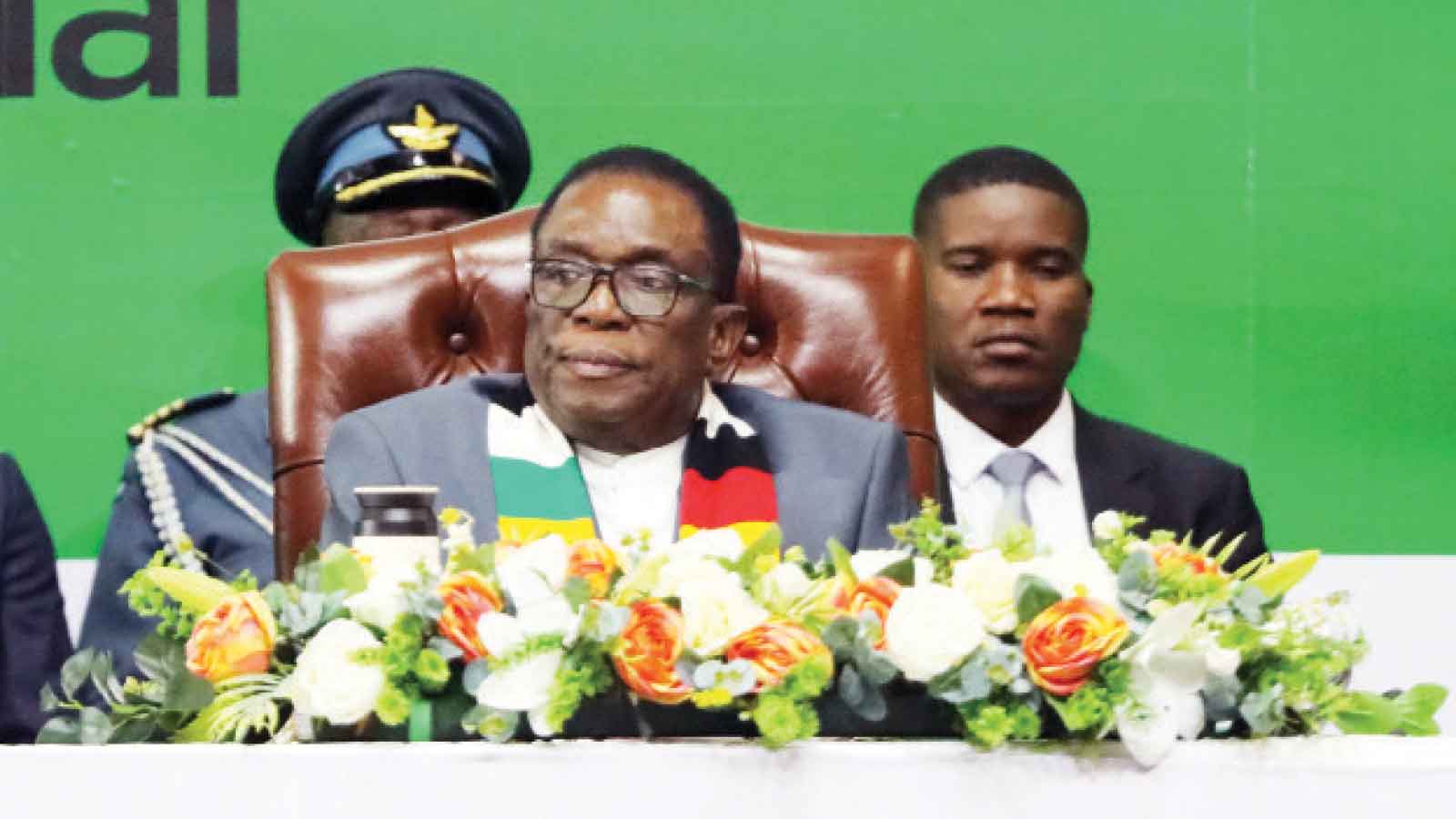
Zimbabwe’s economy is ready for take-off, with various mechanisms put in place to ensure the successful implementation of Zim-Asset. Delivering his State-of-the-Nation Address to a joint sitting of the National Assembly and Senate in Harare recently, the President said the government had adopted a 10-point plan that cuts across all economic enablers.
The speech predominantly focused on the economy that he said recorded modest growth owing to the negative impact of drought on the agricultural sector given that Zimbabwe is an agro-based economy.
“Zimbabwe is already positioning itself for major economic take-off in keeping with Zim-Asset, which requires massive capital injection and rapid implementation,” President Mugabe said.
“This has seen government signing key projects with China covering energy, roads, railways and telecommunication, water, agriculture, mining and tourism.”
He said to maintain economic growth and create employment, government had drawn a 10-point plan to revitalise agriculture and the agro-processing value chain, advance beneficiation and value addition to agricultural and mining resource endowments, among other facets.
The plan would also focus on infrastructure development, particularly in key energy, water, transport and ICT sectors, unlocking the potential of small to medium enterprises, encouraging private sector investment and restoration and building confidence and stability in the financial services sector. Government also plans to promote joint ventures and public private partnerships to boost the role and performance of state-owned companies, modernising labour laws, pursuing the anti-corruption thrust and implementation of Special Economic Zones to attract investment.
The government, he said, was pursuing both domestic and external alternative financing for key Zim-Asset programmes such as infrastructural development.
“Let me reiterate that government recognises the importance of strengthening re-engagement with the international community.
“Indeed, current re-engagement efforts with both bilateral and multilateral partners, including the African Development Bank, the Afro-Asian Bank and the World Bank under various initiatives, should see improvement of relations and the opening up of new financing avenues, for long overdue reforms and development cooperation.
“In order to buttress the positive economic gains recorded to date, the government will implement policies that will improve the business environment and promote and attract both domestic and foreign investment. In this regard, it is our expectation that once the National Diaspora Policy is finalised, it should spur our people in the Diaspora to take advantage of the many investment opportunities existing in the economy,” President Mugabe said.
The President said in line with the Rapid Results Approach Framework, government endeavours to overhaul the Companies Act and other legislation that hinder the ease of doing business in Zimbabwe.
Instead, he said, government would push for “robust legislative and regulatory framework” to establish a One Stop Investment Centre that streamlined processes and procedures.
“This is now a very urgent and high priority matter for which those responsible will be held to account.
“Government acknowledges that unsound procurement practices are slowing down economic growth in the country. In view of this, a new Procurement Bill will be drafted and tabled in Parliament before the end of 2015. The Bill incorporates Comesa procurement guidelines which emphasise devolution of power to award tenders to procuring entities.
“The procuring entities would comprise government ministries, parastatals, state enterprises and local authorities,” he said.
President Mugabe added that the SPB would be transformed into a new non-executive procurement authority tasked with setting standards and guidelines as monitoring compliance by procurement entities.
The board would also act as advisor to the government on public procurement policy.
The President said another strategy would be reforming parastatals and State enterprises to record sustained growth.
“In this regard, government has now embarked on a programme of parastatals reform which has prioritised 10 strategic state enterprises to urgent attention.
“In each case, specialised audits are to be undertaken and various reform and turn-around options identified. Underlining the importance we accord agriculture, the parastatals reform programme is beginning with the Grain Marketing Board and the Cold Storage Company.
“In the interim, however, and as an important parallel process, government has also turned the spotlight on Corporate Governance throughout the Public Sector, including across all parastatals and State enterprises and local authorities.
“It’s very clear that, over many years, and due to a variety of reasons, the level of compliance with good corporate governance principles at many, if not most, of our parastatals or State enterprises, has fallen to levels well below what might be regarded as even ‘minimally acceptable’,” said President Mugabe.
The President said huge salaries and other benefits that boards and managements at parastatals and State enterprises awarded themselves exposed their greed at the expense of delivery.
The Head of State and Government and Commander-in-Chief of the ZDF, said following the Supreme Court ruling last month that saw thousands of workers fired, government immediately reviewed the Labour Act to protect workers by doing away with common law.
He said the amendments were meant to guarantee a win-win situation.
President Mugabe said overall economic performance had slowed down in agriculture, mining, tourism, construction and telecommunications.
“The economic growth rate, which was initially projected at 3.2 percent, is now expected to register 1.5 percent growth in 2015, this being occasioned primarily by the negative impact of drought in our agricultural sector.
“In the 2014/2015 season, crop production was negatively affected by a combination of the late onset of rains and its uneven distribution, both consequences of climate change. Consequently, the agricultural sector performance will be below expectation,” he said.
The President who remained calm despite botched attempts by the opposition MPs to hackle during his speech, hailed Zimbabweans for maintaining peace and stability, itself a key enabler to economic development.
He implored Zimbabweans to continue safeguarding the prevailing peace and promote the unity and spirit of hard work, a virtue that citizens of this country are known for.
President Mugabe recently gave the State of the Nation Address (SONA) to which he laid the ten pointers namely:
- Revitalising agricultural and the Agro-processing value chain;
- Advancing beneficiation and/or value addition of agricultural and mineral resource endowment;
- Supporting infrastructure development in key sectors like energy, water, transport and Information Communication Technologies (ICTs);
- Unlocking potential of Small to Medium Enterprises (SMEs);
- Encouraging private sector investment;
- Restoration and building of confidence and stability in the financial services sector;
- Promoting joint ventures and public private partnerships (PPPs) to boost the role and performance of state owned companies;
- Modernising labour laws;
- Pursuing an anti-corruption thrust; and
- Implementation of special economic zones to provide impetus for foreign direct investment.
It is important to note that SONA came at an opportune time when the country is under threat from a number of constraints which inter-alia include lack of access to finance, policy uncertainty, poor infrastructure, inefficient bureaucracy, corruption and restrictive labour regulations.
The President spoke on the need to restore and build confidence and stability in the financial services sector as well as the need to encourage private sector investment. These two issues are positively correlated. To have these two targets achieved, the country requires policy consistency and stability.
Zimbabwe is poorly ranked in the overall infrastructure pillar by the World Economic Forum’s Global Competitiveness Report (GCR). In 2014-15 report, Zimbabwe was ranked 124 out of 144 countries. However, electricity supply, overall infrastructure quality and limited airline seats are perceived to be a problem in Zimbabwe.
With respect to labour market rigidities, the President was spot on that we need to modernise the labour laws. Zimbabwe’s overall labour market efficiency ranking was at 137 out of 144 countries in the 2014-15 GCR. By the same token, Zimbabwe ranks in the bottom 3 in terms of hiring and firing practices, flexibility of wage determination and pay and productivity indicators.
Tied to this, is fact that Zimbabwe’s output per unit of labour is very low compared to its comparator countries, implying that the average productivity in the country is very low. To beef it up with facts, Zimbabwe’s productivity, that is output per unit averages around $2,000 in monetary terms while other countries like Zambia, South Africa, Botswana and Mauritius averages around $4,000, $11,000, $14,000 and $22,000, respectively.
Although the Labour Act has been signed into law, there are serious concerns from the business sector regarding the provision made in the new labour act. According to the World Bank, the notice period an employer must provide in Zimbabwe is equal to 13 weeks, which is roughly three times as lengthy as what is required in the neighbouring countries. Likewise, the severance payment that Zimbabwean employers make on average equals 69,2 weeks of wages, which is also nearly three times as high as the neighbouring country average of 25,4 weeks. When added together, the total costs of retrenchment in Zimbabwe is 82,3 weeks of wages (a little over a year and a half), which is the highest in the region and nearly 9 times the 9,3 weeks of wages in South Africa.]
What is important to note is that the country’s major source of employment is agriculture. It, however, has the lowest productivity due to climate change, limited resources and lack of business ethics by some of our resettled farmers. What this means is that as we move in to amend the labour laws we must also take into account issues of productivity in the agricultural sector as enunciated in the SONA. In this regard, we need to take into account three factors.
First, investment into input support schemes for this 2015-2016 agricultural season. My humble submission is that in order to revamp agricultural output we must put resources to support agriculture now and also incentivise companies to engage in contract farming and other value chain support initiatives like business linkages.
Second, there is need to strengthen our institutions in the agricultural value chain. The current seeds services unit which is a unit in a division of a department in the Ministry of Agriculture was established around 1950 with capacity to service only five seed companies. To date, we now have more than 45 seed companies, more than 2,000 seed dealers across the country, widening of seed grower base — new players introduced through the Land Reform Programme and ballooning number of varieties registered.
Recently, Agricultural Marketing Authority (AMA) boss Basil Nyabadza bemoaned rampant acquisition of local seed companies which include SeedCo, Pioneer, Agric Seeds and Pannar. This is of course good as we are looking for investments. However, this comes with side effects such as oligopolistic structure of the seed market which will result in exploitation of customers. More problems we are likely to face will include smart importation of the genetically modified organisms (GMOs).
In our case, we have observed a situation where the rat (the seed services) is monitoring elephants (SeedCo, Tobacco Research Board, Pannar, Agric Seeds). These elephants have both strong financial muscle and technological advancement which the rat doesn’t have!
Third, provision of markets — this has been like cancer in the bone marrow especially for the agricultural sector. For starters, it is open secret that farmers are still owed monies by the Grain Marketing Board (GMB) for the crop they delivered last year! Technically, the farmers have lost the crop. As a result, the farmer cannot go back to farming. On this, it is my humble submission that the Ministry of Finance must do justice with our local farmers in the same way they do with farmers in Zambia, Malawi and South Africa — we heard that they are both well paid and timeously.
In the same vein, we must work on creating business linkages particularly in the agricultural value chain. Here we can take lessons from the work which is being done by the Ministry of Industry and Commerce together with the Ministry of Small and Medium Enterprises and Cooperative Development — the two ministries are created a platform SMEs to be given a platform to supply subcomponents for big enterprises.
A case in point is the Capri Private Limited which is getting components for its refrigerators from SMEs! This can be applied and expanded in agricultural sector although it is not well incentivised. We need to look at how we can incentivise companies to follow companies involved in out grower schemes like of Delta, SeedCo, Pannar, Pioneer, Irvines, Nestle etc.


 Online Reporter