Chronicle Editor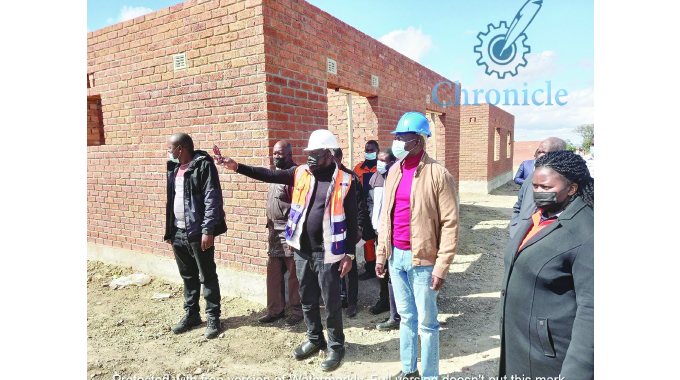
Mashudu Netsianda, Senior Reporter
GOVERNMENT has migrated from the traditional use of brick and mortar to modern technologies, which will enable the construction of 100 blocks of flats per month per site as the Second Republic steps up efforts to delivering 220 000 houses by 2025.
Government received US$63 million from Shelter Afrique to fund the construction of eco-friendly buildings, that will not only cut costs, but also ensure Zimbabwe moves with the times as the world goes green.
Green building materials also called eco-friendly materials that Government is adopting are construction materials that have a low impact on the environment, composed of renewable resources which have to be natural and will not be spoiled by heat, humidity or coldness.
Precast concrete slabs, reclaimed steel, hempcrete and ferrock are among some of the green materials for construction. In this regard, Zimbabwe’s development is in tandem with world trends where innovation has seen the construction of eco-friendly houses.
Housing delivery is one of the National Development Strategy 1 (NDS1) pillars. The key drive, therefore, is to address the inadequacies pertaining to infrastructure, and provide citizens with access to affordable and quality settlements.
The trajectory towards the attainment of Vision 2030 revolves around providing human settlements, which meet the aspirations of the Zimbabwean people, while addressing affordability and modernisation aspects.
The housing delivery pillar within the NDS1 is expected to deliver 220 000 housing units by 2025, through collective efforts from stakeholders and all parties involved in human settlements deliver
Speaking in Parliament on Thursday last week, National Housing and Social Amenities Minister Daniel Garwe said Government was on course to deliver 220 000 housing units by 2025 in line with the National Development Strategy 1 (NDS1).
“To deliver those, we have now migrated from the traditional use of brick and mortar to the use of new technologies, which allows us to deliver a minimum of 100 blocks of flats per month per site,” he said.
Minister Garwe said Government has already engaged some contractors ahead of the commencement of the programme next month.
“We have already employed some contractors. It has already gone through tenders and are now starting that programme in September and October,” he said.
“The first phase has five provinces and we will be delivering 500 blocks of flats every month going forward.”
The housing delivery target will also be met through combined efforts and interventions by private players.
Minister Garwe said Zimbabwe, which has a housing backlog of around 2 million, has made significant strides in providing houses.
According to statistics from the 2022 population census, about 60 percent of Zimbabweans own the houses they live in, with 83 percent of those dwellings being modern.
Minister Garwe said the Government will continue to facilitate and encourage private developers such as insurance and pension funds to develop more housing units.
“Housing delivery is a collective responsibility. People should not look at Treasury as the only source of financing for housing delivery,” he said.
The minister said the national housing delivery programme is also targeting to deliver over 470 000 housing units in the long term.
He said in terms of the Zimbabwe National Human Settlements Policy, no houses or super structures will be constructed before the provision of services.
Minister Garwe said his ministry is working with the Ministry of Local Government and Public Works in bringing to book local authorities that are awarding stands without the requisite offsite infrastructure being established.
Densification of settlements, spatial planning requirements and the development of off-site and on-site infrastructure before occupation of land, are among other essentials in the policy.
The Zimbabwe National Human Settlements Policy, officially launched by the President on September 2, 2021 replaces the National Housing Policy of 2012, and addresses several shortcomings inherent in the preceding policy outline.
The human settlements policy is aimed at informing the implementation of relevant facets of Agenda 2030’s Sustainable Development Goals, the African Union Agenda 2063, Vision 2030 and national and international resilience frameworks. It guides all human settlement developments in the country as enshrined in the national Constitution (Amendment No. 20 of 2013).
The demand for housing has risen over the years, in tandem with population growth, and in a bid to accelerate the provision of housing, the Government has adopted several strategies to ensure access to housing by the majority of citizens.
As part of mechanisms to address the housing backlog and enhance human settlements delivery, the regularisation/sanitisation of informal and dysfunctional settlements is now gathering momentum across the breadth and length of the country.
Efforts meant to bring sanity in those settlements are underway targeting Cowdray Park in Bulawayo, Caledonia in Goromonzi, Harare South, Hatcliffe North and Gimboki South in Mutare.
The Government has also adopted the urban regeneration and renewal project as part of its strategy to provide decent housing to citizens.
Urban regeneration is targeting Makokoba in Bulawayo, Mbare residential suburb in Harare and Sakubva in Mutare.
In terms of implementation, Sakubva Urban Regeneration is most advanced, and has since been accorded National Project Status, entailing duty free importation of capital equipment, materials and/or goods, among other attendant concessions.
In these areas, construction of social amenities infrastructure, such as recreational facilities, clinics, among others shall also be prioritised.
The Government has initiated Revitalisation Programmes for Rural Settlements, which are intended to bridge the gap between the rural and urban areas. The Ministry is developing proto-type housing designs for use in rural areas, and more designs are being developed to widen selection. — @mashnets



 Online Reporter