Zvamaida Murwira
Senior Reporter
MORE than 10 000 unemployed youths and graduates across Zimbabwe’s 10 provinces are set to benefit from a proposed industry-specific skills development programme backed by a Malaysian university, in an initiative aimed at strengthening entrepreneurship, innovation and practical skills under the Heritage-Based Education 5.0 model.
The programme, to be supported by Malaysia-based Binary University, in collaboration with local tertiary institutions, will target 1 000 beneficiaries in each province, equipping them with skills intended to improve their employability and capacity to establish businesses.
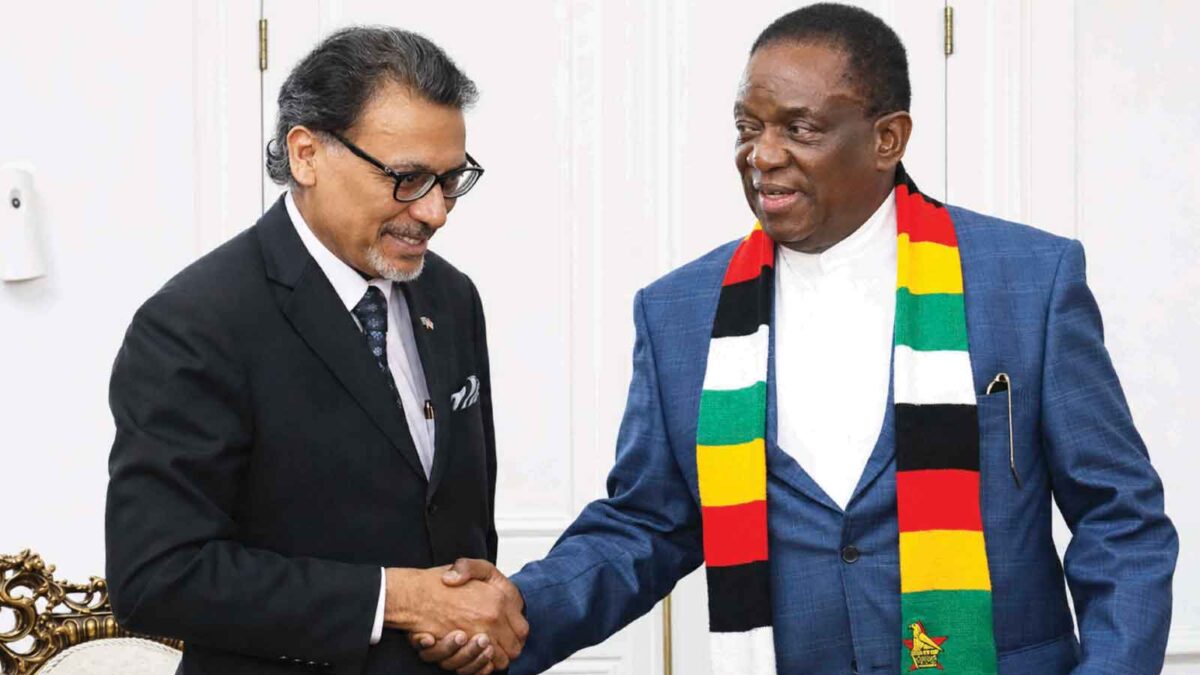
Binary University founder Professor Joseph Adaikalam announced the initiative after paying a courtesy call on President Mnangagwa at State House in Harare yesterday.
During the meeting, they discussed implementation of an agreement reached during their previous engagement in November 2022.
Prof Adaikalam said he had initially proposed training 3 000 unemployed young people and graduates, but President Mnangagwa had challenged the university to extend the programme to all the 10 provinces.
“One objective of my meeting with His Excellency, the President, is to continue from my previous engagement with him in November 2022. I was here and proposed the idea of upskilling unemployed youth and also unemployed graduates. So, I proposed that we start with about 3 000 students. But His Excellency responded by saying, I have 10 provinces and I want 1 000 per province,” he said.
Binary University, Prof Adaikalam said, had agreed to scale up the programme, which would be delivered online, making it possible to reach beneficiaries across the country.
Under the proposed funding arrangement, Binary University will provide scholarships covering 70 percent of the training costs, while the remaining 30 percent will be financed through arrangements still being worked out.
“So, I said yes, of course, we can do that because all these skill programmes are done online, so it can be easily scaled up. So, in principle, His Excellency, the President, has agreed to implement this programme. In this programme, Binary University will provide 70 percent scholarship to the students and 30 percent will be funded in a way to be ascertained,” he said.
The initiative is expected to complement the Government’s Heritage-Based Education 5.0 model, which emphasises education that promotes innovation, industrialisation, entrepreneurship and the development of solutions to national economic challenges.
Prof Adaikalam said discussions on implementation had also involved Skills Audit and Development Minister Dr Jenfan Muswere, who had expressed support for the initiative.
The proposed training programme forms part of broader efforts to strengthen educational and economic cooperation between Zimbabwe and Malaysia, with discussions also focusing on expanding trade, investment and technology partnerships.
Prof Adaikalam said he had also proposed President Mnangagwa as the founding patron of the Africa-Asia Institute, a South-South cooperation platform headquartered in Addis Ababa that seeks to promote partnerships between African and Asian countries.
President Mnangagwa, he added, had accepted the nomination in principle, subject to completion of the necessary protocols.
The institute seeks to promote cultural exchanges, joint academic programmes, interdisciplinary research and trade cooperation between the two regions.
Prof Adaikalam said the platform could help Zimbabwe access wider Asian markets, with Malaysia serving as a potential gateway for local products and businesses.
“With the Africa-Asia Institute, we can open new doors for a bigger market, because the Asian market is about 650 million people. So, it is a huge market for Zimbabweans to tap into,” he said.
He said cooperation would also focus on digital technology, digital entrepreneurship and education, while creating opportunities for increased trade and investment between Zimbabwe and Malaysia.
Foreign Affairs and International Trade Minister Professor Amon Murwira and the ministry’s Permanent Secretary, Ambassador Albert Chimbindi, attended the meeting.