Online Reporter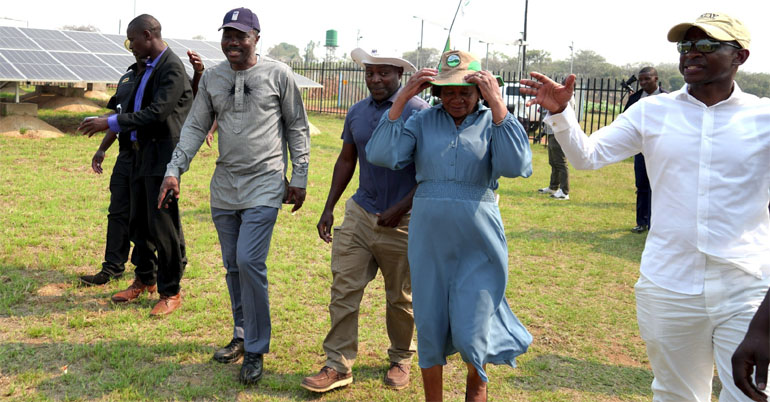
Tendai Gukutikwa
Post Reporter
THE Government has hailed the British Government for supporting a £14,1 million Climate Adaptation Water and Energy Project (CAWEP), whose interventions have expanded access to clean energy in Hakwata, Chipinge, while strengthening the country’s capacity to respond to climate change through improved weather monitoring systems.
The four-year project, funded by the British Embassy’s Foreign, Commonwealth and Development Office, and implemented by the United Nations Development Programme (UNDP) in partnership with the Ministry of Environment, Climate and Wildlife, has delivered climate resilience interventions across several districts.
Speaking during the CAWEP Learning Event held in Vumba last Friday after touring project sites in Hakwata, Environment, Climate and Wildlife Minister, Dr Evelyn Ndlovu, described the initiative as a powerful example of how investments in climate adaptation can improve livelihoods and build resilient communities.
She commended the British Government, UNDP and other partners for supporting Zimbabwe’s climate adaptation agenda, saying the project’s achievements should help shape future national development programmes.
“The impact of CAWEP is evident in the lives of the communities it has served, particularly through improved access to climate-resilient water and energy solutions, strengthened livelihoods and enhanced resilience to climate-related challenges,” she said, having been particularly impressed by the impact in Hakwata, and emphasised the need to build on interventions to benefit more communities.
The Hakwata project, which includes a 200-kilowatt solar mini-grid, has expanded access to clean and productive energy, while creating opportunities for local enterprise development.
The mini-grid is benefiting approximately 12 500 people, providing an intervention aimed at strengthening energy access and supporting economic opportunities in the Chipinge community.
Minister Ndlovu said climate change should no longer be viewed as an environmental issue alone, as its effects are increasingly felt in agriculture, water resources, public health, infrastructure and livelihoods.
She said the Government’s response needs to translate climate commitments into practical interventions that reduces vulnerability and strengthens resilience.
“Climate change is, not simply an environmental challenge, but a major development challenge of our time. It has implications for food and water security, energy access, poverty reduction, economic growth, employment and the achievement of our sustainable socio-economic development,” she said, adding that climate resilience is integral to Zimbabwe’s aspiration of attaining an upper middle-income status by 2030, as outlined in the national development agenda.
Minister Ndlovu said investments in climate adaptation, including renewable energy and climate information systems, are necessary to support sustainable development and protect communities from climate-related shocks.
“Our climate response must therefore move beyond policy statements and international commitments to investments, institutions, technologies, knowledge and community-level interventions that build resilience and improve livelihoods,” she said.
Minister Ndlovu said CAWEP should be regarded as a source of knowledge and experience to guide future Government programmes, rather than simply as a completed project.
She urged stakeholders to examine interventions that had worked, identify areas for improvement, and determine how successful approaches could be replicated and expanded.
“As we reflect on the programme, we should consider what has worked, what lessons have been learnt, what can be replicated and upscaled, and how these lessons can inform future climate adaptation and mitigation investments,” she said.
Minister Ndlovu said climate adaptation is a responsibility shared across Government and society, with national development planning needing to account for risks posed by climate change.
“Climate adaptation, therefore, is not a stand-alone activity of the environment. It is a whole-of-government and whole-of-society development priority,” she said, adding that knowledge and experience gained through CAWEP should strengthen future climate adaptation investments and help the Government build resilience among vulnerable communities across the country.
The project also installed 18 automatic weather stations across four provinces, strengthening early warning systems and supporting availability of climate information for decision-making.
UNDP Resident Representative, Dr Ayodele Odusola, said the weather stations, alongside support for Agritex officers and the integration of indigenous knowledge systems with scientific forecasting, has strengthened climate information services.
He said the interventions are helping expand access to climate information and early warning services, which are important for communities and sectors vulnerable to droughts, floods and other climate-related shocks.
“The project has directly and indirectly supported approximately 2,86 million people through investments in water security, renewable energy, livelihoods, climate information services and institutional strengthening. CAWEP has also demonstrated that climate adaptation works best when different sectors are addressed together, rather than through isolated interventions. Climate adaptation works best when water, energy, livelihoods, finance and institutions are addressed together,” said Dr Odusola.
He said lessons from CAWEP should support scaling up of integrated resilience models that combine renewable energy, water security, climate-smart agriculture, enterprise development and access to finance.
He said long-term resilience requires partnerships between the Government, local authorities, development partners, financial institutions, private sector actors and local communities.