admin
admin
#1980: Motherly counsel to errant youths
Fortious Nhambura Senior Features Writer
Zimbabwe has many unsung heroes of the nationalist movement. These are people who have chosen to remain behind the scenes where they continue fighting for a worthy cause, that of keeping Zimbabwe free from colonial bondage.
Many times people are surprised when these names pop up in the liberation history.
When Mbuya Adah Murape’s home was included on the list of houses that were to be upgraded to national heritage sites, many people wondered who is Mbuya Murape and what role did she play in the nationalist movement?
I recently caught up with Mbuya Murape who will celebrate 87 years of life on April 28 this year, at her Highfield home.
She still recalls the days of the nationalist movement with ease and speaks like she is reading it from a book.
From the meetings, the organisation, road barricades and protests, she still recalls all as if it happened yesterday.
Mbuya Murape rubbed shoulders with late veteran nationalists like George Nyandoro, Daniel Madzimbamuto, James Chikerema, Maurice Nyagumbo, Robert Marere, Dr Joshua Nkomo and Mukarati, among others.
Entering politics in 1959 right in the very formative years of organised political movement under the Southern Rhodesian African National Congress, she has never looked back.
“By then I was the treasurer of the women’s league, while Regina Mupondamwara was our chairwoman for Highfield Branch. Evelyn Mushonga was secretary.
“That was also the time that marked the beginning of a closer alliance between organised African labour and African political parties,” she said.
The ANC was to be banned in February 1959 by the white settler regime giving way to the formation of the National Democratic Party in 1960.
“At our congress as National Democratic Party (NDP), I first met President Mugabe who was the publicity secretary back then.
“By then I was now chairwoman of Highfield. We had a chairwoman each for the four African townships namely Highfield, Mbare, Mabvuku and Mufakose. These were the only African townships that were there back then.
“Thanks to Zimbabwe, Harare has grown this big and now we can settle anywhere in the country.
“Back then passing messages between nationalist leadership was through messengers. The organising secretary had to visit the different townships to call for a meeting. It was a very effective way of communicating our news. It would only take a few hours to bring the people together for a meeting,” she reminisced.
The NDP was founded with the goal of achieving African rule gradually. Members of the party demonstrated, rioted and committed acts of arson in the hope of attracting the attention of Britain and forcing the British government to intervene and coerce the white supremacist government to cede power in Rhodesia.
The party was to be banned the following year by Rhodesian Prime Minister Edgar Whithead leading to the formation of the Zimbabwe African People’s Union. The banning of the NDP also heralded the end of the period of protests in Rhodesia. It led to the formation of a more vibrant political party, the Zimbabwe African People’s Union in 1962 and the commencement of the confrontational politics (1964 to 1971) by African nationalists.
Mbuya Murape was to be part of Zapu and continued the fight under the new political party led by the late Father Zimbabwe.
“We used to move from town to town teaching the people about the party and our slogan was “Mwana wevhu”. We went to Mutare, Gweru and Bulawayo but when we were heading for Bulawayo, we heard that the deputy president of the party Dr Tichafa Parirenyatwa had died. Only President Mugabe had to continue to Masvingo to announce the death of Dr Parirenyatwa.
“Dr Parirenyatwa was to be buried at his father’s farm in Murehwa. As we returned from the burial of Parirenyatwa we were greeted with the sad news that the party had been banned. That is when we formed the People’s Caretaker Council to circumvent its ban and assure people that the struggle against colonial rule was indeed progressing,” she said.
During that era the women and youths played a critical role in destabilising the country.
“I would wake up around 3am to go to pull out tobacco plants at a farm situated where Glen Norah C suburb is today. We used to lay boulders on the road to so that police Jeeps would not enter the suburbs.
“African consciousness was now high. We used to sing ‘pasi pamera madhuna mutuna’.
“Indeed the land was upside down that time. People were conscious of the need to fight for liberation,” she added.
In 1963 President Mugabe, the late Enos Nkala and others broke away from the party to form ZANU.
That did not deter her as she continued the struggle for independence under ZAPU.
“I was not deterred because I knew what we were all fighting for was black majority rule. We used to recruit youths for the liberation struggle. We knew that those who went to Zambia had joined ZAPU while those who went to Mozambique were joining ZANU.
“We fought the struggle as two parties until 1980 and got our independence. I was not devastated by the loss of ZAPU in the elections because our goal for the liberation was black rule. So when President Mugabe and Dr Nkomo signed the Unity Acord in 1987, I was greatly overjoyed because at last they had achieved the wish of the people of Zimbabwe, unity.
“Even when Dr Nkomo died we were not shaken because we knew he had left us with a capable leader, President Mugabe. We are firmly behind him because he is an able leader, a leader who has managed to unite us as a people of Zimbabwe,” she said.
Mbuya Murape worked with the late First Lady Sally Mugabe and at one time they were arrested together in 1961 and sentenced to three months or £3 fine after protesting the arrest of ZAPU leadership.
They were sent to Harare Central Prison. Back then she was chairwoman of Highfield branch and the late Cde Sally Mugabe was women’s secretary.
“We refused to pay the fine because we felt that some of our women arrested could not afford that money. We were only released after our husbands had paid the £3 fine. The late Sally actually used to strap my three month old son, Amos, on her back while we were in prison.”
In 1964 she and other women were arrested after protesting the arrest of nationalist leaders and their banishment to Gonakudzingwa Restriction Camp.
“At that time we did not know where they had been taken to. All women in the four African townships protested and many including me were arrested, charged and sentenced to six months in prison each,” an emotional Mbuya Murape said.
They were first sent to Harare Central Prison before being taken to Marondera Prison.
A few days after her release from prison her husband, a nationalist in his own right, was also arrested following an emergency round up in Highfield.
He was sent to detention at Hwawha.
Mbuya Murape was to stay at home for only three weeks before she was again arrested and sent to Gonakudzingwa detention camp and later Hwahwa Prison.
“Despite these hardships, we maintained the zeal to fight for the country. We are happy now that we won our independence and are now free. We indeed beat the Boers, stepped on them, stoned them and defeated them for good.
“I did not feel the toll of the struggle because I was in it full time, my husband and family were also in the deep end. For me it was a national sacrifice that had to be made,” she added.
Until recently she has remained an active member of ZANU-PF, the union of the parties that prosecuted and led the country’s liberation struggle.
Her message to the younger generation is clear: move away from abusing this hard won freedom.
“I say to youths stop wearing three pants, dropping trousers and from smoking dagga. It is imperative that these young people know that the freedom that they are enjoying to drink bronco and smoke dagga is because of the sacrifices of other people.
“They must learn how the country was liberated. This country has people who suffered for it and even died for it. It has boys and girls who wanted to have degrees but sacrificed that for the love of the country and that must be respected,” she said.
She said the youths should understand that the country was liberated by their grandparents and parents and must be protected jealously.
She said children must be taught the history of the liberation of Zimbabwe from the earliest grade to university.
Feedback to [email protected]w
#1980: Gender: Independence brings equality
Zimbabwe’s independence not only brought equality among races of this country, among a myriad freedoms, rights and opportunities. It also especially brought equality among men and women, a departure from the racist, patriarchal settler regimes.
The post-Independence Government has accorded equality between girls and boys; men and women and moved from the reprehensible dispensation of the previous era where women were treated as minors and did not enjoy equal rights with men.
A milestone was scored in 2013 with the cementing of women’s rights in the new Constitution.
The new Constitution’s provisions on gender equality align with several of the key international and regional gender equality and women’s rights instruments that Zimbabwe has signed and ratified.
These include the Protocol to the African Charter on Human and Peoples’ Rights on the Rights of Women in Africa — and the Southern African Development Community Gender and Development Protocol — among others.
The Constitution opens with provisions stating that respect for gender equality is one of the country’s Founding Values.
The Declaration of Rights includes a section on women’s rights, has been expanded to include socioeconomic and cultural rights, and it could be used in legal or judicial proceedings. This means new opportunities for women in jobs, education, finance and credit must be ensured by the Government and in national funding.
The new Constitution also includes a special measure to increase women’s representation in Parliament, introducing for this purpose in the National Assembly, 60 reserved seats for women who are elected through a system of Proportional Representation based on the votes cast for political party candidates in a general election for the 210 members. The 60 reserved seats for women are in addition to any women elected to the other 210 seats.
The provisions also apply to the Senate, to the 60 directly elected members among a total of 80 (the other 20 are reserved for Chiefs and people with disabilities).
The new Constitutional measure state that the 60 elected Senators will be chosen from a party-list system of Proportional Representation, in which male and female candidates are listed alternately, with every list headed by a female candidate.
The new Constitution also provides for a Gender Commission tasked with promoting gender equality in all spheres of life. Its mandate includes: the investigation of possible gender rights violations, receiving and considering gender-based complaints from the public, conducting research on gender and social justice issues, recommending changes to discriminatory laws and practices, and proposing affirmative action programmes.
As all existing laws are set to be reviewed to ensure they comply, the new Constitution is expected to have a domino effect. Additional laws will also be drafted where gaps currently exist. All this has come with Independence where previously women were treated like children. — Additional info from UN Women
#1980: The metallic wings that didn’t deter us
Sydney Kawadza Senior Feature Writer
In the Midlands provincial capital of Gweru is an important area rich in Zimbabwe’s history. It is in the “City of Progress” that the National Museums and Monuments of Zimbabwe set up the country’s Military Museum where history lies untapped for the benefit of the nation’s younger generations.
Gweru residents dismiss its importance to Zimbabwe’s history before and after independence.
The museum is a source of knowledge as its history has an important part in projecting the challenges endured during the liberation struggle, the challenges Zimbabwe faced as a young nation and how it conquered to become the great country it is today.
Zimbabwe celebrates 35 years of Independence on Saturday this week.
In 1980, as the then Prime Minister, now the President of the Republic of Zimbabwe, Cde Robert Gabriel Mugabe called on Zimbabweans to unite, to put the past behind and develop the country.
He said: “I urge you, whether you are black or white to join me in a new pledge to forget our grim past, forgive others and forget, join hands in a new amity, and together as Zimbabweans, trample upon racialism, tribalism and regionalism, and work hard to reconstruct and rehabilitate our society as we reinvigorate our economic machinery.
“The need for peace demands that our forces be integrated as soon as possible so we can emerge with a single national army.”
However, within two years of those inspirational words, the remnant forces fighting against the new dispensation decided to cripple that same army President Mugabe sought to unite.
On July 25, 1982, the former Rhodesian soldiers turned their backs on the hand of unity to attack Thornhill Airbase.
National Museums and Monuments of Zimbabwe militaria curator Mr Amos Zevure narrates how a group of disgruntled army officers could not stomach being commandeered by blacks and plotted to destroy the fleet at the airbase.
“Bombs were planted between the five aircraft by some demoted white officers from South Africa but were serving in the Rhodesian army. Fortunately, only one bomb exploded, damaging one Hawker Hunter FGA9,” he said.
“There was a problem because the whites did not believe that blacks could operate the aircraft and the fact that their beliefs were unfounded really made them angry, leading to such an attack.”
The plane is parked at the Military Museum in Gweru but not much is known of its rich history.
Air Commodore (Retired) Peter Samuel Nkulu, who assumed command of the base that fateful night, believes the history that is parked with the retired aircraft at the museum should always be told.
“That incident hit me hard because I did not expect anything like that to happen but we were having our challenges during that period where the three former forces were being integrated into a single unity,” he said.
“However, on that night I was visiting my aunt in Chikwaka when two vehicles picked me. I remember the driver as Sergeant Silver Hakuna who told me that an aircraft had been burnt at Thornhill Airbase and I was to assume command immediately.”
The base commander Air Vice-Marshall Hugh Slatter had been taken to the police for questioning and Air Commodore (Rtd) Nkulu, then a squadron leader, assumed command of Thornhill Airbase.
The police suspected a deliberate security laxity involving the command at the airbase.
“Our relationship with our white colleagues was somewhat frosty and always at arm’s length. The sheer challenge was to understand the integration which had white instructors training black officers.
“There was a lot of mistrust and the relationship was like a double edged knife. It was through sheer determination and forward looking that pushed us to soldier on. We had to understand that after coming from the liberation war, we were now in a different war of rebuilding our nation,” he said.
Air Commodore (Rtd) Nkulu, however, believes that incidents like the 1982 attacks should teach Zimbabweans to guard jealously their heritage.
“People have to look back and reflect on such events. It would teach them the necessary lessons and build on the necessary achievements that would see us remain a strong nation.
“We must not drop our guard because as the world changes, the enemy targeting to destroy our inheritance and sovereignty has also developed new tactics.”
He said Zimbabwe was a more treasured natural asset than the Chiadzwa diamonds.
The sabotaged plane had been operated during the liberation struggle by the Rhodesian army.
It was also used in Operation Hurricane where enemy forces targeted Zanla combatants operating in the north eastern parts of Zimbabwe especially in Marondera, Murehwa, Uzumba-Maramba-Pfungwe and Mudzi areas.
The plane did not see much action after independence before the sabotage attack.
The South Africa Truth Commission also captures the sabotage, adding that “Zimbabwean agents and SADF Special Forces operatives were involved in the attack on the Thornhill Airforce Base near Gweru on July 25, 1982, in which thirteen fighter trainers of the Zimbabwe Air Force were destroyed.”
Four senior air force officers, including Air Vice-Marshall Slatter, were arrested for this operation.
The officers confessed but were acquitted by trial judge who deemed their confessions inadmissible.
It was, however, concluded that the operation was undertaken by a South African Special Forces group led by a long-serving member of the Recces operating as an agent in Zimbabwe.
The commission has the names of four SADF Special Forces operatives who participated in that attack.
There are 12 aircraft of various ages and history at the museum.
Another Hawker Hunter, which was retired in 2000 after flying for 3 353:45 hours, is also at the museum.
The jet, used as a fighter aircraft, bomber and reconnaissance, was introduced in the then Royal Rhodesian Air force on May 15, 1963 based at Thornhill Air Force Base Number 1 Squadron.
Mr Zevure said the aircraft has both bad and good memories for the Zimbabwean people.
“The aircraft participated in many internal s and external operations including Operation Dingo, the codename for the Chimoio massacre of Zanla cadres in Mozambique,” he said.
The aircraft also took part in Operation Uric, codename for the Mapai attack to cut off Zanla forces supply route in Gaza province of Mozambique by the Rhodesian Forces.
Nevertheless, after independence, the aircraft was used by the Air Force of Zimbabwe during the Mozambique campaign from 1988 to 1992.
Some notable pilots who operated the aircraft include Air Vice Marshal Elison Moyo, Air Vice Marshal Shebba Brighton Shumbayaonda, Air Commodore Jasper Marangwanda, Air Commodore Biltim Chingono and Air Commodore Innocent Chnganze.
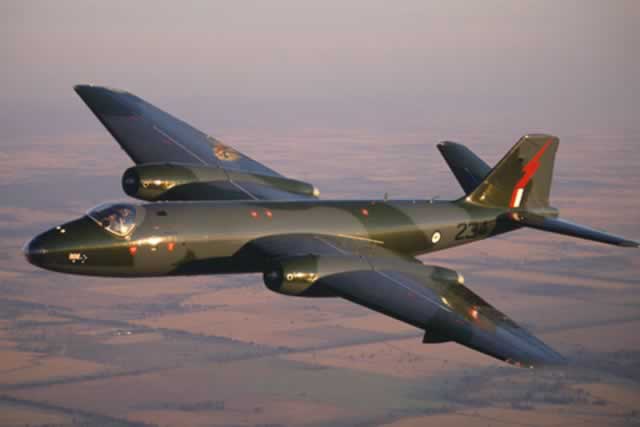
Also found at the museum is the Canberra R2504 jet bomber which had a capacity of carrying 6 000 bombs.
The large aircraft had a crew of only two.
“It was a big aircraft but very quiet. It was also fast enough to evade interception hence could take enemies by surprise. The Rhodesian army used the plane in cross-border incursions into Mozambique and Zambia attacking freedom fighters at their camps,” Mr Zevure said.
“Its capabilities for aerial surveillances saw it being used to monitor movement of freedom fighters along the borders.”
One of the plane’s notable operations involved attacks on freedom fighters in 1973.
“This was a year after the freedom fighters launched a sustained guerrilla warfare with an attack on Alternor Farm in Mazowe,” he said.
The Canberra at the museum was also used by the Rhodesian government’s joint operation command (JOC) that planned the attacks on Chimoio, Nyadzonya and Tembwe camps in Mozambique.
“The aircraft does not make a lot of noise and since it is fitted with cameras, the JOC used it to survey the landscape in the three camps to strategise on their attacks that left thousands of guerrillas and ordinary refugees dead,” Zevure said.
He however, commended the commanders who took over operations and making the Air Force of Zimbabwe the remarkable outfit that it is today.
“The whites did not believe that blacks could competently operate the fleet but we have seen our forces perform wonders in Mozambique, Democratic Republic of Congo and Angola,” he said.
As the metallic birds of death lie quiet in their hangers, it is worth remembering the history that is associated with the great nation called Zimbabwe.
Feedback: [email protected]
#1980: Zim empowered to grow economy
Business Reporters
Business leaders who have been in the corporate world since 1980 have said Independence brought about an era of economic evolution, expansion and empowerment of the underprivileged majority. Soon after Independence each year had a theme; a year of development and progress and there was the five-year development plans.
Former Delta Corporation chief executive Mr Joe Mtizwa said there was excitement in the early 80s.
“In the early 80s the dramatic thing was that there was a great spirit of wanting to build a new nation, of pulling in one direction. There were no discordant voices then. There was incredible consensus, great excitement and great energy to work together. The world’s focus was on us.”
Interestingly also making the headlines in 1981 were the US views on Zimbabwe: “Zimbabwe could become the US’ Central Africa regional trade base depending on the long-term investment conditions that exist in the country. Lack of information on the political and economic situation could hamstring large-scale US investment and trade” (The Herald June 1981).
#Growth-with-equity
Fresh from independence in 1981, the Government followed the Growth with Equity plan whose main aim was to achieve a sustainable high rate of economic growth and speedy development in order to raise incomes and standards of living of the people.
Even then a Commission of Inquiry into the Incomes, Prices and Conditions of Service was set up headed by Roger C Riddell. The Commission promising a sound deal for workers came with a “Poor People’s Charter” which proposed sweeping changes designed to provide a minimum salary close to the Poverty Datum Line.
The Riddell Commission also suggested radical changes in urban transport with a flat fee for commuters travelling to work and back and a higher rate for people travelling for pleasure.
After that came the Transitional Development Plan in 1982 and the Five-Year National Development Plan in 1986, the second year of the Five-Year National Development Plan was abandoned in favour of the Economic Structural Adjustment Programme (ESAP) in 1991.
#Structural-adjustments-in-the-90s
Industrial Development Corporation of Zimbabwe chief executive Mr Mike Ndudzo who was the country’s first black Accountant-General said the first 10 years of independence were driven by a developmental and reconstruction agenda under ZIMCorD, centralised economic planning and control, which saw a rapid acceleration of infrastructure development funded by multilateral and bilateral sources and equally exponential increase in the secondary and tertiary school and education enrolment.
“This was, however, under an inward looking and controlled import substitution economic regime, which soon reached its growth threshold based on the domestic market, antiquated technology and inability to absorb the multitudes graduating from the mainly academic education system.”
Allied Timbers Chairman Mr Emmanuel Fundira who in 1983 was the deputy group internal auditor for the United Transport Group, said the first 10 years after Independence were encouraging.
“During the first 10 years, business was very buoyant and growth prospects were exponential,” said Mr Fundira.
“There was a lot of excitement in rebuilding the economy while the country received a low on inward investments.”
Bulawayo South Member of Parliament Mr Eddie Cross who was general manager of the then Dairy Marketing Board and later Cold Storage Commission in the early 80s said the 15 years just after Independence signalled an expansionary trajectory for the country.
“There was some stability in the economy then. However, the following 15 years after ESAP saw the country subjected to inflation and the economy started going towards a decline,” said Mr Cross.
OK Zimbabwe chief executive Mr Willard Zireva who was working at Manica Freight in 1981 said the situation in the retail space had more cause for concern than there was to celebrate in that most rural supermarkets had made way for large retailers.
He said whereas Zimbabwe used to have many indigenous owned supermarkets at Independence; most such operators had since disappeared. The retailers used to thrive in the rural areas where growth points also grew fast.
“We used to have greater participation by indigenous people, but most have gone down because of what happened in the economy since 2007. The meltdown destroyed most rural businesses, little is happening there now.
“They have all gone down, we have lost that whole community, the space is now dominated by big businesses, small ones have been forced out. Previously, big businesses never controlled 50 percent of the space.
“The small businesses have been destroyed because of what happened in the economy, not because they were taken over by big guys. We now have more foreign supermarkets than at independence in 1980.”
ESAP was implemented to boost growth and create jobs. Then the issue was the removal of subsidies and the decontrol of prices to free up the market. International capital funded the programme. However what would bring about sustainable economic growth even at that time was restraint on expenditure and bringing the budget deficit down by directing spending to capital rather than recurrent expenditure. Again those are still the same problems government is facing now.
The then chairman of TA Holdings the late Ariston Chambati said government had embarked on ESAP when the economy was still in reasonable and manageable shape while IDC’s Mr Ndudzo said the second ten years were mainly liberalization of trade under ESAP.
“Unfortunately without a development and effective export promotion and value addition agenda, which saw those with the means importing luxuries and trinkets and the foreign debt stock soaring without much to show for it, while industry started to show strain from imported competition from better equipped foreign firms, thus closing and formal employment starting to decline,” said Mr Ndudzo.
#Vision-2020
After that there was Zimprest in 1996, Vision 2020 in 1999 after the devaluation of the Zimbabwe dollar in November 1997 and the Millennium Economic Recovery Programme (MERP) in 2000.
After the turn of the millennium various economic plans were followed but the harsh decade which was also characterised by the effects of the illegal sanctions placed on the country by the west had already started which was to lead to the hyperinflation era in 2007-2008.
Mr Ndudzo said since 1997, the Government responded to the failures of ESAP with empowerment of the broad based majority through access to land under the land reform programme .“ But unfortunately, the West reacted to this by imposing sanctions which restricted access to multilateral and bilateral aid and development finance inflows and strangled the nascent new farmers who were poorly equipped, trained and funded to raise their productivity and yields to competitive levels and some ended heavily indebted and bankrupted.”
Mr Ndudzo said the fiscal pressures and loss of skills to the Diaspora all combined to put the economy under severe pressure, hence the spiraling prices on the few goods available and low productivity that ensured , made worse by price controls and other measures taken in good faith but that were not the most appropriate, like expanding money supply without the underlying productivity.
“Hence hyperinflation and burning and speculation that ensured. With multicurrency or dollarization as the only option to curb this, local industry lost all retained earnings and found itself borrowing in a strong currency, at a time of cheap imports and porous borders and even outright dumping, with an uncompetitive cost structure , of utilities and inflexible labour laws, which made variable costs fixed, and a very negative country and risk perception from domestic and foreign investors, shortermism.
The IDC boss who has been at the company since 1991 said as a result there was a decline in capacity utilization below break even in some cases with high unit costs or, low economies of scale and high nonperforming loans, with surviving Executives spending disproportionate time , cost and effort engaging and negotiating with irate creditors, bankers and workers owed arrear salaries, and thus further cases of judicial management and liquidations and a high level of anxiety and stress across the social spectrum.
The hyperinflation era led to dollarisation from 2009 to date. “The dollarisation of the economy has however made things difficult for many companies and that can be substantiated by the number of companies that have closed or retrenching,” said Mr Cross.
#The-new-economy-emerging
While a lot of workers had seemingly been thrust into joblessness as a result of shrinking formal sector, there has been a substantial redistribution of wealth from big business to small business, thereby empowering previously un-empowered workers.
Traditional big entities have been replaced by SME’s, informal traders and small scale commercial farming in agriculture, mining, retail, manufacturing and construction.
Economists believe that the emergence of a robust SMEs and informal sector was a step forward in Zimbabwe’s quest for sovereignty, self determination and buffer to shield it from the sometimes devastating impact of global economic dynamics.
Huge foreign conglomerates usually take different positions and strategies at the slightest seismic shift in the global economic trends and order and highly sensitive to geopolitical tensions even the ones that have nothing to do with a particular nation.
Mr Zireva pointed out that the retail space in urban areas had also been changed and was now dominated by big foreign entities such as Pick ‘n Pay and Choppies with only OK Zimbabwe a truly indigenous large operator.
Mr Zireva said a few indigenous owned retailers survive today in the retail sector in urban and rural areas than the period soon after independence after they were taken out of business by sanctions induced difficulties.
Economist Dr Stanley Mahlahla who was head of Economic Planning in the Ministry of Finance in the early eighties said the “transition” was common with developing countries.
“Just look at the shift from few commercial tobacco farmers to thousands small scale farmers,” said Dr Mahlahla. “Countries such as India and Brazil have gone through similar process. However, this does not mean the economy will be driven by small scale companies forever. But big companies will also re-emerge. Take Brazil for instance, it is now building planes but it’s informal and SME sectors remains critical.
“What the Government needs to do is to probably conduct study on how countries such as India and those in South America are getting revenue from the informal sector.”
He also noted that Zimbabwean economy was modeled in a similar way as European economies and was now adjusting to follow the trends in developing economies.
#Change-in-attitude
Mr Mtizwa however noted that the country was no longer pulling in the same direction.
“One doesn’t find the same consensus now as was at Independence. There’s a great deal of pulling in different directions. We have lost the energy that was pulsating through the national veins of the country. We have lost that dynamism, sense of energy and urgency.
“I don’t see it anymore. The rallying call then was focus on solving a common problem- that of educating the majority- and this made all the difference.
“The investment in human capital, in primary and secondary education, tertiary and universities and this made it easy for everyone to join the bandwagon. The results speak for themselves.
“That spirit of working together arose to address that problem. The challenge is how to get the products of the investment in education working.
“That’s the tremendous rallying call that we should work on. No one can politicize about that. It’s a national issue,” he emphasised.
Mr Cross is however optimistic: “Despite all the hardships that the economy has faced, there is still hope that in the next twelve months there is expected revival in different sectors of the economy.
“If good policies are implemented there is no doubt that Zimbabwe is a sleeping economic giant and in the next five years Zimbabwe will be among the best economies in Africa,” said Mr Cross.


 Online Reporter