

 Chronicle Editor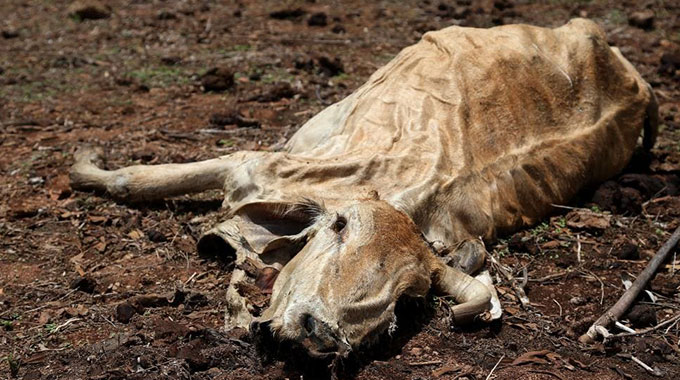
Precious Manomano, Harare Bureau
THERE were 2 392 El Nino-induced cattle poverty deaths last week alone in the western and southern provinces, but pastures and cattle condition are expected to improve following the ongoing rains.
This pushed the deaths of cattle reported this season to 7 643.
Government has since embarked on nationwide borehole drilling to save the lives of both livestock and people.
Through the Livestock Recovery and Growth Plan, Government is putting in place measures to address production and productivity issues, thereby laying the foundation for the sector to take a leading role in transforming the livelihoods of millions of farmers and creating a source of the much-needed raw materials for local industries.
Hay bales are being distributed and Zinwa rigs assigned in areas where livestock is most vulnerable.
Matabeleland South reported 640 cattle deaths, Matabeleland North 1 006 deaths, Masvingo 11 and Midlands, which had not reported any deaths before, had 735 deaths.
The Agriculture and Rural Development Advisory Service (ARDAS) said cumulative cattle poverty deaths reported this season stand at 7 643, with Matabeleland South the most affected having lost 4 432 animals, followed by Matabeleland North 2 573, Midlands Province 735 and Masvingo 103.
“A total of 1 488 523 cattle were identified as high-risk animals prone to drought conditions and poverty deaths in the four mostly affected provinces out of a total of 2 882 710 animals,” said the department.
“Farmers from Tsholotsho District, Matabeleland North, have started collecting hay bales donated by Mary Ellen farms. With rainfall activity being reported in the affected provinces, the situation is now expected to improve.”
In a recent interview, Matabeleland South acting director Agriculture and Rural Development Services, Mr Mkhunjulelwa Ndlovu, said areas affected by poor rains were Mangwe and Matobo.
Government had already intervened through bringing Zinwa drill rigs and haybales into the areas.
Farmers were also provided biomass seed to ensure that livestock get nutritious feed.
Lands, Agriculture, Fisheries, Water and Rural Development Permanent Secretary Professor Obert Jiri recently said the ministry was promoting the production of small stock as part of adaptation to climate change effects and vulnerabilities.
“‘We are promoting the production of goats and sheep so that at least we stand a chance and mitigate the vagaries of climate change,” he said. “The small stock is climate smart. Under this we have the Presidential Goat Scheme and poultry programme.
“We are targeting six million head this year and by 2025 our target is eight million. We have particular programmes of trying to climate-proof our livestock through the adoption and promotion of small stock.”
Zimbabwe Commercial Farmers Union (ZCFU) president Dr Shadreck Makombe said farmers should consider the long-term sustainability of the pasture and not exceed its carrying capacity.


 Online Reporter