Emmanuel Kafe
Check Point Desk
AT 3.20am, when Harare is still wrapped in darkness and most of the city is fast asleep, Judith Kaseke is already preparing for another day at work.
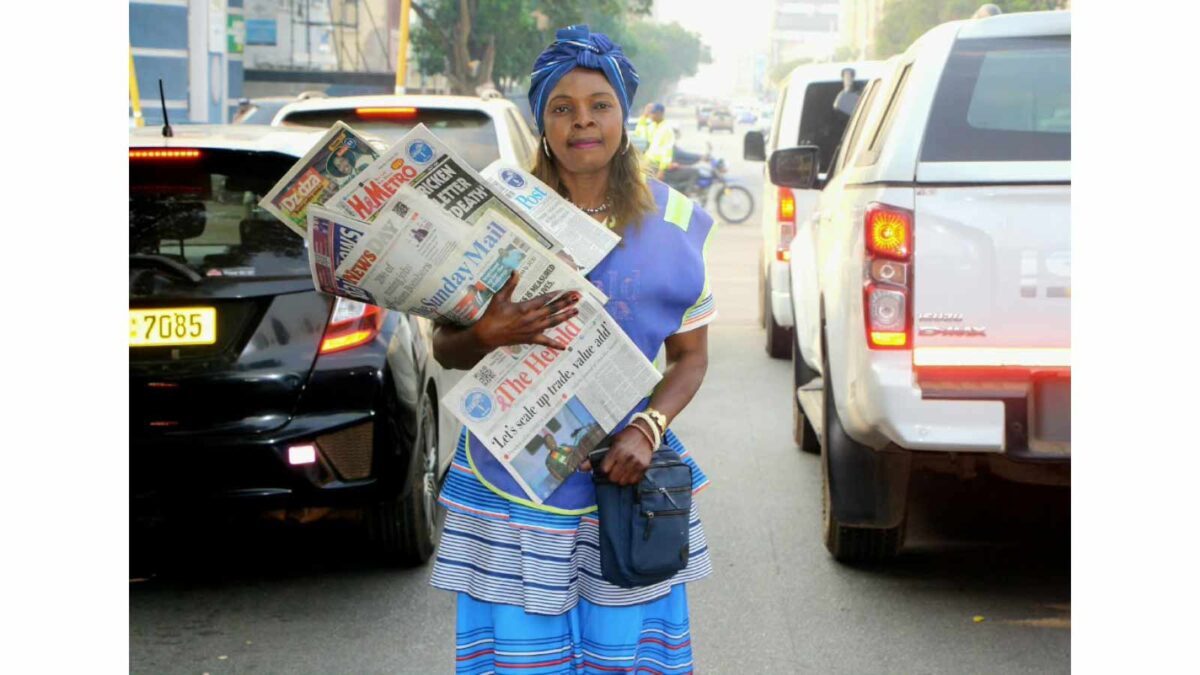
By 3.50am, she is at the intersection of Sam Nujoma Street and Chitepo Avenue, ready to sell newspapers to early risers beginning their journey through the capital.
And she has been doing this for 26 years.
Rain or sunshine, summer heat or winter cold, Judy, as she is affectionately known by her peers, has remained at her post, newspapers in hand and eyes trained on the traffic. For more than two decades, the intersection has been her workplace, her meeting point with the world and, in many ways, her second home.
At 55, she has watched generations of motorists come and go, witnessed Harare change around her and seen the newspaper trade she has devoted much of her life gradually lose its place in the daily routines of readers.
Yet, every morning, she returns.
For Judy, selling newspapers has never been simply about making a living.
It has been about raising her children, preserving her independence and providing for those who depend on her.
“I have been doing this for 26 years. I wake up early every morning because I know that if I do not go to work, I will not make anything,” she says.
There are no weekends in her working calendar.
Monday through Sunday, her day begins before dawn, long before many of the people who buy newspapers from her have even opened their eyes.
Her story is not only one of perseverance, but also of the sacrifices and uncertainties that come with earning a living on the streets of a changing city.
A front-row seat to Harare life
Over the years, Judy has witnessed scenes that would leave even the most seasoned city dweller shaken.
She has seen horrific road accidents, motorists speeding through red traffic lights, armed robberies and thieves operating in the busy streets.
She has also watched the struggles of city life unfold around her, including the activities of commercial sex workers in the Avenues area.
Her position gives her a front-row seat to the city’s daily drama, but it also places her in danger.
Twice, she says, she narrowly escaped being struck by vehicles involved in accidents at the intersection.
She has also survived encounters involving guns and robberies.
“I thank God for keeping me alive. I have seen a lot here, and there are times when you realise that your life could have ended in a second,” she says.
There is no telling what the next set of traffic lights might bring.
A motorist could be rushing to work, a driver could ignore a red signal or an accident could unfold without warning.
But the newspapers must still be sold.
For her, fear has become one of the risks she has learnt to live with in the course of earning an honest living.
And there is another side to her long vigil at the intersection: the people she has met.
When the intersection became a meeting place
If the roads could speak, Judy believes, they would tell stories of the many prominent Zimbabweans who once stopped to buy newspapers from her.
Her customers include people who would later occupy some of the country’s most influential positions, alongside businesspeople, politicians and professionals who made the intersection part of their morning routines.
She recalls selling newspapers to President Mnangagwa long before he became the Head of State.
Whenever he passed by, she says, he would ask for his preferred newspapers.
“Chana, dohovuya undipe The Zimbabwean newspaper and The Patriot,” she recalls him saying.
Businessman Mr Philip Chiyangwa was another familiar customer, sometimes buying volumes of newspapers from her.
Former Reserve Bank of Zimbabwe Governor Dr Gideon Gono, Mr Ray Kaukonde, Harare Mayor Jacob Mafume and Professor Jonathan Moyo are among the other prominent figures she remembers encountering at the intersection.
These encounters are part of the rich tapestry of a working life spent in the same place. She has watched people arrive at different stages of their lives and careers while she continued with the familiar business of selling newspapers.
Her memories also offer a glimpse into a time when printed newspapers occupied a different place in Zimbabwean society.
In 2008, she recalls, The Herald was the only newspaper being printed at one point, and people would queue in the hope of securing a copy.
Those were different days for Judy, when demand was high and the morning rush meant brisk business.
Today, the same intersection tells a different story.
The slow disappearance of a trade
The traffic still moves, the city still wakes up and Judy still arrives before sunrise. What has changed is the appetite for the product she sells.
Social media and online news platforms have transformed how people consume information.
News that once required a reader to purchase a newspaper can now be accessed on a mobile phone within minutes.
She has watched the change from the roadside, where the consequences are measured not in digital statistics but in the newspapers left unsold.
“Things have changed. The way we used to sell newspapers is no longer the same because people now get their news on social media,” she says.
Her remaining customers are largely regular buyers, businesspeople looking for tender notices and other announcements, as well as university students checking newspapers for published names or information relevant to their studies.
The shift has made the business increasingly difficult to sustain.
For someone who has spent 26 years building a livelihood around the printed word, the changing fortunes of the newspaper industry represent uncertainty about the future of a trade that has supported her family for decades.
She believes newspapers must find new ways of packaging and presenting news if they are to remain attractive to readers. Her perspective is grounded in experience. She has watched readers queue for copies, seen the morning rush at its busiest and lived through the gradual decline in demand.
But the most painful memories of her working life have little to do with technology or falling sales.
When the past drove by
In her early years as a newspaper vendor, Judy says she sometimes watched former schoolmates drive past the intersection in their vehicles.
They had once shared classrooms and youthful ambitions. Now, their lives appeared to have taken different directions.
For a woman trying to make ends meet through roadside newspaper sales, such encounters could be painful reminders of the paths life had taken. But she has learnt to look at life differently.
“What gave me hope was knowing that life is not the same for everyone. We all have different paths. I had to accept my situation and concentrate on earning a living and taking care of my children,” she says.
She could not afford to abandon her work because of what others might think. Her responsibilities were too pressing and the needs of her family too real.
She had children to raise and a household to support. Her dignity could not depend on whether someone from her past approved of the work she was doing.
So she continued selling newspapers.
Over time, the intersection became less a place where she compared her life with that of others and more a place where she worked towards a future for her children.
A mother’s investment in the future
Judy is a single mother of two — Tatenda and Ennievilatora.
Among the milestones she holds closest to her heart is Ennievilatora’s graduation with a media-related degree from the University of Zimbabwe.
Behind that achievement lies a story of early mornings, long hours and commissions earned one newspaper at a time.
The money Judy received from selling newspapers helped finance her child’s education, turning a modest roadside business into an investment in a future beyond the intersection.
For years, her work has involved standing among moving vehicles, approaching motorists and trying to sell enough copies to meet the needs of the day.
The commissions may have been small, but their purpose was enormous.
They helped keep her children moving forward.
Her daughter’s graduation represents something more enduring than the daily proceeds from newspaper sales.
There is also a poignant connection between mother and daughter.
Judith has spent much of her adult life selling newspapers, helping to sustain a household through the circulation of information. Her daughter has pursued an education in a field related to the media.
Her contribution was made far from university lecture halls. It was made at the intersection.
She does not speak of her work as a grand sacrifice.
She speaks of it as what a mother must do.
The price of standing still
There is a cost to spending much of one’s working life on one’s feet.
Judy says she has developed arthritis, which she associates with the demands of a job that requires her to stand for long periods.
At 55, after 26 years of selling newspapers, she continues to rise before dawn and return to the same intersection.
The routine that has sustained her family has also become increasingly difficult to manage physically.
She has no regular day off. Her workweek stretches from Monday to Sunday, with the hours dictated by the need to find customers and make sales.
For her, the challenge is not simply to continue working.
It is to find a way to sustain herself as the physical demands of newspaper vending become harder to bear and the business offers fewer returns.
She says she has acquired a residential stand in Harare but has not been able to raise enough money to build a house.
She is also considering alternative sources of income.
A small poultry project could help diversify her earnings, while access to a small piece of land could allow her to grow crops and supplement the money she makes from newspaper sales.
These ventures could offer a measure of security as the newspaper trade continues to change.
Judy is not asking for her past to be undone. She is asking for a chance to prepare for what comes next.
Why she still shows up
With newspaper sales declining and her health demanding attention, one question naturally arises: why does she continue? Judy’s answer is rooted in the independence she has found through working for herself and the responsibilities she carries.
She is content with what she has managed to achieve, even as she acknowledges the difficulties confronting her. She also supports many people, a responsibility that makes walking away from her work particularly difficult.
After 26 years, the intersection is familiar territory. She knows where to go, when to arrive and how to approach her customers.
Giving up without a viable alternative would mean surrendering a source of income before another had been established. Her determination is not simply a refusal to change. It is also an understanding of what survival requires.
She is prepared to explore new opportunities, whether through poultry, cropping or other small projects, but she cannot afford to abandon the work that has sustained her family without knowing what will replace it.
She remains grateful to Zimpapers for giving her the opportunity to work for an institution whose newspapers she has sold for more than a quarter of a century.
The work has helped her support her children, finance an education and maintain a degree of independence.
Her story is also a reminder that behind every newspaper sold is a network of people whose livelihoods depend on getting news to readers.
When buying habits change, the effects reach beyond the printing press and newsroom to the vendors who wake before dawn and wait for motorists to stop. Tomorrow, long before sunrise, Judy will wake up, collect her newspapers and make her way to Sam Nujoma Street and Chitepo Avenue.
Some drivers will stop. Others will pass without looking. She will keep offering her newspapers, as she has done for 26 years, even as she considers how to build a future beyond them.