

 admin
admin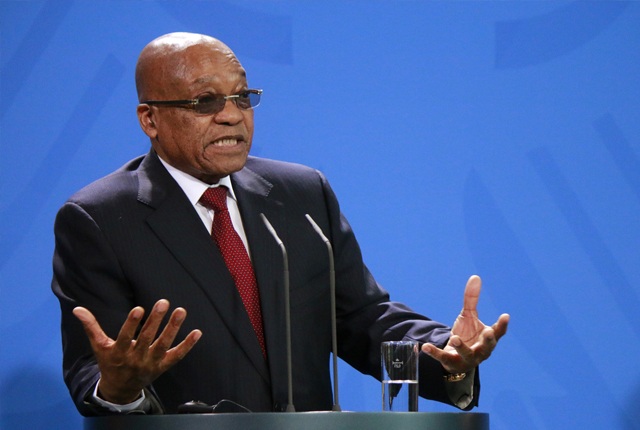
A court in South Africa has ruled that a 2009 decision to drop 783 corruption charges against President Jacob Zuma was irrational and should be reviewed – another setback for the scandal-ridden leader. The decision to set aside the charges seven years ago allowed Zuma to run for president.
The High Court decision at the time was based on phone intercepts presented by Zuma’s legal team that suggested the timing of the charges in late 2007 may have been part of a political plot against Zuma. The court ruling does not automatically reinstate the charges against Zuma. A legal process involving state prosecuting authorities and the courts must reach a decision on whether to charge the president.
The president’s office said that it has noted and will give consideration to the 2009 court ruling.
“These charges were formally withdrawn by the High Court in Pietermaritzburg during April 2009 and as such there is no pending litigation before court against President Zuma,” Zuma’s office said in a statement. “As a party to the proceedings, the President has noted the decision of the court and will give consideration to the judgment and its consequences and the remedies available in terms of our law.”
The go-ahead from the court adds pressure on Zuma, who has faced calls for his resignation even from inside the ruling African National Congress party since a damning constitutional court judgement against him last month. “This is a hugely significant decision,” Tania Page said, reporting from Pretoria. “Yet another big blow for President Jacob Zuma.”
Application for review of the National Prosecuting Authority’s decision seven years ago to drop the charges against Zuma was made by the country’s main opposition party Democratic Alliance (DA).
After the High Court’s ruling, James Selfe, the DA’s federal executive chairman, said that they are delighted by the outcome.
“We’ve been at this case for seven years. This is what we wanted right from the start,” he said. “We believe that the decision to drop the prosecution was irrational.”
It was not immediately clear whether Zuma would appeal against yesterday’s court ruling, according to Reuters news agency.
Meanwhile, the ANC said yesterday that the High Court ruling was irrational does not mean that he is guilty. “It’s important to note that the court didn’t deal with the merits of any allegations against President Zuma, nor did it make any finding declaring guilt on any matter against President Zuma,” ANC spokesperson Zizi Kodwa said in a statement.
“Today’s judgment was solely a judicial review of an administrative action taken by the NPA as allowed for in our law. We trust that it shall therefore not be used by any in our society to infer any culpability in any crime or offence by the president.”
Deputy Judge President Aubrey Ledwaba said yesterday that Zuma should face the charges that were dropped.
“Having regard to the evidence before us, we find that Mr Mpshe found himself under pressure and he decided to discontinue the prosecution of Mr Zuma and consequently made an irrational decision,” Ledwaba said.
In September 2008, Pietermaritzburg High Court Judge Chris Nicholson dismissed criminal charges against Zuma, citing a political conspiracy to influence the case by former president Thabo Mbeki and others.
Nicholson’s decision was taken to the Supreme Court of Appeal, and overturned. Zuma subsequently appealed this in the Constitutional Court, setting in motion a direct approach to the NPA to make written and oral representations on why the case should be dropped. On April 6, 2009, then-NPA head Mokotedi Mpshe said recordings of telephone conversations between then-Scorpions boss Leonard McCarthy and former NPA boss Bulelani Ngcuka, showed political interference in the decision to charge Zuma.
The two were recorded discussing the timing of bringing charges against Zuma. The charges related to his alleged involvement in the country’s multi-billion rand arms deal.
Zuma’s former financial advisor Schabir Schaik was found guilty of fraud and corruption by the Durban High Court in June 2005. He tried to solicit a bribe for Zuma from a French arms company involved in the deal.
On April 7, 2009, the charges against Zuma were withdrawn in the High Court in Durban. Zuma was sworn in for his first term as president in May that year, following general elections.
Kodwa said that the ANC has consistently supported the legal maxim that justice delayed is justice denied.
“This matter has dragged on for close to a decade and the ANC is pleased, therefore, that it now appears closer to resolution, seven years since the NPA decision,” he said.
“We once again reaffirm our full confidence in our legal system, with its adequate and extensive checks and balances designed to protect and promote accountability and transparency.’’
Members from several local ANC branches joined a small group of anti-Zuma marchers in Bloemfontein yesterday.
“In 2007, when other ANC comrades said Zuma must be the president, my region never supported him, and now we’ve been proven right,” said one marcher, Thokozile Mokoenanyana.
Other marchers included members of the Congress of the People, the Economic Freedom Fighters, religious groups, and the National Unemployment Voters Organisation. — AP.


 derick.khumalo
 Online Reporter