admin
admin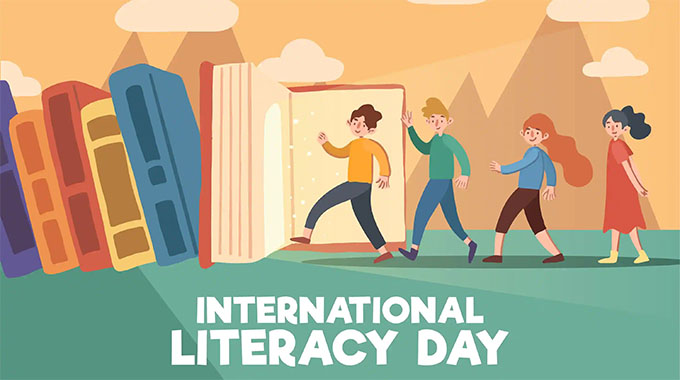
Flora Teckie A Bahai Perspective
International Literacy Day, observed on September 8, underlines the vital role education plays for the empowerment of individual, and the development of society.
While education is a basic human right to which everyone is entitled, according to a 2020 UNESCO report, 763 million young people and adults lack basic literacy skills and majority of them are women and girls.
The education and training of every individual, bringing their personality, mental and physical abilities and spiritual qualities to their fullest potential, is the right of everyone.
The Bahá’í Writings prescribe that education should be provided for all and equally to boys and girls, men and women.
In its statement entitled ‘The Promise of World Peace’, the Universal House of Justice, the governing council of the Bahá’í international community, says: “The cause of universal education … deserves the utmost support that the governments of the world can lend it. For ignorance is indisputably the principal reason for the decline and fall of peoples and the perpetuation of prejudice. No nation can achieve success unless education is accorded all its citizens”.
A balanced education that would enrich both mind and spirit would try to develop the essentially moral attributes — including truthfulness, courtesy, generosity, compassion, justice, love, and trustworthiness — whose reflection in the everyday lives of human beings can create harmonious, productive families and communities. Such education, at the same time, should help to instil in every individual the awareness of the fundamental oneness of humankind.
Need for a balanced education
“True education,” according to a statement of the Bahá’í International Community, “releases capacities, develops analytical abilities, confidence, will, and goal-setting competencies, and instils the vision that will enable … [individuals] to become self-motivating change agents, serving the best interests of the community”.
The Bahá’í Writings speak of three kinds of education: material, human, and spiritual.
Material education concerns itself with the progress and development of the body; teaching us how to improve our physical well-being including better nutrition and hygiene, better family health and greater capacity to earn and provide food, shelter and clothing.
Human education concerns civilisation and progress in activities which are essential for us, such as knowledge of commerce, the sciences and the arts, and the understanding of institutions and policy.
Spiritual or moral education deals with acquiring the right values and with the shaping of our characters.
It is through spiritual education that we are directed to use the knowledge, tools and means acquired through material and human education, for the advantage of humanity.
Therefore, for individuals to realise their full potential as contributing members of socially and spiritually advancing communities, there is need for a balanced education — combining all three kinds of education.
According to the Bahá’í Writings: “Arts, crafts and sciences uplift the world of being, and are conducive to its exaltation. Knowledge is as wings to man’s life, and a ladder for his ascent”.
However, academic education has to be balanced with spiritual education; and it is important that education, whether at home or at school, leads individuals in their moral empowerment as well as their intellectual development.
As the Bahá’í Writings confirm: “Knowledge is praiseworthy when it is coupled with ethical conduct and virtuous character”.
Need for nurturing an appreciation for diversity
Although education must be provided to all, it is not enough to focus only on enrolling children, youth and adults in schools and colleges.
We need to generate in individuals a vision of the kind of community they wish to live in – a just and peaceful community, a community in which the potential of every individual is valued and utilised.
This will ensure they can consider how to help shape their future to be the kind of individuals that will have influence in building such communities.
If our vision is to create societies in which men and women of different backgrounds and classes can live in unity and peace and enjoy mutual prosperity, then we must consider what kinds of educational processes can support such a vision.
It is the Bahá’í view that, the educational programmes and activities must nurture in our children and youth an appreciation for the richness and importance of the world’s diverse cultural, religious, and social systems.
They should encourage unity in diversity. To achieve this, our educational programmes and activities should be free of all forms of prejudice whether religious, national, cultural, gender based, racial, of class or creed or ethnic origin.
There will be need for a systematic approach to transforming the attitudes, values and behaviours of individuals, their families and communities to achieve this, and through appropriate spiritual education such transformations can take place.
According to a statement of the Bahá’í International Community asserts: “Successful education will cultivate virtue as the foundation for personal and collective well-being, and will nurture in individuals a deep sense of service and an active commitment to the welfare of their families, their communities, their countries, indeed, all mankind.”
Feedback: [email protected] or [email protected]
Website: www.bahai.org


 Online Reporter