Online Reporter
Mbulelo Mpofu, Zimpapers Arts and Entertainment Hub
THE air above the royal kraal pulsed — not only with the rhythmic stomp of thousands of bare feet striking the ochre earth, but with the resonant clack-clack-clack of emafahlawane — the beaded anklets worn by the maidens. It was a sound as ancient as the Lubombo Mountains, yet as immediate as the dust rising in the late afternoon sun.
Through the lens of Eswatini photojournalist and documentary filmmaker Simenzelweyinkosi Vilane, capturing the 2025 Umhlanga Reed Dance, more than a ceremony was revealed; it was a masterclass in cultural vitality — a vibrant blueprint from which Southern Africa could draw profound lessons.
At Ludzidzini Royal Residence, tradition is no relic — it is a dynamic, living force. The sheer scale is always the first assault on the senses. Tens of thousands of maidens — a flowing river of tindlamu (skirts), intricate beadwork, and the proud, unmistakable crowns of emagwalagwala (red feathers) — converged, carrying bundles of freshly cut reeds.
This procession, winding from the cutting grounds back to the Queen Mother, the Indlovukati, forms the ancient, pulsing heart of the ceremony.
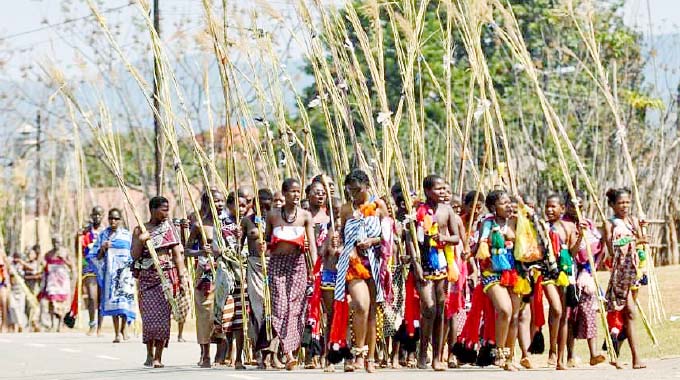
“For me, the most powerful moments were in the process itself. I found myself murmuring as I adjusted my focus — thousands of maidens carrying their reeds in a blend of new and old traditional songs that have echoed through this ceremony for centuries,” said Vilane.
It’s a sight unchanged in its essential form for generations — a testament to endurance. The act of presenting the reeds to fortify the Queen Mother’s residence remains the ceremony’s potent core: symbolic protection, safeguarding the nation through unity and ritual.
Yet Umhlanga is far from frozen in amber. This year, a powerful visual narrative underscored its evolution. Weaving through the throngs were young women living with disabilities and others with albinism — their participation marked not by separation, but by profound belonging.
“I was deeply moved by the movement and elements that revealed the ceremony’s modern evolution. I noted, my shutter clicking rapidly to capture the determination and pride in their strides. These moments showed that Umhlanga is not about exclusion but belonging. It reaffirmed that this long-standing tradition has a space for everyone who carries the spirit of Emaswati,” Vilane added.
This conscious, visible inclusivity sends a thunderous message to our region: deep-rooted traditions can adapt, embracing changing social values without sacrificing their soul.
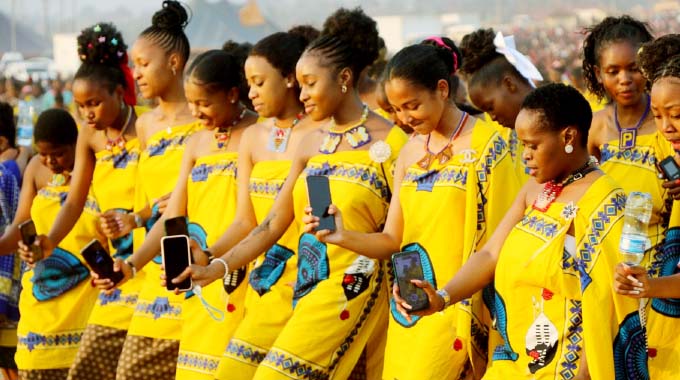
The artistic language of Umhlanga is visually intoxicating. Beyond the reeds, it’s a symphony of colour, texture, and movement.
“The beadwork, the vibrant skirts (tindlamu), emagwalagwala, and the anklets (emafahlawane) striking the ground in unity — these are not just decorative elements, they are visual languages,” he reflected, composing a frame where the intricate patterns on a maiden’s sidvwashi (top) contrasted sharply with the dusty ground.
“The regalia tells stories of identity, pride and belonging. When thousands of maidens dance together, they create unforgettable visual imagery of resilience and unity for domestic audiences.
“These images reaffirm who we are, while to international visitors, culture here is the soul and breath of the Swazi people.”
This potent visual identity is a form of soft power Eswatini wields masterfully. The resonance extends beyond Eswatini’s borders. The presence of maidens from neighbouring South Africa, and the echoes of the Zulu Umhlanga, underscored a profound regional kinship.
“Umhlanga is not an isolated tradition — it speaks to the broader Southern African heritage,” he observed, panning his camera across groups whose dance formations felt intimately familiar.
“The reeds themselves are a shared cultural motif, and the dance formation resonates with other Nguni practices. Watching it unfold, you can see the visual threads connecting us. These moments remind us that even though borders divide us politically and geographically, culturally we are woven from the same fabric.”
The visual unity was striking for Vilane.
“Honestly, from the vantage point at the stands, if it weren’t for the slightly different regalia, I could not differentiate between the Zulu maidens and the Swazi maidens. That shows the unity — in rhythm and song.”
For Southern Africa, often fragmented by politics and history, Umhlanga offers a compelling vision: shared cultural roots can be a powerful, unifying force — a foundation upon which deeper regional understanding and cooperation can be built.
This year, the global audience was undeniable. The stands hosted a constellation of dignitaries: South Africa’s former President Jacob Zuma, Botswana’s former President Ian Khama, and traditional leaders from across the continent.
“This year’s ceremony felt especially global,” Vilane remarked, capturing moments of foreign dignitaries visibly moved by the spectacle. The interaction between Swazi tradition and global presence created a powerful narrative of cultural diplomacy and the unifying power of culture.
Here lies another vital lesson: culture is a potent diplomatic currency.
“I believe that most who were attending the ceremony for the first time saw that tradition here is not nostalgic, but an active practice of identity, pride and unity. To me, this year’s ceremony demonstrated without doubt that our culture — and African culture broadly — can be, and is, another strong form of diplomacy.”
Documenting Umhlanga was both a privilege and a profound challenge.
“Photographing and documenting Umhlanga is both a challenge and a gift. The challenge is the scale, but within that vastness lies opportunity.
“Every frame contains layers of meaning: personal pride, collective and national identity, feminine strength and intergenerational continuity,” he confessed.
Vilane’s task, like the ceremony itself, was about balance.
“My task is to show that Umhlanga is not frozen in time, but a living tradition. I aim to balance wide shots that capture the tradition’s essence, with intimate portraits that reveal the human heartbeat of the ceremony.”
This is the ultimate lesson emanating from Ludzidzini: culture thrives not through mere preservation, but through active, dynamic practice that honours the past while embracing the present. It must have space to breathe, to include, to evolve, and to speak to both the local and the global.
Follow on X @MbuleloMpofu


 Sidumisile Mabena