Online Reporter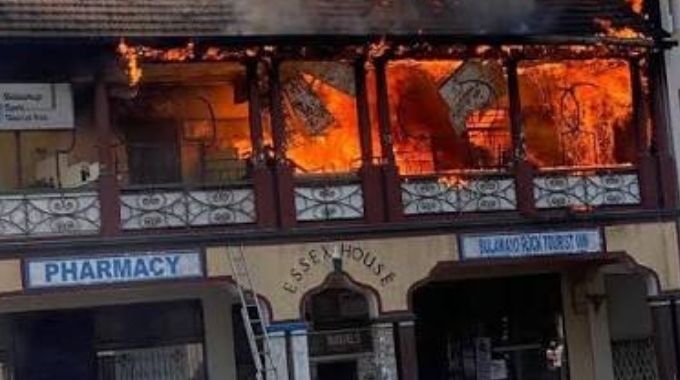
Bruce Ndlovu, Sunday Life Reporter
FOR a few breathless seconds, the young woman had nowhere to go.
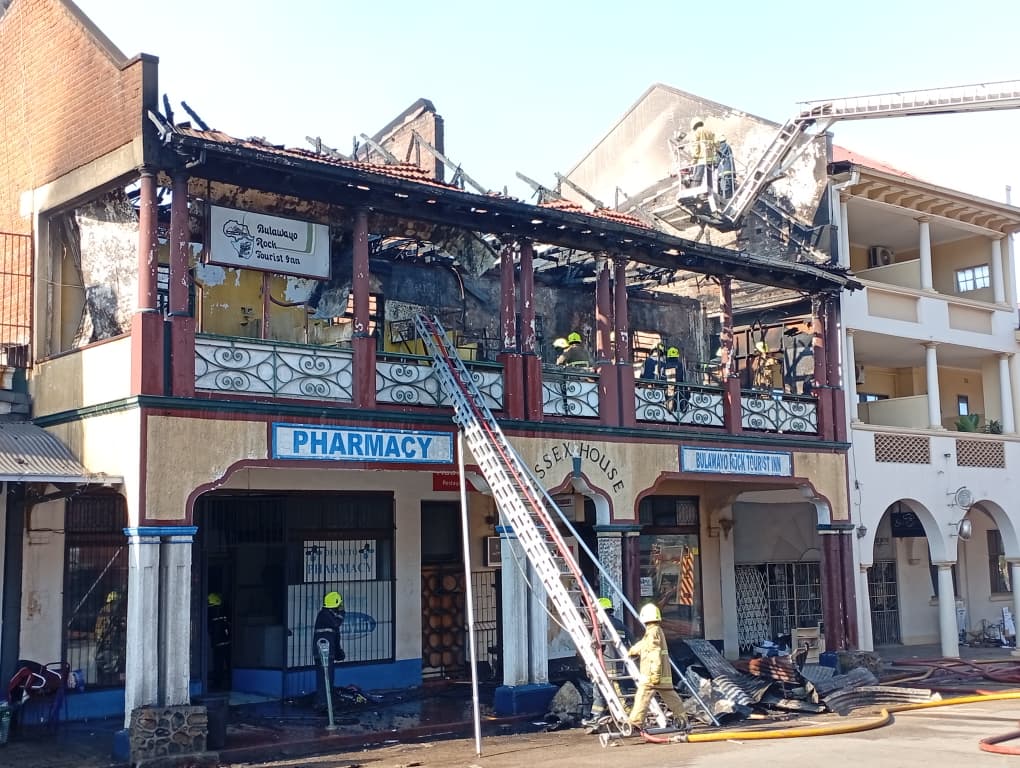
Behind her, Essex House was filling with smoke and flames. Below, on Leopold Takawira Avenue, a crowd had gathered, their faces tilted upwards as they watched the fire consume the historic building.
Then she appeared on the balcony.
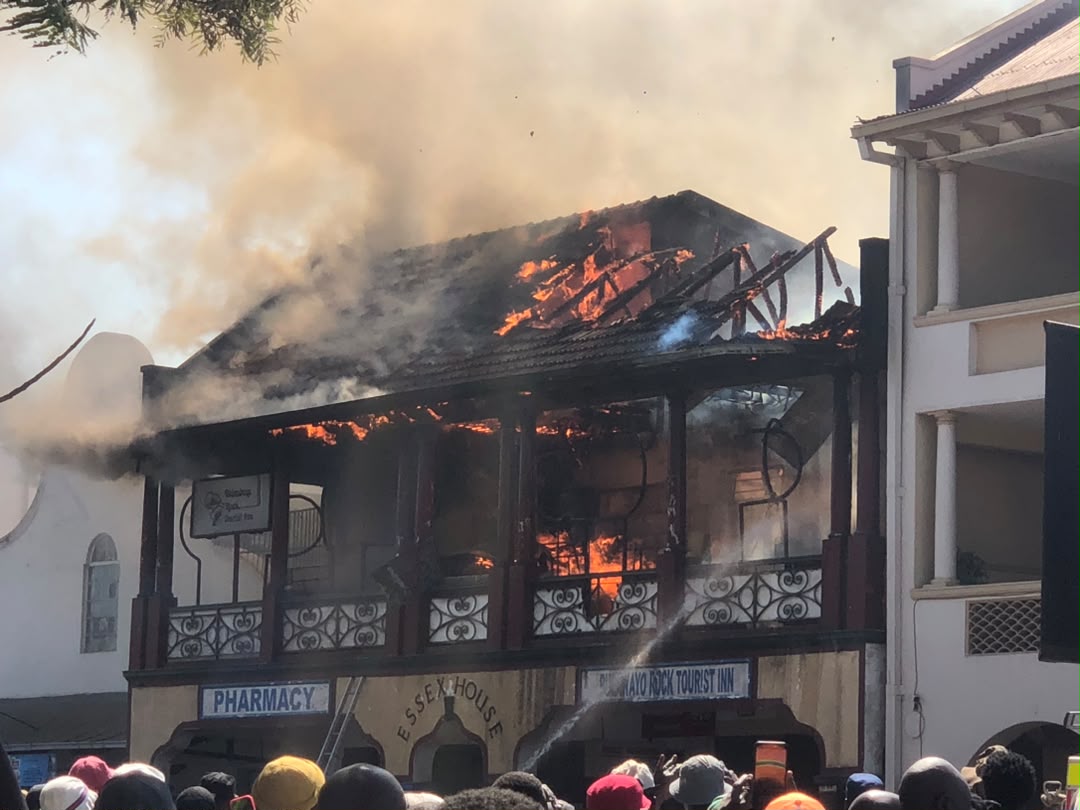
There was no time for a fire escape, no time for a carefully planned exit and certainly no time to wait for help to reach her.She climbed out.
For a moment, she hung above the street, suspended between the burning building and the hard ground below.
Then she let go.
People on the ground rushed forward, instinctively forming a human safety net with their arms stretched upwards. As the young woman dropped, they caught her, breaking what could easily have been a fatal fall.
It was the kind of dramatic scene that turns a fire from a distant spectacle into something painfully immediate.
On Wednesday, Essex House, one of the older buildings in Bulawayo’s Central Business District, became the latest stage for a city that increasingly appears to be battling fires on two fronts.
On one side are the veld fires, devouring dry grass on the outskirts and open spaces around the city.
On the other are structural fires, erupting inside buildings, sometimes doing so in the very heart of a city built largely from concrete, brick and steel.
After all, Bulawayo is not a city of wooden skyscrapers waiting to become tinder. Its CBD is dominated by substantial, decades-old structures that appear, from the outside, to be almost immovable. Yet behind those thick walls are electrical systems, appliances, gas cylinders, ageing infrastructure and human beings whose lives can be changed within minutes by a spark.
The destruction of Fairy Café in February provided one of the year’s earliest reminders of the city’s vulnerability.
In June, another fire along Lobengula Street displaced families, bringing the danger into people’s homes. Then came the blaze at Lalani Hotel and Conference Centre, where more than 20 rooms were gutted.
And now Essex House has joined that growing list.
For Bulawayo Fire Chief Mhlangano Moyo, the figures tell a story that is difficult to ignore.
“In the same period between January and June last year, we had 96 fires. Now we are sitting on 154, a 60 percent variance. Electrical faults in these buildings are the most common cause, ranging from faulty electrical wiring, overloaded sockets and extension cords to electrical sparks caused by poor workmanship and heaters left switched on during the night.
“Many of these buildings were constructed decades ago and some have deteriorated electrical wiring and structural features that allow fires to spread more quickly,” he said.
We also see poor housekeeping practices, especially in some old flats and buildings that have been converted without proper regulations from the relevant authorities,” he told media recently.
According to Moyo, the problem is compounded by the age of many of Bulawayo’s buildings.
“Many of these buildings were constructed decades ago and some have deteriorated electrical wiring and structural features that allow fires to spread more quickly,” he said.
We also see poor housekeeping practices, especially in some old flats and buildings that have been converted without proper regulations from the relevant authorities.” Compounding the situation, old flats and commercial premises are being subdivided, converted into accommodation or repurposed without the necessary regulatory oversight. What begins as a seemingly harmless adaptation can create a maze of rooms, cables, appliances and occupants that becomes difficult to evacuate when disaster strikes.
Moyo says poor housekeeping is another recurring problem, particularly in older flats and buildings that have been converted without proper approval.
At Essex, fire-fighters also encountered several gas cylinders believed to have been used by students renting rooms on the first floor.
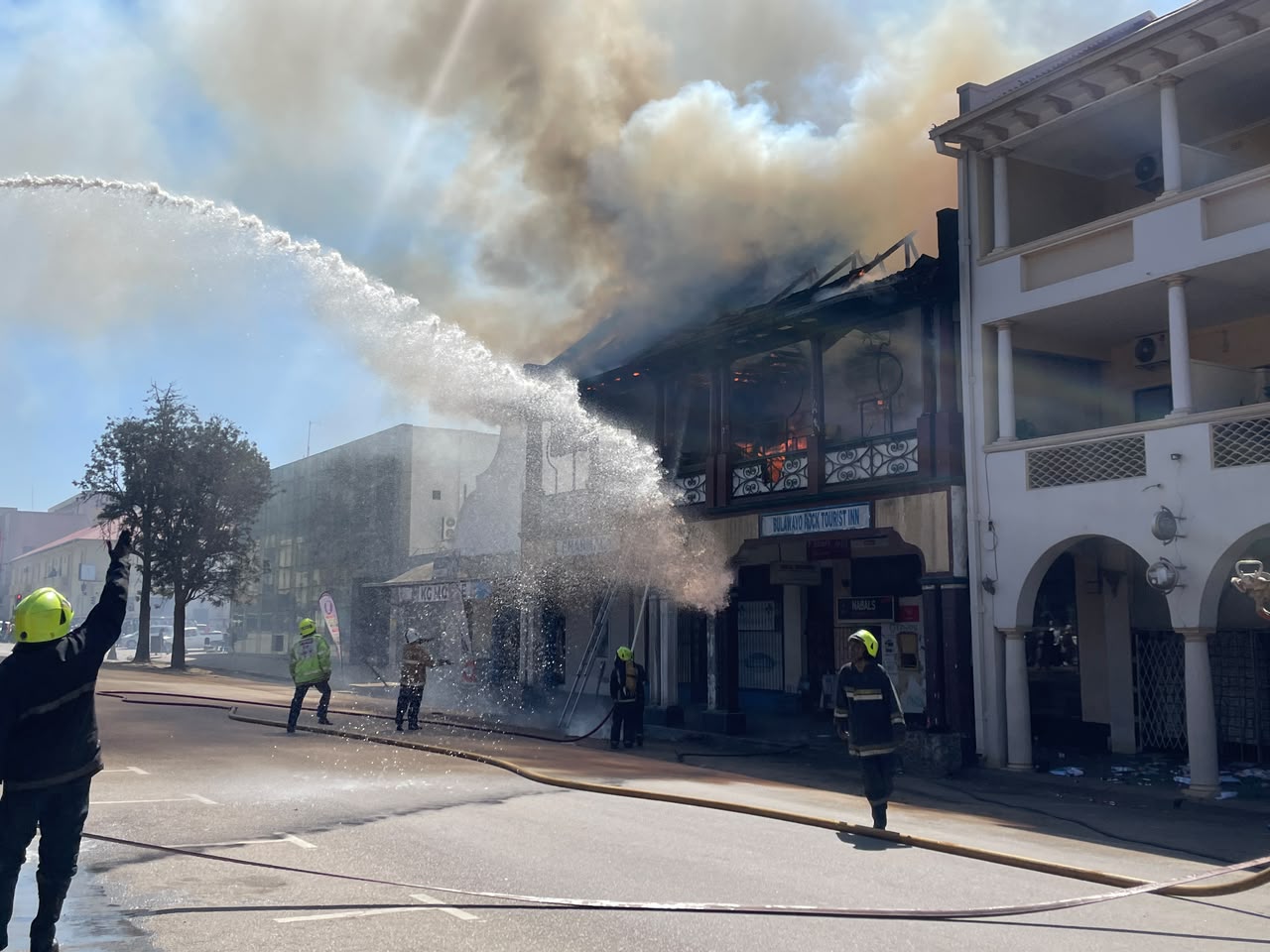
“We observed several gas cylinders that we believe were being used by students who rented rooms on the first floor,” said Moyo after Wednesday’s fire.
Yet while structural fires have been producing some of the city’s most dramatic images, another battle is quietly raging beyond the walls of the CBD. The grass in and around the city is burning.
And it is burning with increasing frequency.
During July alone, the City of Bulawayo Fire and Ambulance Service responded to 126 fire calls. Of these, 110 were veld fires, accounting for 87 percent of all the fire incidents attended during the month.
That represented a 75 percent increase compared with the same period last year.
In a city where dry winter vegetation can turn golden brown before becoming tinder-dry, fire needs very little encouragement.
Sometimes it comes from a cigarette butt tossed carelessly into the grass.
Sometimes it is deliberate.
Moyo says some people burn grass while clearing newly acquired stands, while others use fire to prepare agricultural fields. Once the flames escape their intended boundaries, however, they can spread rapidly across large areas, particularly when wind enters the equation.
There is also a less obvious source.
Some people conduct outdoor worship and light fires to keep warm during the cold months. The danger comes when those fires are abandoned before they have been properly extinguished.
“There are people who worship outdoors and because it is cold they light fires to keep warm. The problem is that some leave the fires unattended. Once the wind picks up, the fire spreads into the surrounding dry grass, resulting in veld fires,” Moyo said.
A small warming fire can become a wall of flame once the wind catches it and carries it into the surrounding dry vegetation.
The city’s fire problem, therefore, is not simply a story about careless smokers, ageing wiring or dry grass.
It is also a story about a changing urban environment and how people interact with it.
Zimbabwe’s wider experience offers an even more sobering backdrop.
Figures contained in the Environmental Management Agency’s 2025 fire assessment show that 985 314 hectares were lost to veld fires last year, slightly more than the 982 964 hectares recorded in 2024. But perhaps the more worrying feature of the figures is not simply the amount of land that burned.
It is how efficiently individual fires are now consuming it. The number of recorded fire incidents fell by roughly a third in 2025, yet the area destroyed remained almost unchanged. In other words, fewer fires were capable of consuming substantially larger areas before they could be brought under control.
The consequences were not confined to grass and trees.
The country recorded about US$1,4 million in documented structural and agricultural losses, with homes and property, farming equipment, tourism facilities and boundary fencing among the casualties. There were also human fatalities.
n Full story on www.sundaynews.co.zw
For Bulawayo, the official fire season began on July 31 and will run until October 31.
It is a period when dry vegetation, rising temperatures and strong winds combine to create the perfect conditions for a fire to travel.
However, the fires tearing through the city’s landscape do not always respect the neat boundaries between urban and rural.
A veld fire can begin on the edge of the city and creep towards homes.
A spark inside a building can turn a busy CBD street into an evacuation zone.
The result is an unsettling picture of a city surrounded, and sometimes engulfed, by fire.
There is something particularly jarring about seeing flames against the skyline of a city whose architecture appears so resistant to them.
Concrete does not burn in the same way that dry grass does. Brick does not behave like a field of tinder.
However, buildings are more than their walls.
They are networks of electricity, fuel, appliances and people. And once fire finds a pathway through those networks, even a seemingly solid building can become a trap.
The image of the young woman at Essex House perhaps captured this vulnerability better than any statistic could.
A woman climbing through a first-floor window, smoke behind her, while strangers below prepared to catch her, was a reminder that the difference between an ordinary working day and a life-threatening emergency can sometimes be measured in seconds.