admin
admin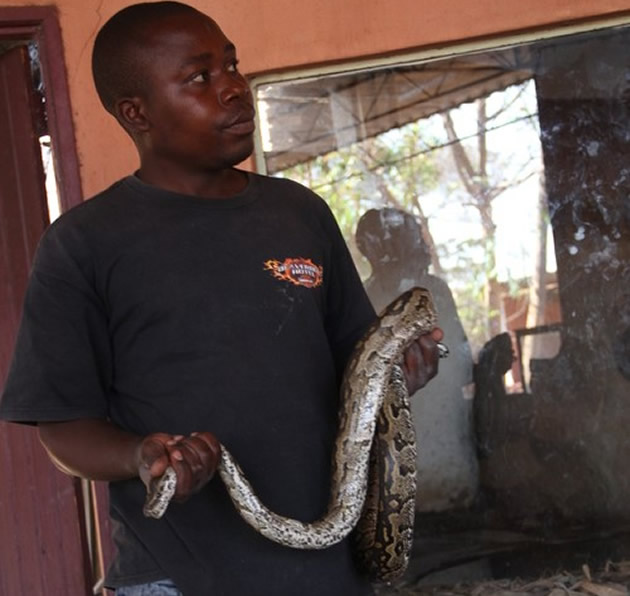
Sydney Kawadza Senior Features Writer
Snakes have always had a bad reputation and scare a lot of people, young and old. From those who believe in Christianity, to many who follow other religions, the serpent and man have always been the worst foes.
It goes back to the story of Adam and Eve when a serpent deceived Eve into eating fruit from the forbidden tree, and then gave some to Adam. God then cursed the serpent and the ground. In African society, the “relationship” between man and snake is taboo.
Anyone found keeping snakes is accused of dabbling in witchcraft. Yet, 27-year-old Abraham Singano of Harare has brushed aside this long-standing “war” and perceptions about humans and serpents. He has chosen a rather eerie profession and works in an enclosure with venomous snakes.
The snake enclosures at the famous Snake World, a part of the Lion and Cheetah Park about 20 kilometres west of Harare, are his offices. His is not an easy job. Everyday duties may include anything from animal care and feeding to enclosure cleaning, design and maintenance.
But, Abraham feels his father has taught him enough about snakes that he will always be safe from the dangerous reptiles.
“Snakes rarely attack humans but people panic when they see one. It’s unfortunate that even when a person encounters a snake deep in the bush, they want to attack it when it is easier to leave it alone,” Singano told The Herald. Singano seems to know just too much about the scary reptiles for his age.
He learnt the trade from his father, Brown, who has been holding fort at Snake World for more than three decades.
Born on October 29 1988, Singano has been exposed to snakes ever since; they were even his pets. Surprisingly, chameleons scared him. “I was born in this area and from a young age I was exposed to snakes and learning from my father who has worked here for the better part of his life. Funnily enough, I was more scared of chameleons than snakes,” he confessed.
“Sometimes my father would show me how to handle snakes and that is how I got to understand the reptile.” Singano was immediately roped into the Snake World business when he completed Ordinary Levels. In 2007 I started working with my father. I guess the owners had realised how well he had taught me and they hired me,” he said.
He adds that his father is a master in the field and clearly wanted a dynasty of snake handlers by training his two other brothers – Jealous and Bigstone.
“My two brothers can also handle snakes. My brother Jealous has gone into information technology. He is equally good but my brother Bigstone has even gone further and is now based in Cape Town where he works at a similar snake park,” he said.
Singano believes the knowledge from his father is not enough and he has done further research into the various types of snakes found in Zimbabwe and throughout the world.
“I have studied a number of books on snakes and their behaviour. There are so many types of snakes and I am sure I do not know all of them.
“I have read a lot of books about the different types and their characters, where they are found and how to identify each and every snake that can be found in Zimbabwe,” he said.
Singano believes he can identify a snake type by just seeing its tail. He has also been called to capture snakes that have ventured into residential areas. “When I am called to capture a snake, I first make sure I understand whether it is agitated or calm.
“Snakes can be dangerous when they are agitated. People usually throw stones at snakes and this agitates them and makes them dangerous to handle.
“I always handle the snake well when I capture it and make sure it’s calm so that it does not attack me,” he said. Unlike his father who has been bitten by poisonous snakes, Singano is yet to have such an encounter with the dangerous varieties.
“I have been bitten by the non-poisonous snakes while my father has had a different experience after having been bitten four or five times by poisonous snakes. He survived to teach us well,” he said.
He says people should not agitate snakes.
“Snakes rarely attack people except when you touch or step on them. However, a snake like the black mamba attacks people and it is dangerous.
“People should also avoid underestimating baby snakes because they are more poisonous as they do not control the amount of venom they emit when biting a person. They should be avoided at all costs,” Singano said.
However, with all his courage in a strange environment, Singano is scared, really scared of one Egyptian cobra dropped at the Snake World a week ago.
The Zimbabwe National Parks and Wildlife Management Authority recently brought the infamous snake that was impounded from Grey Mupinganjira, a Mahusekwa man who was found in possession of the reptile in his laptop bag at a roadblock in Hatfield, Harare.
Mupinganjira pleaded guilty to contravening the Parks and Wildlife Act and was fined $150. He claimed he inherited the snake from his late mother and told the court that he was arrested while taking it to a traditional healer in Epworth.
What scares Singano is that he suspects the snake might have been used for juju or other supernatural acts. “That snake makes me feel very uncomfortable because of the stories associated with it. Many people have visited us just to see how it behaves since it was found in someone’s possession,” he said.
According to Singano, one strange thing is that from the day it was brought to Snake Park, the snake rarely leaves the water pond. “The snake is in the same enclosure with two other Egyptian cobras which move around the new snake. However, that snake does not come out of the water pond,” he said.
At the Snake World enclosures visitors will see the green and black mambas, Egyptian cobra, olive grass snake, tree-stripped skaapsteker, boomslang, pythons, puff-adders, forest cobra, vine snakes, gaboon vipers, Mozambican spitting cobra and night adders.
Authorities at Snake World also take time to teach visitors about snakes and other reptiles common in Zimbabwe.
They declare that snakebites are a rare occurrence.
“Snakebite is not a serious danger. In Zimbabwe, deaths from snakebite are minimal compared to deaths from lightning, car accidents or illness.
“Most snake bites occur in early summer during the warm, wet nights. More people die from puff adder bites – about 90 percent – than from any other snake bites. Very few species are lethal to man.”
For first aid treatment, anti-venom is the most specific treatment for snake bites.
However, while anti-venom is not harmless, it can cause serious allergic reactions in some people and is best administered in hospital.
“First aid treatment slows the entry of venom into the bloodstream allowing time for the victim to get to a hospital.
“It is, however, recommended that people do not cut or suck the bite or use the tight tourniquet that might cause more harm than good.
“Wrap an elastic or crepe bandage around the bite and up the limb towards the body. Finally, immobilise the limb with a splint.
“If possible, kill the snake and take it with you to a hospital as it may help the doctor to determine the treatment required.”
It is also recommended that the victim is kept calm with no food or drink.
- Feedback: [email protected]


 Online Reporter