Taking Stock
Kudzanai Sharara
Zimbabwe’s capital markets were sending contradictory signals last week.
On one side of the ledger, Amalgamated Brands Limited arrives on the Victoria Falls Stock Exchange, offering investors a stake in a restructured fast-moving consumer goods group with familiar brands and a stated growth story.
On the other, OK Zimbabwe prepares to retreat from the Zimbabwe Stock Exchange, taking with it the public accountability that came with the US$20 million it raised from investors just over a year ago.
The juxtaposition is stark: a market welcoming a new participant while simultaneously watching an established one slip out of public view.
The question is what these twin developments reveal about the health of Zimbabwe’s equity culture and whether the protections for minority shareholders are adequate for the risks being taken.
Amalgamated Brands: New listing, old questions
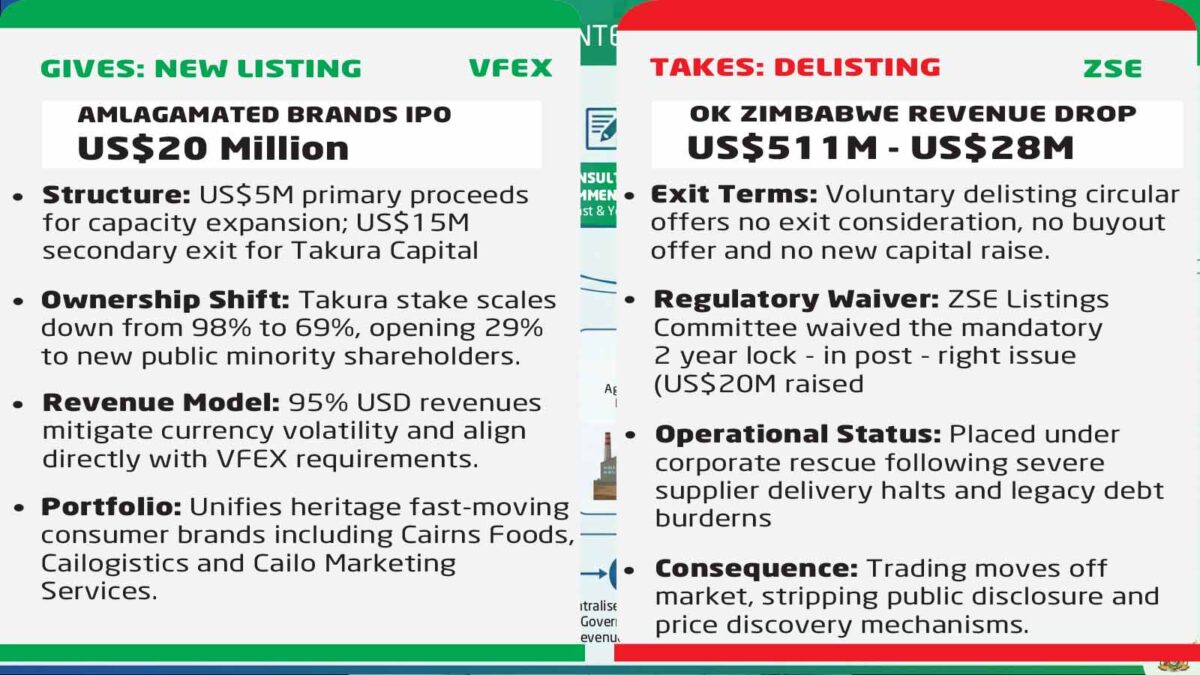
Amalgamated Brands Limited last week launched a US$20 million initial public offering on the Victoria Falls Stock Exchange, structured as US$5 million in new shares and US$15 million in existing shares sold by Takura Capital.
The offer is priced at US$0,35 per share, with the primary proceeds earmarked for capacity expansion across the group’s manufacturing operations.
Following the listing, Takura’s stake is expected to fall from 98 percent to approximately 69 percent, with new minority shareholders holding about 29 percent.
The group brings together Cairns Foods, itself a former ZSE constituent, along
with Cailogistics and Cailo Marketing Services.
The investment case, as presented by Group chief executive Anele Zunga, rests on heritage brands, owned route-to-market capability, and a five-year capital expenditure programme.
Cairns Foods owns popular brands such as Spuds, Sun Jam, Willards, Charhons biscuits, Cashel Valley, among others.
But at the IPO launch, questions from the floor cut to the heart of the minority shareholder experience. One analyst noted that Cairns Foods had previously delisted from the ZSE and minorities lost out on their investments.
With Takura set to hold 69 percent post-listing — closer to that 75 percent threshold than many investors might find comfortable — the question was direct: what protection exists for minorities, and what is different this time?
Mr Zunga’s response emphasised operational transformation rather than governance reform.
He pointed to the shift in channel architecture from modern trade to informal trade, the creation of three operating business units with synergies, and the fact that Cailogistics and Cailo Marketing Services earn third-party revenue, making the investment proposition “more lucrative” than the old Cairns Foods.
However, the response addresses the commercial case and does not directly address the governance question.
A second question was sharper still: only US$5 million of the US$20 million offer is primary capital, with US$15 million going to Takura.
Why, one analyst asked, does this look “predominantly a liquidity event for the shareholder rather than a more substantial recapitalisation of the business”?
And with the valuation relying on an earnings recovery that has not fully materialised, where is the confidence that this is an attractive entry valuation for new shareholders rather than an optimal exit for Takura?
The response noted that the business can fund its US$46 million capital expenditure programme from earnings and debt over five years, and that the valuation at US35c per share represents a discount to
peers.
Whether that satisfies investors will depend on their confidence in the projections and on their assessment of the governance arrangements that will protect them if those projections disappoint.
Still another question is the decision to list on the VFEX, a USD denominated market, instead of the Zimbabwe Stock Exchange, a ZiG denominated market.
Currently, AMB’s revenues are 95 percent in USD making it easy for the company to meet its USD obligations on the VFEX. But what if the economy goes to a ZiG mono-currency?
Will the company be able to meet its USD obligations?
Management says it be able to grow its export earnings from the current 5 percent to an ambitious 30 percent by year 2030. It seems their work is cut out.
OK Zimbabwe: The exit
nobody asked for
The contrast with OK Zimbabwe could hardly be more complete.
On November 6, shareholders of the 83-year-old retailer will gather for an Extraordinary General Meeting to vote on a voluntary delisting from the ZSE.
The circular offers no buyout, raises no new capital and provides no exit consideration. Investors will keep their shares, but those shares will no longer trade on a regulated market.
Transfers will occur off-market, through transfer secretaries, potentially at greater cost and with no readily ascertainable market price.
What makes this moment particularly difficult is the timeline.
In July 2025, OK Zimbabwe shareholders approved a US$20 million rights issue at US$0,0109 per share, offered at 1,37 new shares for every one held.
The National Social Security Authority led the underwriting, with Datvest and Old Mutual as sub-underwriters.
The money arrived in August but six months later, after suppliers stopped delivering, the board placed the company in corporate rescue, and trading in the shares was halted .
ZSE rules normally bar a voluntary delisting within two years of a capital raise. That rule exists for an obvious reason: a company should not collect money from public investors and then step out of public view. On October 7, the Exchange’s Listings Committee waived it.
What delisting removes is disclosure and it does so at precisely the moment when disclosure matters most.
The decisions that will determine what equity is worth have not yet been made.
Properties are being sold, and some may be leased back.
Bank guarantees are under discussion, while legacy creditors, owed more than US$30 million, are being settled.
Each of these transactions moves value between creditors, landlords and shareholders.
On the exchange, their terms would be published but off it, there is no such obligation.
The broader question
There is a fair case for the OK Zimbabwe board.
A company whose revenue collapsed from US$511 million to US$245 million in a year and then to US$28 million in the following six months, cannot justify spending scarce cash on listing compliance.
Creditor negotiations often go better in private and the rescue practitioner has duties to creditors that do not wait for shareholder comfort.
But that case supports lighter disclosure, not none. A credible proposal would quantify the savings and commit to audited annual reporting for every holder.
It would set out how proceeds from property sales are applied.
It would define the conditions for a relisting or an exit offer but none of these appear in the circular.
This matters beyond one retailer.
Zimbabwe’s capital markets depend on a simple promise: money raised from the public comes with continuing accountability to the public.
If that promise can be waived for the company that most recently tested it, investors in the next rights issue will price that risk in. They will demand a deeper discount or decline to participate.
The Amalgamated Brands listing and the OK Zimbabwe delisting are not equivalent events as one brings capital and a new participant to the market while the other removes one.
But together they tell a story about where the balance of power sits between controlling shareholders and minorities and about whether the rules that are supposed to protect the latter are being enforced with the seriousness they deserve.
The market is giving with one hand and taking with another. The question for investors is which hand they trust more.
Remember, if you are in any doubt about the actions you should take regarding these corporate actions, consult your stockbroker, banker or professional advisor.
Until next time.
Kudzanai Sharara writes the weekly Taking Stock column, providing commentary and analysis on Zimbabwe’s stock markets and listed companies and this should not be taken as financial advice. For feedback you can email: [email protected]