Martin Kadzere
Power utility, ZESA, is transitioning into a single, vertically integrated power entity, dismantling its decades-long unbundled structure following a sweeping executive reorganisation.
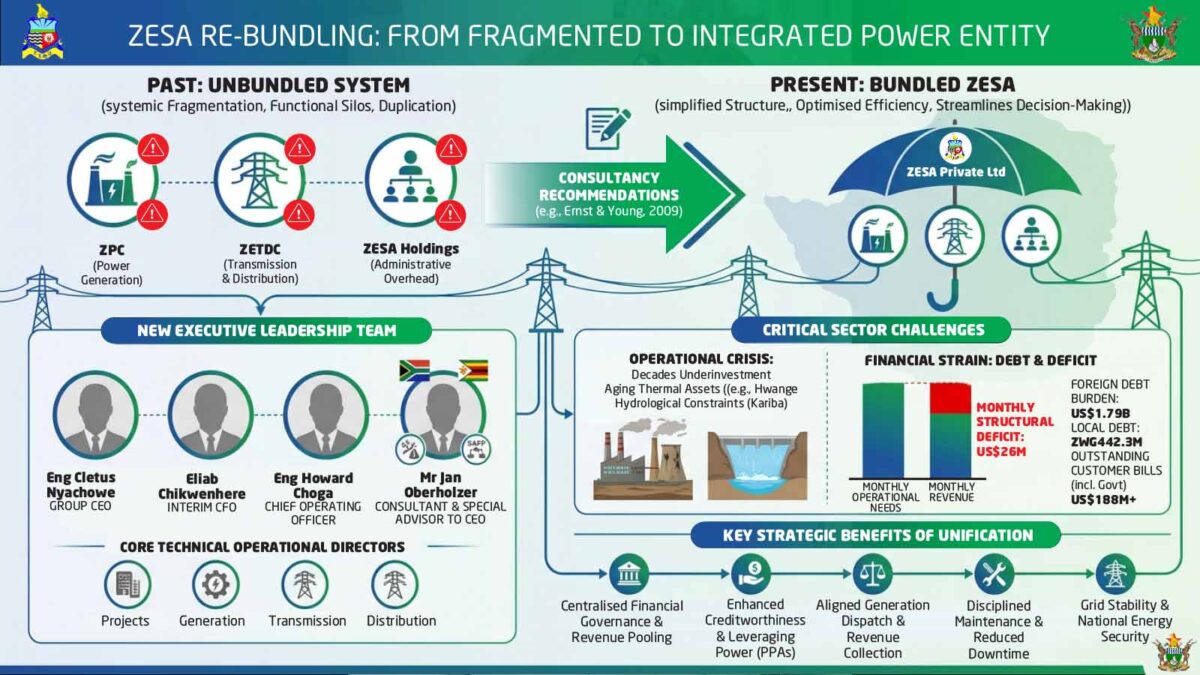
The structural consolidation, orchestrated by Mutapa Investment Fund, — which assumed control of the state utility in 2020, previously under the Ministry of Energy and Power Development — merges ZESA Holdings and its core operational subsidiaries, the Zimbabwe Power Company (ZPC) and the Zimbabwe Electricity Transmission and Distribution Company (ZETDC), under one corporate umbrella: ZESA Private Ltd.
The new executive structure, led by group chief executive officer Engineer Cletus Nyachowe, includes key leadership placements such as Mr Eliab Chikwenhere as interim chief financial officer, Eng Howard Choga as chief operating officer and former Eskom executive Mr Jan Oberholzer as consultant and special advisor to the CEO.
Eng Nyachowe, who served as the acting CEO following the passing of former executive chairperson Dr Sydney Gatawas appointed to lead the consolidated power utility on a substantive basis on May 1 this year, laying the groundwork for the structural reorganisation.
The rebundling aims to streamline decision-making, eliminate administrative redundancies and optimise operational efficiency.
“These appointments form part of the wider organisational transformation of ZESA, which seeks to establish a unified management structure with clearly defined responsibilities,” Eng Nyachowe noted in an internal circular to employees.
He emphasised that the streamlined framework is designed to steer the utility towards operational viability and energy self-sufficiency, calling on staff to support the transition towards “Total Electrification and Energy Security” in line with Vision 2030.
Initially unbundled in the early 2000s to foster competition and attract private capital into power generation, the decentralised model instead induced systemic fragmentation. Rather than sparking efficiency, it resulted in functional silos, administrative duplication and misaligned operational priorities.
In 2019, consultancy firm Ernst & Young recommended a complete re-bundling of ZESA’s power assets to address these crippling structural friction points.
Alongside the top executive leadership, the circular detailed a broad slate of placements across technical operations, headed by Eng Ndomupeyi Chikonye (chief shared services officer), Eng Itai Utah (chief projects and strategic planning officer), Eng Norbert Matarutse (director power generation), Eng Ralph Katsande (director distribution and detail), Eng Peter Tshuma (director generation projects) and Eng Forbes Chanakira (director transmission projects).
While these appointments establish a core leadership group, Eng Nyachowe noted that additional appointments remain ongoing.
A former ZESA Holdings executive, while not dismissing the new approach, offered a different perspective, asserting that he remains a strong proponent of the unbundled structure, suggesting that, if administered properly, it guarantees better transparency.
“I am pro-unbundling because it enhances transparency. I think the problem has been the long time taken to remove ZESA Holdings.
“The entities would run better as independent companies, but I guess ZESA Holdings has been maintained to ensure undivided control,” the former executive said.
He noted the wealth of experience Mr Oberholzer brings, which will be critical in transforming ZESA Holdings, but stressed that his contribution will depend on what his specific role in the bundled structure will be.
Overcoming structural bottlenecks and financial strain
The corporate overhaul comes at a critical juncture for Zimbabwe’s power sector, which continues to grapple with deep-seated operational and financial crises.
Decades of underinvestment, aging thermal assets at Hwange and hydrological constraints at Kariba Dam have left the national grid vulnerable to recurring generation deficits.
Compounding these generation bottlenecks is a heavily indebted balance sheet.
ZESA is weighed down by a massive total foreign debt burden of US$1,79 billion alongside ZWG442,3 million in local obligations.
On a monthly basis, the utility requires approximately US$93 million to cover operational expenses, power imports and essential capital expenditure, but generates only US$67 million in monthly revenue — leaving a severe structural deficit of US$26 million every single month.
Exacerbating this deficit is a chronic collection shortfall from defaulting consumers.
ZESA is owed hundreds of millions of dollars in outstanding electricity bills, including US$188 million owed directly by Government institutions and local authorities.
This debt load severely strains liquidity, making it difficult for ZESA to service external loans (such as the US$350 million debt tied to Kariba South expansion) and purchase bulk power from regional suppliers. By centralising asset allocation and financial governance under a single balance sheet, the re-integrated model enables ZESA to pool revenue streams directly.
This consolidated capital structure is expected to improve creditworthiness, restore leverage when negotiating bulk power purchasing agreements (PPAs) and streamline debt-restructuring programmes directly with the Treasury and international development finance institutions.
Strategic impact of Mr Oberholzer’s expertise
A standout element of the new structure is the recruitment of South African power veteran Mr Oberholzer as special advisor to the Group CEO.
Mr Oberholzer brings over three decades of heavy power-utility experience, most notably serving as chief operating officer of South Africa’s Eskom from 2018 to 2023.
During his tenure at Eskom, Mr Oberholzer navigated unprecedented operational pressure, managing severe generation fleet decay, overseeing complex load-shedding protocols and executing maintenance recovery interventions across aging coal stations.
Mr Oberholzer’s technical experience in optimising aging coal-fired power plants is directly applicable to stabilising output at the legacy units at Hwange Power Station.
Having operated at the peak of Southern Africa’s largest electricity utility, his technical oversight will assist in enforcing strict maintenance schedules and reducing unplanned downtime across thermal and hydro generation units.
His deep familiarity with the Southern African Power Pool (SAPP) dynamics provides ZESA with high-level leverage when navigating regional power trade, imports and emergency supply contracts.
Economic implications
and sector outlook
The transition back to vertical integration marks a decisive shift in Zimbabwe’s energy strategy.
By eliminating the friction between generation (ZPC) and distribution (ZETDC), the unified entity can align power dispatch directly with revenue collection priorities.
For industry and mining, the pillars of Zimbabwe’s economic growth, a stabilised, single utility promises streamlined commercial engagement and clearer policy direction.
If paired with disciplined governance, tariff rationalisation and debt recovery, ZESA’s corporate rebirth under Mutapa Investment Fund could serve as the long-awaited catalyst for grid stability and national energy security.