
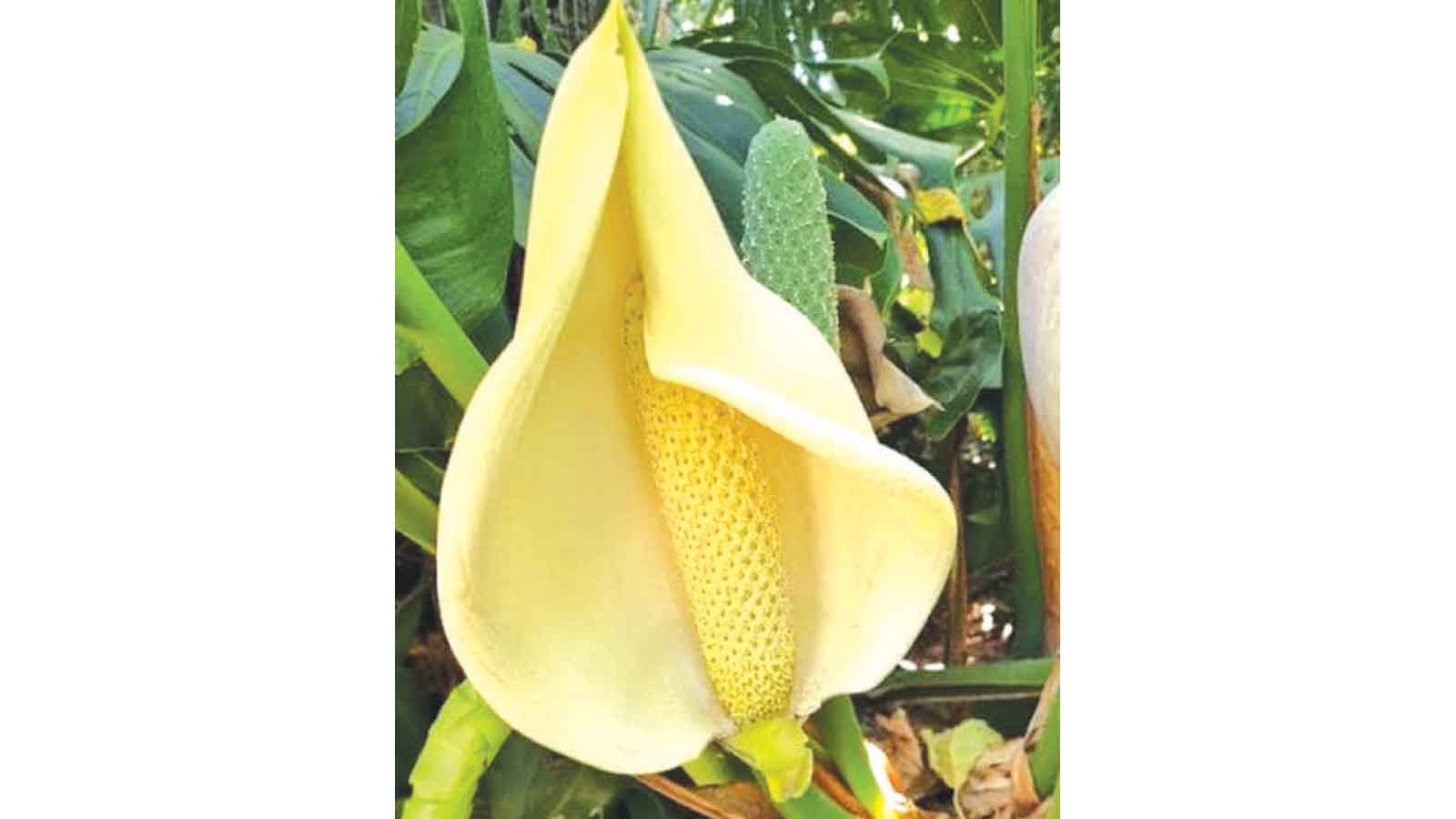
SOME people believe the flavour of the delicious monster is a mixture of pineapple, mango and banana, though I will let each person be the judge of that.
I urge you to try it, but be wary because it is delicious yet still a monster.
It leaves a stinging feeling on the tongue after eating due to irritant fibres on the surface, although these can be wiped off with a little citrus juice.
The monstera deliciosa is a plant originating from the rainforests of South America as a climbing member of the arum family.
Note that all parts of the plant are considered poisonous except for the ripe fruit, due to the presence of oxalic acid, which is known to cause kidney failure and is harmful if swallowed.
Additionally, the latex of the plant can cause skin rashes, so you should always wear gloves when handling it.
A lot of patience is required before one can enjoy the fruits of this exotic plant, as it takes up to one year for the fruit to mature and ripen.
However, it is worth the long wait since the fruit can be used to flavour ice cream or drinks.
The delicious monster fruit is packed with plenty of vitamin C and some protein, making it particularly good for athletes and those recovering from radiotherapy.
The monstera deliciosa, or the fruit salad plant, as it is commonly called, is truly a beautiful indoor or garden specimen that can grow up to 20 metres in height while clinging to a tree trunk or supported by a structure.
Its leaves are particularly impressive, being glossy, dark green and heart-shaped, up to 75 centimetres (cm) wide and 90cm long.
While the monstera will rarely flower indoors, it can flower outdoors within three years, reinforcing its status as a plant for the very patient.
The fruit can grow to about 25cm in length and 4cm in diameter, making it almost the size of a maize cob.
It is covered with symmetrical hexagonal scales that only detach when the fruit is fully ripe.
Once the top scales start coming off, you can speed up the ripening process by wrapping the fruit in a paper bag until all the scales peel off to reveal the fragrant ripe flesh.
Unripe fruit must never be eaten because it will severely irritate the throat.
To get the best out of your specimen, you need to replicate the tropical jungle conditions where the plant originates.
High humidity is very important when growing it indoors or else the leaves will start drying out at the edges.
Leaf yellowing can also occur due to moisture stress or nitrogen deficiency.
The plant responds well to a well-drained, rich organic potting mix created by combining one part compost, one part river sand and one part soil.
To propagate the plant, make cuttings 10-15cm in length and plant them in river sand, where they will root fairly fast.
Once the leaves reach a good size, you can transplant the plants into a normal potting mix.
You can also propagate the plant by air layering, which involves making a small incision near a bud, covering it with moistened moss or a suitable rooting medium and securing it with a plastic covering.
Roots will soon emerge, allowing you to cut away the branch and plant it in a normal potting mix.
The most common pests affecting the delicious monster are mealybugs and red spider mites.
You can treat these by spraying with a suitable systemic pesticide and cutting back the plant if the infestation is too heavy.
While you wait for the fruits to develop, you can simply enjoy the aesthetic beauty of this plant, which is truly a botanical gem.
If you would like to be featured in our green-up campaign, contact us on: [email protected] or [email protected]