Vusumuzi Dube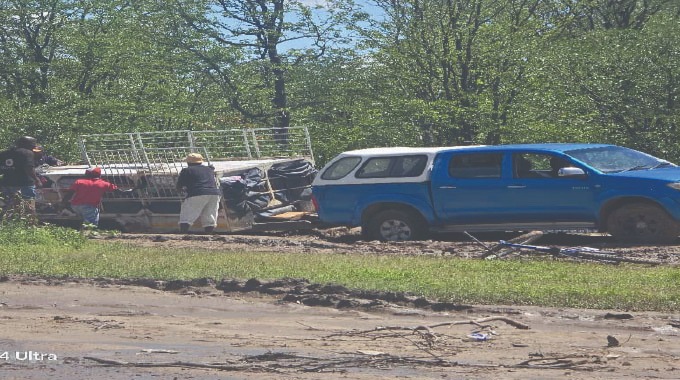
Mthabisi Tshuma, [email protected]
THE state of roads and bridges across much of Matabeleland South’s seven districts has become a crisis that deepens every time the rains fall, exposing the advanced state of wear and tear affecting ageing infrastructure and leaving many rural communities struggling to stay connected to the rest of the country.
The 2025/2026 rainy season was, in many ways, a blessing long awaited. Villagers watched with gratitude as dry fields came back to life, crops flourished and granaries slowly filled. In mud kitchen huts across the province, fires crackled daily as families roasted maize and peanuts, grateful that the land had once again provided food and relief after difficult seasons.
But the same rains that brought hope and nourishment also arrived with destructive force where infrastructure was already fragile. Roads were washed away, bridges collapsed or vanished beneath floodwaters, and entire communities found themselves cut off. What should have been a season of growth quickly turned into one of danger, with children struggling to get to school, the sick unable to reach clinics, and emergency services unable to cross rivers that had burst their banks.
In many areas, the danger lies in bridges built decades ago, designed for lighter traffic and rainfall patterns very different from those seen today. Built too low and lacking the capacity to withstand heavy vehicles or sustained flooding, they are easily submerged when rivers swell. Vehicles are forced to turn back, while pedestrians attempt risky crossings on foot, wading through fast moving water and placing their lives at risk simply to reach the other side.
The damage caused by this weakened infrastructure goes far beyond inconvenience. Farmers who benefitted from good rains are losing produce because they cannot reach markets in time. Crops spoil along the way, income is lost, and what should have been a profitable season becomes one of frustration and disappointment, even as nature continues to be generous.
The reality of the situation is felt in everyday journeys that have become exhausting ordeals. Before the rains, travelling from Ndolwane to Plumtree town in Bulilima District would take about two hours and 30 minutes. Today, villagers can spend more than five hours on the road, navigating diversions, deep mud and damaged crossings just to reach town.
A similar struggle is faced by residents travelling from Emvalweni village in Mangwe District. What was once a 45 minute journey now takes close to two hours, with each trip shaped by uncertainty and road conditions that change after every heavy downpour.
One of the worst affected roads remains the Plumtree–Maitengwe route, a critical corridor linking Zimbabwe and Botswana and supporting cross border trade and movement. Recently, this news crew came across a cross border transporter vehicle stuck deep in the mud just after Maitengwe Border Post, between Tjilukutu and Tjitabataba villages. The vehicle sat helpless, surrounded by churned up earth, reflecting the daily challenges faced by those who rely on the route for their livelihoods.
Mr Bukhosi Ncube, a cross border operator commonly referred to as Omalayitsha, said urgent attention was needed to restore the road and prevent further deterioration.
“This road is a key player in the economy of our country, as we bring in money through revenue paid at the border post. The state of the road as you enter the border post is so worrying. Even at the border post it’s always muddy and we are asking if the area can be paved.
“We therefore call upon the Government to prioritise fixing this road as it is costly for us to divert routes and use the Beitbridge route when in actual fact we will be going to places like Bulilima, Tsholotsho and Nkayi,” said Mr Ncube.
For small scale entrepreneurs, the poor road conditions are quietly undermining livelihoods. Ms Senziwe Mhletshwa, a villager from Empandeni East, said her egg business has been badly affected by transport delays and reduced travel.
“I used travel to Emvalweni settlement by Empandeni East village from Bulawayo almost on a daily basis because of my egg business with the bulk of my clients in Bulawayo. With the state of the roads I am now being forced to only make the travel once or twice a week which has had a blow to my business as my clientele has dwindled dismally,” said Ms Mhletshwa.
Government has, in recent years, embarked on efforts to rehabilitate damaged and ageing road networks across the province, with priority being given to major corridors and communities most affected by seasonal flooding. However, the scale of deterioration, combined with increasingly heavy rains, continues to present complex challenges on the ground.
Efforts to obtain a comment from the Matabeleland South Provincial Director in the Ministry of Local Government and Public Works, Mr Sijabuliso Ncube, were unsuccessful by the time of going to print. However, Mr Ncube is on record stating that Government is working to ensure that all damaged and ageing infrastructure across the province is repaired or replaced.
@mthabisi_mthire



 Online Reporter