daniel chigunwe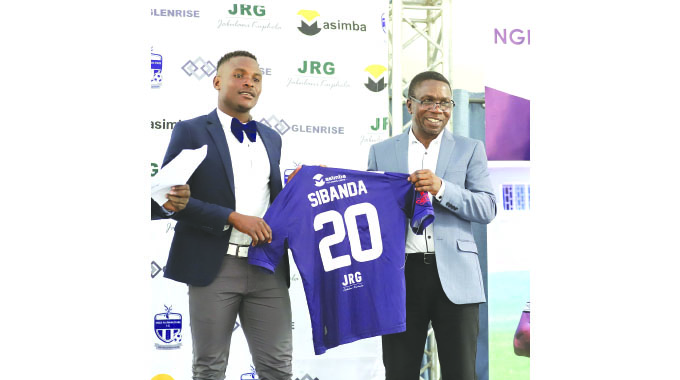
Tadious Manyepo Sports Reporter
AT just 23, Ngezi Platinum Stars full-back Tapiwa Sibanda counts himself lucky not to have tasted prison life. Several times he was tempted to engage in criminal acts as street life pushed him into the obvious. But, somehow, his sixth sense kept reminding him, being a destitute was something temporary, notwithstanding his age.
“I was only 12 or 13 years old when I found myself living in the streets.
“Life was tough and I had just dropped out of school when I was barely in Grade Six following my mother’s death.
“I was literally eating from the bin…,” recalls Sibanda.
“I am the last born in a family of eight and my mother’s death affected me the most. It was so hard. My father is diabetic and he was hardly able to look after himself. He was also badly affected by my mother’s death. He too led a desperate life and he would wander around…
“You know street life is something else, I was tempted, at every turn, to commit crime and take dangerous substances but I would always tell myself, this was not me, this was not the life I wanted to lead…” After getting wind of what her nephew had become, Sibanda’s maternal grandmother, who stayed in Mutoko, came looking for him in the streets of Harare and, luckily, managed to find him.
“Despite the fact that I had spent part of my life in Chitungwiza and then in the streets where everything was fast, I couldn’t find it difficult to adjust to rural life.
“I enrolled for Grade Six at Tsiko Primary School where I made a name for myself playing football.
“But I wouldn’t see off the Grade 6 studies that year as I dropped out of after the guardians failed to raise the required school fees.”
Things got worse after his grandmother passed on.
“Down there in the village I was staying doing nothing and at one point became a herd’s boy, tending cattle for several families.
“I would cry every day, cursing everything.”
Meanwhile, at every turn in the village, Sibanda would always carry with himself a plastic ball he would play either with friends or by himself. In 2015, he decided to take a bus back to Harare not exactly sure where he was heading to. Along the way Sibanda remembered he had a brother who wouldn’t turn him away.
“I then decided to go to his house. He was renting one room in Chitungwiza near where we were all raised up.
“My brother was already married and it made everything complicated. But I should say he helped me find myself again.
“He survived out of fixing people’s shoes and I also learnt the skill. I would become a cobbler and contributed a lot in our upkeep. Actually I was able to buy my first football boots from the money earned from this trade. That is when I started attending training sessions with such teams like lower division side Cargo Carriers which would help mould me into the player I am today.”
Two years later, Sibanda joined Black Rhinos in a move he describes as surreal.
“It was something phenomenal. I knew I wouldn’t be in a position to play in every match but I certainly realised after all the struggles, I would have something to call a job.
“At Black Rhinos, there was Jameson Mukombwe (at right-back) and he was then a top, top player who was even in the Warriors squad.
“The competition was stiff and I was contend being his understudy.” That was how Sibanda ended up being loaned to fellow army team Cranborne Bullets in 2020. Another one-year struggle was awaiting.
A lengthy Covid-19-induced lock down meant Sibanda had to find something to do to look after his family. His father is also now under his care.
“I have built a cottage at a stand I acquired from my football savings in Southley Park.
“I have a wife and a kid. After signing my first contract with Black Rhinos, I decided to look for my father and I took him under my care.
“So when I am away at work (in Ngezi), he would be with my wife. I am permanently grateful to her.
“So when the game was hit in the Covid-19 storm, I had to man on. I was moulding bricks in Southley Park and Ushewokunze to supplement what Cranborne Bullets was giving me. I want to thank this team for looking after us during those hard times.
“Nevertheless, I had to mould bricks and sometimes assisting bricklayers, those things…”
But when the game made a rebound with the Chibuku Super Cup last year, Sibanda took the local football fraternity by storm. He helped the top-flight debutants reach the semi-finals where they were beaten 1-0 by his new employers – Ngezi Platinum. But he had done enough in the tournament to attract interest from several clubs, including Dynamos, Highlanders and CAPS United before he settled for the Mhondoro team.
Sibanda also got his first call-up to the Warriors when he made the provisional squad for the African Cup of Nations finals which was staged in Cameroon between January 9 and February 6 this year.
“That was a dream come true. I couldn’t imagine it but there I was in a team with the best players from Zimbabwe. I know it’s only the beginning…” His former Cranborne Bullets coach Nesbert “Yabo” Saruchera believes Sibanda can easily become one of the best players in Zimbabwe.
“Tapiwa (Sibanda) is definitely one of the top prospects in the local game. His potential is magnificent,” said Saruchera.
“He can easily become one of the best players in the country. He has everything in himself, is a good defender and a good attacker. His runs on the flank and perfect crosses is what every coach look at when examining a wing-back. His talent is top of the shelf.” As he was unveiled along with four other new faces at Ngezi Platinum – Last Jesi, Delic Murimba, Carlos Mavhurume and Takunda Benhura – on Monday, Sibanda couldn’t help but shed a tear as the players took photos in the aftermath.
“This is the only thing (playing football) I know in my life. I haven’t been to school and I know only football can save me from poverty…”


 Online Reporter