admin
admin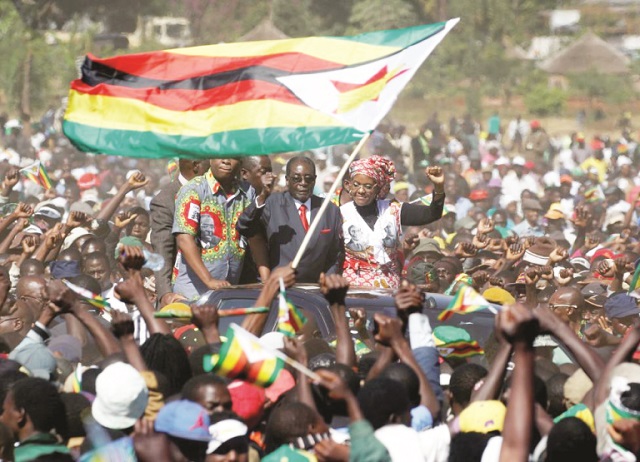

Nduduzo Tshuma
THE year 2016 was an eventful political year characterised with a number of developments but most notably infighting within the ruling Zanu-PF almost threatening to tear it apart.
However, at the recently ended revolutionary party’s 16th Annual National People’s Conference, Zanu-PF attended to the divisions and emerged the strongest political party in the land.
President Mugabe, opening the conference, said despite internal fights, Zanu-PF remains strong and those who leave the party would always come back.
“The party remains strong, there is no doubt about this, infact very strong and formidable by any account. We have had all our opponents, prostrated thrown down flat on the ground, they are just wandering aimlessly.
“Parties are sprouting without any ideology, without any thinking, they have practically no ideas, practically no principles and therefore practically no thinking of how this country can be transformed and have its economy transformed,” said the President.
He said external forces had also failed to destabilise the Zanu-PF Government.
“Externally, countries that have been hostile to us and have all this time expected that the Zanu-PF Government shall listen to them and that there shall be regime change have failed to achieve that. There has not been regime change and there shall not be regime change so they stand defeated on that one,” said President Mugabe.
“We have had quite some success in that area, we still have to fight anyway to defend ourselves, protect our policies and programmes so that we are not inhibited in what we try to do in Zim Asset,” said President Mugabe.
He called for unity within Zanu-PF saying the spirit that bound the party during the liberation war, should be the same that binds it now not only as a liberation movement but also as a party that forms a government.
One Million-Man March
The Zanu-PF Youth League organised a march in solidarity with President Mugabe, confirming that the President and the ruling Zanu-PF are still very popular in the country.
MDC-T chaos
Opposition parties continued to disintegrate with factionalism rocking the main opposition party MDC-T. Further divisions were to emerge when MDC-T leader Mr Tsvangirai revealed in June that he had been diagnosed with cancer of the colon with officials fighting as they positioned themselves to succeed him.
The party was shaken again when Mr Tsvangirai appointed Mr Nelson Chamisa and Engineer Elias Mudzuri as additional vice-presidents in a move that was viewed as attempts to limit the powers of Ms Thokozani Khupe.
The party has also been evasive on the issue of coalition with other political parties.
Failed Mawarire
Now self-exiled Pastor Evan Mawarire of the #ThisFlag made futile attempts to cause chaos in the country by calling for a mass stay away which he termed the national shut down.
However, the closest he came to achieving his agenda, was an attempt to hijack a strike by civil servants over salaries on 6 July to claim credit that he had caused people not to go to work. Successive attempts for the so called shut down failed dismally and the shamed Pastor skipped the border for self exile in the United States.
The Tajamuka that never was
During the same period, an MDC-T affiliate organisation calling itself #Tajamuka tried to cause civil unrest by holding violent demonstrations that led to the destruction of property in Harare.
The demonstrations were largely ignored by the people.
National Electoral reform Agenda (Nera)
Opposition political parties joined together under the banner of National Electoral Reform Agenda (Nera) pushing for what they called the electoral reforms. The grouping of 13 political parties engaged in a number of demonstrations, some which turned violent.
The ZimPF Congress that never was
After getting into the opposition politics fray following her expulsion from the Government, former Vice President Dr Joice Mujuru’s ZimPF party failed to hold its elective congress initially scheduled for December.
Instead, the party was rocked by divisions and infighting as officials angled themselves for positions.
Negotiations for a coalition with other parties also hit a snag with indications that the Dr Mujuru led party wants to go it alone in the 2018 elections.
The party was also accused by Mr Tendai Biti’s People’s Democratic Party of dealing in bad faith by snatching its members most notably vice-president Samuel Sipepa Nkomo who crossed the floor to Dr Mujuru’s party.
The death of Biti’s PDP?
Mr Tendai Biti’s party was hit by a mass exodus of senior party officials threatening to destroy the political organisation. The ex-members spread among MDC-T and ZimPF.
MDC-T/MDC Re-unification
In July this year, MDC leader Professor Welshman Ncube staged a spectacular about turn, cosying up to his MDC-T counterpart, Mr Morgan Tsvangirai, whom he vowed never to work with because of “his dictatorial tendencies and propensity to breach the party constitution at will.”
Reeling under resignations by senior party members including former acting secretary-general Mr Moses Mzila Ndlovu and 64 others,
Prof Ncube said his party was willing to join hands with Mr Tsvangirai for a “greater national good”.


 Online Reporter