

 dyton mupawaenda
The Great Zimbabwe Initiative is hosting Innovation Week Zimbabwe 2025 alongside the ICT Start-up Policy Hackathon at the Postal and Telecommunications Regulatory Authority of Zimbabwe (Potraz) main auditorium.
The event is supported by the Ministry of Information Communication Technology, Postal and Courier Services, POTRAZ, the Zimbabwe Youth Council and the Institute of Entrepreneurs Zimbabwe.
Running under the theme: “Accelerating the Digital Economy for Inclusive Development,” the hackathon aims to drive policy solutions that foster innovation and economic growth.
Our reporter, Ivan Zhakata, is at the venue, bringing us live coverage.
Excitement builds as Innovation Week Zimbabwe 2025 kicks off
As Innovation Week Zimbabwe 2025 and the ICT Startup Policy Hackathon prepare to kick off at the POTRAZ main auditorium, the atmosphere is electric with anticipation.
A steady hum of conversation has filled the air as attendees eagerly await the arrival of the Minister of Information Communication Technology (ICT), Postal and Courier Services, Tatenda Mavetera, who will officiate the event.
Entrepreneurs huddle in small groups, exchanging ideas in hushed yet excited tones.

Laptops glow as last-minute slides are adjusted, while startup founders rehearse their pitches with focused determination.
In one corner is a group of young innovators animatedly debating the future of digital entrepreneurship.
Across the room, journalists adjust their cameras, fine-tuning lenses and exchanging quiet remarks about capturing the Minister’s entrance.
Meanwhile, officials from POTRAZ, the Ministry of ICT, the Zimbabwe Youth Council, and the Institute of Entrepreneurs Zimbabwe are engaging in quiet conversations.
Bruteforce Engineering showcases cutting-edge tech
Bruteforce Engineering, a fast-growing technology and engineering firm, is turning heads at Innovation Week Zimbabwe 2025 and the ICT Startup Policy Hackathon, currently underway at the POTRAZ auditorium.
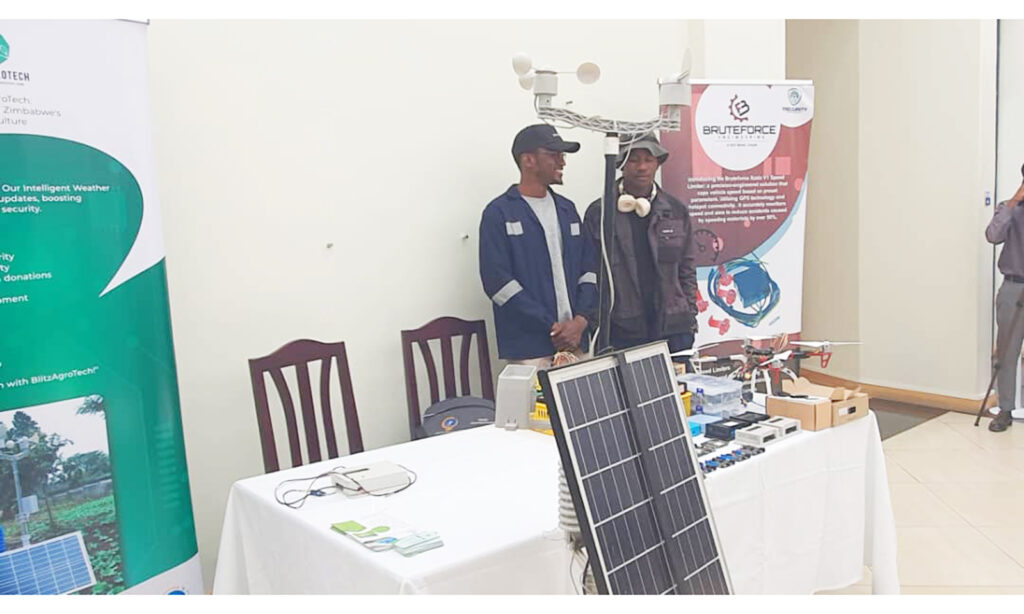
The company is showcasing a range of cutting-edge solutions, from vehicle tracking and speed limit devices to fuel and driver behaviour monitoring, smart electronic systems, research and development and 3D design and printing.
The Innovation Week Zimbabwe and ICT Startup Policy Hackathon, hosted at the POTRAZ auditorium has brought together entrepreneurs, tech startups, policymakers and investors to discuss and promote innovation-driven solutions.

The event serves as a platform for startups like Bruteforce Engineering to gain exposure, connect with potential partners and contribute to the growth of Zimbabwe’s technology ecosystem.
Dr Chirume opens Innovation Week
The Permanent Secretary for Information Communication Technology (ICT), Postal and Courier Services, Dr Beaullah Chirume, has arrived at Innovation Week Zimbabwe 2025 and the ICT Startup Policy Hackathon to officiate the event on behalf of ICT Minister Tatenda Mavetera, who was unable to attend.
She was welcomed by industry leaders, startup founders, and policy-makers eager to discuss the role of innovation in shaping Zimbabwe’s digital future.
On arrival Dr Chirume took time to engage with participants, listen to ideas from young innovators, and explore exhibitions showcasing emerging technologies across various sectors.
Zim targets 80 percent broadband coverage by 2030
The Government is ramping up investments in broadband infrastructure to ensure 80 percent of the population has access to affordable, high-speed internet by 2030, as part of its drive toward a digitally inclusive economy.
Speaking on behalf of the Minister of Information Communication Technology (ICT), Postal and Courier Services, Tatenda Mavetera, at the Innovation Week 2025 and ICT Start-up Policy Hackathon, ICT Secretary, Dr Beaullah Chirume highlighted technology’s pivotal role in national development.
“Innovation is not a luxury — it is the lifeblood of economic growth and social progress,” she said.
“Under President Mnangagwa’s leadership, we are investing ambitiously in broadband expansion to ensure 80 percent of Zimbabweans have access to affordable, high-speed internet by 2030.”
She said this year’s theme: “Accelerating the Digital Economy for Inclusive Development,” aligns with the National Development Strategy 1 (NDS1), and reinforces the country’s vision of leveraging technology for economic transformation.
Dr Chirume highlighted ongoing Government-led initiatives such as the Smart Zimbabwe 2030 which aims to enhance digital literacy programmes and establish tech hubs nationwide.
“Our focus is on reducing regulatory bottlenecks, incentivising venture capital and protecting intellectual property rights,” she added.
“We are also finalising modalities for a National ICT Innovation Fund to provide start-ups with seed funding and regulatory support.”
She said public-private partnerships are key to fostering a thriving digital ecosystem.
“Zimbabwe is open for business through innovation-led growth,” she added.
“This is your moment — seize the opportunities, collaborate and build solutions that shape Zimbabwe’s future.”
‘Streamline ICT policies to unlock Zim’s digital potential’
Industry leaders have called on the Government to streamline its ICT development policies by removing barriers such as high startup costs, limited access to funding access and complex registration processes to accelerate growth of the local tech sector.
Speaking at the ongoing Innovation Week 2025 and ICT Startup Policy Hackathon at the POTRAZ auditorium, Great Zimbabwe Initiative (GZI) chief executive Mr Stephen Muraga said there is an urgent need for policy reforms to nurture Zimbabwe’s burgeoning tech ecosystem.
“Zimbabwe has the talent and potential to become a leading tech hub in Africa, but without the right policies, many startups struggle to survive,” he said.
“We must create policies that simplify startup registration, provide tax incentives and open funding channels for young innovators.”
The event, which is running under the theme: “Unlocking Zimbabwe’s Digital Future,” has brought together policymakers, investors and entrepreneurs to discuss the challenges facing the ICT sector.
As part of the hackathon, participants drafted policy proposals, including tax breaks for startups and public-private funding initiatives.
Mr Muraga highlighted that digital transformation could be a major driver of economic growth and job creation.
“If we invest in ICT now, we will see long-term benefits in employment, business growth and global competitiveness,” he said.
The Innovation Week 2025 continued with discussions on fintech, artificial intelligence and e-commerce.



 Online Reporter