

 admin
admin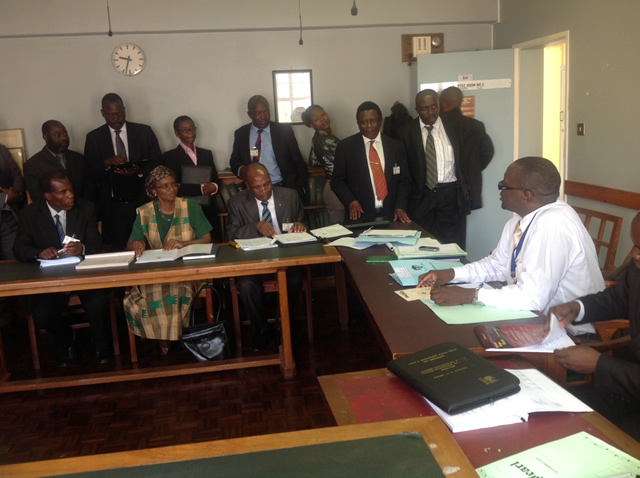
Lloyd Gumbo Herald Reporter
GOVERNMENT must take action against errant headmasters who send away pupils for not paying school fees and levies, lawmakers demanded yesterday.
They made the remarks when officials from the Ministry of Primary and Secondary Education appeared before the parliamentary portfolio committee on Education, Sport, Arts and Culture.
Acting permanent secretary in the ministry Mr Rogers Sisimayi said Government had instruments in place to discipline headmasters who defied its directives.
But committee chairperson Cde Temba Mliswa (Zanu-PF) said it was high time Government made follow-ups to ensure its directives were complied with.
“My worry is that, it’s not the first time that we have heard about children being chased from school,” said Cde Mliswa.
“We are honourable members of Parliament, it happens. But you seem not to have control over that. Yet it’s a nice Press statement which, the minister says ‘no children must be chased from school’ yet it’s happening. So what are you doing?
“We have had enough of those Press statements. We want action since you are the authority.”
Speaking to The Herald after the meeting, Mr Sisimayi said non-compliant headmasters would be charged under provisions of Statutory Instrument 1 of 2000 under Schedule of Acts of Misconduct.
Watch this video
He said the ministry received reports from district offices about the goings on at schools.
“If there is an errant head who decides to expel children against the ministry’s instruction, then we have certain rules and regulations in terms of action against that head.
“So what we are saying is that the ministry has issued a directive and that directive must be complied with.
“On the ground, we have officers that are giving us information in terms of who is complying and who is not complying. Those who are not complying will have to face disciplinary action.”
However, legislators dismissed the claims, saying no action was being taken since headmasters continued to defy the directive.
MDC-T legislator for Glen View North Mr Fani Munengami said: “My child went with the receipt and the other one who opened yesterday also went with the receipt . . . Without a receipt they are not allowed in. It’s the trend in all schools. To say that you discipline those headmasters is being disingenuous.”

Buhera West MP, Cde Oliver Mandipaka (Zanu-PF) said his child was also a victim of the system.
Watch this video
“Last year, my child was doing Form Two. I was here in Harare phoning the headmaster at a certain school in Buhera saying, I am going to the bank, and can you allow the child in? He was not allowed. He didn’t have a receipt. It’s a living testimony. They said he must go back.”
Shurugwi South legislator Cde Tapiwa Matangaidze (Zanu-PF) inquired if the ministry also controlled private schools.
“All schools that offer education in Zimbabwe register with the ministry. We expect them to comply with the ministry regulations and we have a right to revoke any registration if there are practices which go against the ministry policy,” said Mr Peter Muzavazi, who is the director of Policy, Planning, Research and Development.
Chiwundura MP Cde Kizito Chivamba (Zanu-PF) said there were a number of private schools that charged fees as high as US$6 000 per term despite the fact that there were Government schools in the same area that charged US$400 per term.
Mashonaland West proportional representation legislator Ms Consilia Chinhanzvavana (MDC-T) said it was important for Government to consider engaging local communities so that they could help in developing schools.
Mr Sisimayi said they submitted a bid of about US$1,23 billion to Treasury, but were allocated about US$866 million.
He said about 96 percent of the allocated funds would go towards employment costs, crippling other priority areas.
Legislators said they would lobby Treasury to consider increasing allocations to the ministry.
Meanwhile, earlier on, some officials from the ministry of Sport, Arts and Culture and those from its parastatals gave oral evidence before the same committee for about two hours while standing due to space constraints.
Legislators were not spared as some of them had to stand for the duration of the meeting while others took turns to sit since there were not enough chairs and space.
Some of the MPs had to sit on window sills.



 Online Reporter