admin
admin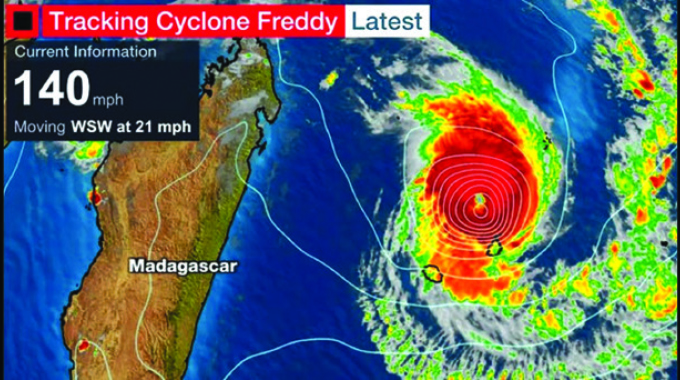
Ruth Butaumocho-African Agenda
The month of February is proving to be tumultuous following a series of natural disasters that have struck several countries across the globe.
More than 47 00 people died in the Turkey and Syria earthquake that hit the two neighbouring countries last week.
Africa could also find itself under siege amid revelations that a dangerous cyclone heading towards the south- eastern of the continent, is expected to dump heavy rain and turbulent winds this weekend.
The United Nations has since labelled Cyclone Freddy as “dangerous”, saying it could cause significant losses of human lives, property and infrastructure to more than two million people mainly in Botswana, Eswathini, Madagascar, Mozambique, Zambia and Zimbabwe.
Mozambique will likely be struck today, according to the country’s national meteorology institute. The country has already experienced widespread flooding in recent weeks, raising fears from the UN humanitarian agency that the “severe humanitarian situation in the region” may escalate.
It is heart-rending, sad and unfortunate that Africa will have to battle yet another natural disaster of such magnitude, barely few months after coming out of several cyclones that affected different parts of the continent.
The significant battering that was experienced in some parts of South Africa, Nigeria and Angola among other countries also resulted in major loss of life, displacement of large populations, and costly damages to major infrastructure.
Already, fears abound that Cyclone Freddy will leave the same trail of destruction in countries that are already battling to reconstruct, regroup and protect their populace from further harm.
At the rate at which natural disaster are occurring, it has become imperative for African states to prepare for the next disaster, weeks, months and years before it happens.
Civil protection units in countries likely to be hit by Cyclone Freddy are probably making last minute strategies to prepare against the looming disaster.
Such strategies may already be late considering the speed at which the cyclone is traveling from the time it was detected in Melbourne on February 6.
Online reports say storm surge – an increase in water level associated with the storm — has been changing its depth from the time it was discovered and may not be the same by the time it reaches its final destination.
The lessons that Africa learnt when Cyclone Idai which hit the southern region should be the basis of the formulation of practical and workable disaster plans that countries should be implementing to reduce further loss of lives.
It would be highly irresponsible, sad and unfortunate for those entrusted in crafting disaster plans and allocation of resources to only move in when landfall, violent winds and rain have already hit the land.
Help may be sent, but it would too late to salvage the situation.
It would be like the case of closing the gate, long after the horses bolted.
The region’s last brush with Cyclone Ida taught us many lessons that we need to constantly introspect on, while strengthening our state of preparedness to any natural disasters which are increasingly becoming regular owing to the effects of climate change.
It remains important to have a template for disaster preparedness and management because of the increase in cyclones and other extreme weather phenomenon’s like droughts and floods, a clear indication of the intensifying effects of climate change.
The template should proffer short and long-term mitigating measures that are ably supported with adequate resources — both human and financial.
Countries are declaring states of emergency while climate change is increasing variability in weather patterns, and other risks such as financial shocks are likely, and should be taken seriously. Therefore, the need to build the general resilience of populations and prepare for these intersecting risks is critical.
This will require countries to break down existing silos between sectors, including disaster management, health, meteorology, agriculture and finance, so that these can respond simultaneously and can be activated at one go.
Mobilisation of resources is a critical component in disaster management, with billions of dollars needed to save lives in the event that Africa continue to experience all forms of natural disasters, that could further destroy lives, while displacing millions.
On a country level, the existence of the National Climate Policy and the National Climate Change Responsive Strategy —should guide the country and highlight the prominence that climate change needs to have, mobilising resources towards such a noble cause should not be a problem.
Because natural disasters permeates through political borders, countries should have sound continental risk management plan, which can be implemented at the slightest indication of danger.
Covid 19 presented the world with enough lessons after countries had to scramble for solutions to avert catastrophic situations, which emerged following the outbreak of the pandemic.
The rate at which solutions were found was unparalleled, and the same feat can be achieved, to counter the effects of natural disasters, which are increasingly becoming frequent.
Nations can take cue from the Africa CDC which took a pooled-resource approach to overcome the continents’ critical shortage of Covid-19 medical supplies at the height of Covid-19.
Its Africa medical supplies platform ably supported the mother body by pooling certified medical suppliers and aggregates demand to create a larger market.
During Covid-19, this consolidated approach enabled competitive pricing and ensured secure supplies, making it easier for member countries to assist medication without any hassles. Departments entrusted with disaster preparedness can learn the value of collaboration through planning, strategising and pooling resources for a worthy cause in turbulent times that Africa finds itself.
Countries cannot develop economically without addressing the risks that can quickly undermine decades of progress, hence it is now imperative for member countries to collaborate on areas of deficiency and abundance.
History has shown that early anticipation and fully-funded response to natural disasters of any magnitude limit their impact by huge margins. Learning from Covid-19 and a long history of natural disasters, governments need to put in place comprehensive response plans.
In effect, governing and managing is anticipating, resilience, adaptation and mitigation. Countries need to know what they might face, prepare to act, and have the funding to respond. Without a disaster preparedness plan, no recovery plan is complete.
Three years after Cyclone Idai ravaged several southern eastern African countries, the damage and the impact is still very severe, and may take years before proper rehabilitation is complete.
Rehabilitation would have been faster had they been a fund to oversee and manage such a calamity.
If the past weeks have taught us anything so far, it is that anything is possible and in 2023, more could be coming from where the two disasters emerged, hence the need to prepare-with haste.
Feedback:[email protected]



 Online Reporter