Online Reporter
Zvamaida Murwira
Senior Reporter
AFRICA must reject the horse-rider relationship being perpetuated by the Global North and push to reset relations and ensure the continent becomes a master of its destiny to attain economic independence and shared prosperity, President Mnangagwa has said.
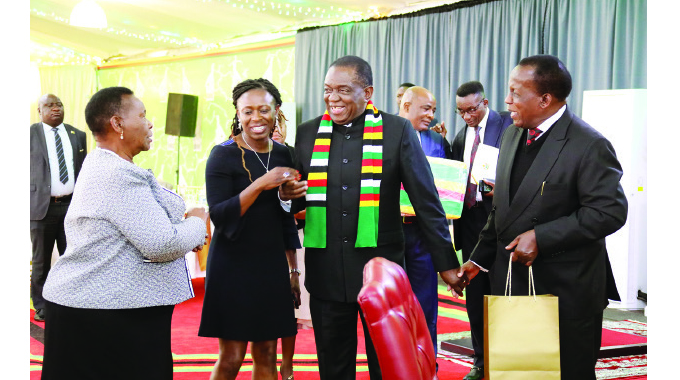
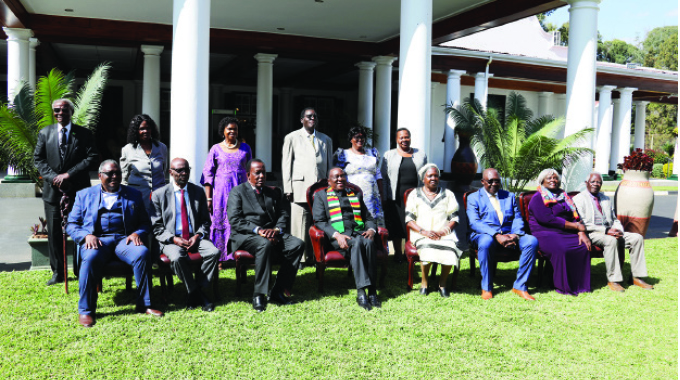
He made the remarks yesterday at State House in Harare, where he was hosting his colleagues from the University of Zambia’s 1975 Law degree class, with whom he studied in Lusaka.
Most of his colleagues became judges, attorneys-general and ambassadors, among others.
President Mnangagwa said after completing his law degree, he practiced law in Zambia before joining his compatriots in Mozambique to wage the war of liberation and free people from the yoke of colonialism.
He said as he practiced law in Zambia, the question that lingered in his mind was his purpose in life and community, hence the decision to leave the practice where he could have a comfortable life as a private legal practitioner to join the liberation struggle.
“While we managed to win political emancipation on the continent, much more must be done to realise sustainable economic independence.
“Our continent continues to grapple with skewed economic relations. These emanate from the Global North, with some countries assuming that they have an inalienable right to keep us in perpetual subjugation.
“This will never be allowed to continue. Africa must confidently assert her standing in the comity of nations. Relations between the North and South should be reset.
“We reject the horse and rider relationship. We are masters of our own destiny. Africa will not fail to deliver for our countries and the continent economic independence and shared prosperity, for the benefit of our peoples. We shall win no matter the challenges and dangers,” said President Mnangagwa.
He said Zimbabwe eventually claimed political independence following the protracted war, against the seemingly indomitable racist Smith regime.
The post-independence years, said President Mnangagwa, were characterised by varying epochs, but ultimately, the people remained guided by the need to reclaim their land from those who had brutally stolen it from them.
“We take pride that as Zimbabwe, we achieved this objective. However, the consequences saw neo-colonial Western establishments imposing sanctions on our motherland, Zimbabwe.
“Today, 25 years after imposition of these heinous sanctions, we are marching on, inspired by our national development philosophy, that ‘a country is built, ruled and prayed for by its people’/Nyika inovakwa, inotongwa, inonamatigwa nevene vayo/Ilizwe lakhiwa, libuswe, likhulekelwe ngabanikazi balo.
“All our people are determined to build, modernise and industrialise our country, no matter the odds pitted against us,” he said.
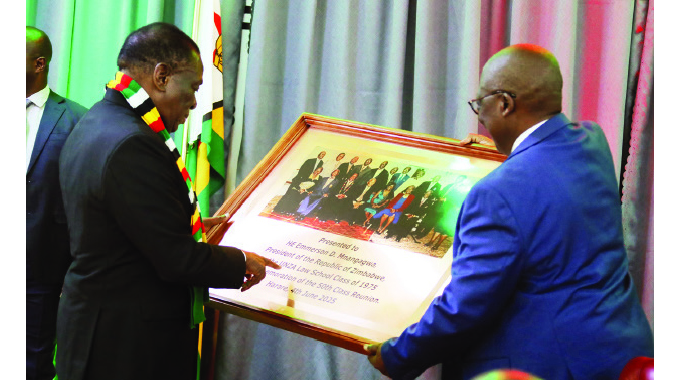
President Mnangagwa explained that the Law School at the University of Zambia had produced two Presidents, a chief justice and two speakers of the National Assembly in Zambia.
Besides him, the other president was President Edgar Lungu.
“This is quite a feat. All these achievements attest to the important role played by institutions of higher learning as incubators of peace, development, modernisation and industrialisation of our countries.
“I challenge the academia in this arena of the education sector to always be aware of the weighty responsibility which is upon them. Their efforts not only contribute to our present national, regional and continental development aspirations, but also the realisation of the ‘Africa we all want’ for a more prosperous and brighter future for generations to come,” he said.
The President described the 50th reunion of their class as a joyous moment for celebration, meant to reflect on achievements and what remains.
“Since our graduation, a lot has happened. The world then was very different from what it is today. Some of the countries in Africa, including us here in Zimbabwe, were still under brutal colonial rule or apartheid. It is heartening that since then, almost every country in Africa has been liberated and are now independent, free and sovereign nation-states,” he said.
President Mnangagwa said members of their class had played their part in the process of political and socio-economic transformation of communities and have impacted humanity anchored on the study of law.
“Some of us took up leadership roles in Government, served as ministers, judges, attorneys general, solicitors general, bank governors, presidents of regional banking institutions and legal advisors to the United Nations.
“This also included some participating in important roles such as the establishment of the International Criminal Court; serving in Ad Hoc Criminal Courts as well as settling disputes between countries. Others rose to the ranks of professors, ambassadors, passionate legal practitioners and legal advocates. We even produced a President,” he said to a rousing applause.
He challenged his colleagues to consider a tangible project that they could collectively undertake that will have an impact and improve the quality of life of people or chosen beneficiaries.
“Personally, to demonstrate social responsibility and give back to our Alma Mater, I established a Fund which awards Zimbabwean and Zambian students scholarships to study law and other disciplines.
“The Scholarship Fund was established in 2019, with a broader objective to assist the less privileged and talented young students. Through the generous support and partnerships of well-wishers, the Fund is so far registering several success milestones.
“I challenge those whom we have interacted with from across all sectors and professions, to draw lessons from this, our ‘Class of 75’ and think of how best they too, can give back to humanity, including for the development and prosperity of Africa,” said President Mnangagwa.
Earlier on, one of President Mnangagwa’s colleagues and close friend, Justice Esau Chulu chronicled their early life at the University of Zambia.
He said they shared the same room and would sleep side-by-side in a show of closeness and their friendship continued even after their graduation.
One of the telling incidents he reminisced was an occasion where President Mnangagwa’s first child went missing soon after she had been delivered at a Lusaka hospital.
The child is Farai Mnangagwa-Mlotshwa.
It took a whole effort by everyone to look for the child at the hospital but the search did not produce positive results.
He said they even went outside the hospital but failed.
There were some babies that would be brought to the mother but she would say it was not her child.
Justice Chulu said it later emerged that there was an accidental swap of children discovered, which then led to the reunion of the baby and her parents.
He described the incident as tension filled and stressful.
Justice Chulu commended President Mnangagwa for his humility by inviting his long time colleagues.
“You are an exceptional leader who has demonstrated true leadership. You never look down upon your colleagues despite your elevation,” said Justice Chulu, who called President Mnangagwa by his first name to show their closeness.
The event was attended by Cabinet ministers, Zanu PF Politburo members, Zimbabwe’s Ambassador to Zambia Charity Charamba and senior Government officials.
Later in the day, the alumni toured the Museum of African Liberation and were led on the tour by its chief executive officer, Ambassador Kwame Muzavazi.
Speaking on the sidelines of the tour, head of delegation Mr Bonavinchia Muthale said they had been impressed by what they saw, describing the project as ambitious.
“ . . . we have been accorded a tour of this museum to share the experiences that you are going through. I must say we are quite impressed with what has been laid out.
“It looks like a highly ambitious project, but with the support of all the African countries, I can see this project fulfilling its objectives,” he said.