Online Reporter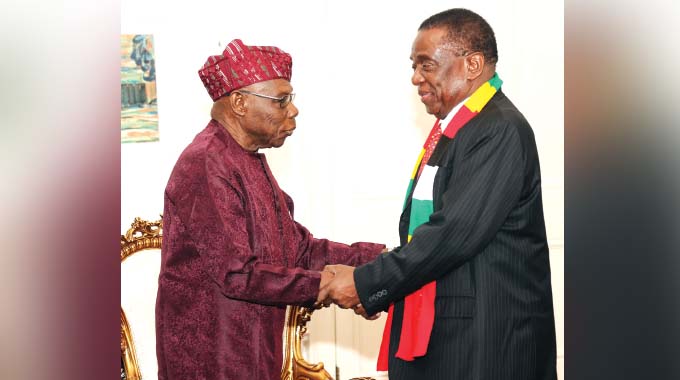
Debra Matabvu
FORMER Nigerian President Olusegun Obasanjo has urged African nations to champion their own solutions to the continent’s challenges, stressing that any resolutions must prioritise the interests of the African people.
Speaking after meeting President Mnangagwa at the State House in Harare yesterday, President Obasanjo stressed that while Africa should receive assistance on various challenges faced on the continent, it should lead in finding the solutions.
The former statesman, one of the five facilitators appointed by SADC and the East African Community (EAC) to mediate in the eastern Democratic Republic of Congo (DRC) crisis, was in the country to brief President Mnangagwa, who is the SADC chairperson, on the ongoing mediation efforts.
Recently, SADC-EAC leaders appointed former Nigerian President Olusegun Obasanjo, former Kenyan President Uhuru Kenyatta, former South African President Kgalema Motlanthe, former Central African Republic President Catherine Samba Panza, and former Ethiopian President Sahle-Work Zewde to spearhead efforts to end the conflict in the DRC.
However, there are reports that DRC President Felix Tshisekedi and his Rwandan counterpart, Paul Kagame, have been having separate peace talks led by Qatar.
“Our leaders have now decided there must be an end to this. There are outsiders who want to help us, and we say, yes, come.
“We do not mind help, whether from the east or from the west, from the south or from the north. Come and help us.
“Please, let us have as many cooks as want to be in this soup that we are making. But there will be a chief chef, and that chief chef must be from our own regional organisation. We believe we can achieve, and we have to achieve, an African solution for African problems,” former President Obasanjo said.
He also noted that various countries on the continent have benefited from African-grown solutions.
“With the assistance and the commitment of those who want to help us, no matter what their interest may be, if their interest can be accommodated, we should accommodate it. But if their interest will be inimical to what we want to achieve, we should be able to tell them gently, ‘now, the way you want us to go will not be in our interest.’ We have done that successfully in Tigray and Ethiopia. And we are able to do it anywhere else,” he said.
The former president praised the current SADC chairperson, President Mnangagwa, and EAC chairperson, Kenyan President William Ruto, for the efforts undertaken to resolve the DRC crisis.
“As you may know, one of the things that he has done as the current chair of SADC (President Mnangagwa) with his brother, the chair of the East African Community, President Ruto, was to join what they used to call the Luanda process and the Nairobi process, and they have brought it into one, under the joint East African Community and SADC.
“And five of us have been appointed as facilitators. I happen to be one of the facilitators. And the present chair of the AU (African Union) has also appointed the president of Togo . . . So we have six of us.
“How do we move together? How do we keep updating our leaders? How do we report to them (SADC-EAC joint meeting)? How do we give them what we know, and they give us what they know? So that we can put to rest permanently the conflict in the DRC.
“I went to the DRC for the first time on the 5th of October, 1960, as a young military officer. The problem that was there in the 1960s is still there today. After 65 years, it cannot go on.”
Recently, the United Nations Security Council applauded efforts by the two regional blocs to resolve the DRC crisis and strongly condemned the ongoing offensive by M23 rebels in eastern DRC.
It reiterated the urgent appeal for all parties to conclude an immediate and unconditional ceasefire, as called for by leaders from the EAC and SADC.
The M23 rebels have been moving south towards Bukavu, the capital of South Kivu province, in what appears to be an attempt to expand their area of control in the country’s east after capturing the city of Goma.
The group has accused the government of Congo of not living up to the peace deal and fully integrating Congolese Tutsis into the army and administration.
The latest advances are part of a major escalation of a decades-old conflict over power, identity, and resources that has killed hundreds of thousands of people and displaced millions since its recent resurgence.
According to reports, at least 7 000 people have died in the fighting since January this year, with over 600 000 people having been displaced by the fighting since November 2024.