admin
admin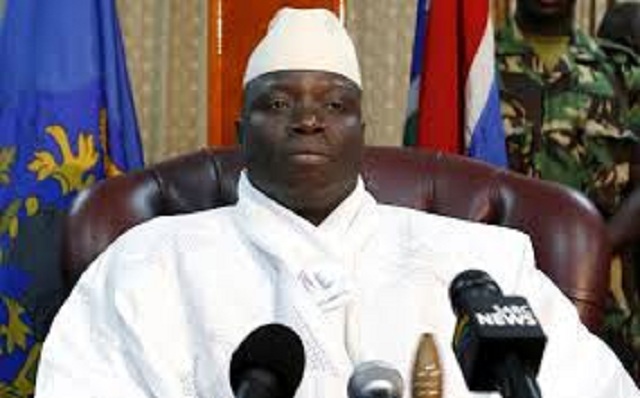
Stephen Mpofu
Two particularly sinister political trends in Africa at this year’s end will certainly not have failed to encode a grim history of the continent with some chapters written in blood.
Events in purview in this discourse pertain to the Democratic Republic of Congo and the Gambia respectively where leaders there are maniacally clinging to power.
In the latter country, president Yahya Jammeh stakes his popularity in an election after ruling his country for 23 years. He is trounced by a rival leading a coalition of opposition political parties. He concedes defeat.
But as the sweetness of power begins to desert his conscience, he changes his mind and digs in his heels, surrounded by members of his security because, apparently, the future ahead of him as an ordinary citizen does not look appetising at all.
Leaders from the regional grouping, the Economic Community of West African States, descend on him in hopes that their combined muscle will dislodge Jammeh from his entrenched position. But this is not to be.
Later a summit of all ECOWAS leaders resolve to attend the January 19 inauguration of Gambia’s new president, a little known businessman, Adama Barrow, to ensure that he embarks on his new term as his country’s head of state.
If by that time Jammeh defiantly remains in power, fortified by his security, the ECOWAS leaders will obviously try to remove him by military force supported by the Gambian coalition – a probability that portends a bloody coalition between the opposing forces.
Reports that some people have already been shot dead by President Joseph Kabila’s security forces in the DRC suggest that parts of that country’s history are already written in crimson red. The trending conflict there is far from over as Kabila – whose predecessor and father, Laurent Kabila, was shot and killed by a bodyguard in 2001 – stayed put in office at the constitutional end of his term on Monday showing no sign of standing down in order for elections to be held to choose his successor.
In the DRC, as in the Gambia, a coalition of opposition parties is involved in an eyeball-to-eyeball confrontation with Kabila who is likely to remain in power until new elections are held in 2018.
The big question that remains to be answered is what the ECOWAS leaders will do next if they fail to install Barrow or whether the African Union will intervene and how so, or whether it will continue to watch on the sidelines as events in the Gambia and in the DRC lead to rivers of innocent blood with neither side in the conflicts throwing in the towel.
Reports say security forces patrolled the streets of Kinshasa, the capital and seat of government, as did their counterparts in Banjul.
Now when political leaders damn the popular vote of the masses seeking change in their countries, does this suggest a false start in democracy for Africa or should people read the political system on the continent as still far, far from maturity?
Or are grand opposition coalition parties viewed by incumbent governments as stooges and proxies of foreign powers that bankroll them and are therefore bad news for the unity of a people united by a desire socially and economically to emancipate their nation without opposition coalitions acting as Trojan horses for imperialists seeking a stranglehold on their country for economic exploitation?
In a mature democratic political environment, at least two and at most three political parties compete to govern the country, with a third, smaller political party playing the role of catalysing political play.
The popular critique against grand coalitions is that the individual political entities testify to insatiable power hunger by their leaders hence their desire to continue in their numbers rather than disbanding to form a single political organisation with one leader in whom they repose all their support and loyalty.
It is for that negative image with which grand coalitions are often viewed that such amalgamations in our country, for instance, cannot expect to escape a tainted image as running dogs of imperialism.
Returning to the situations in the Gambia and in the DRC tough measures appear necessary to enforce the people’s popular desires and their constitutional prerogatives.
Isolating leaders involved in such scenarios as well as their countries from political trade and other contacts with the rest of Africa appears to this pen to be one way by which the AU could enforce democratic practices and with that peace and stability on the continent to engender unimpeded social, economic and political development.
It will certainly not take long for security forces to abandon leaders or for them to become political lone stars and as a result fail to provide sustenance to their protectors and the latter’s families.


 Online Reporter