Africa Newsroom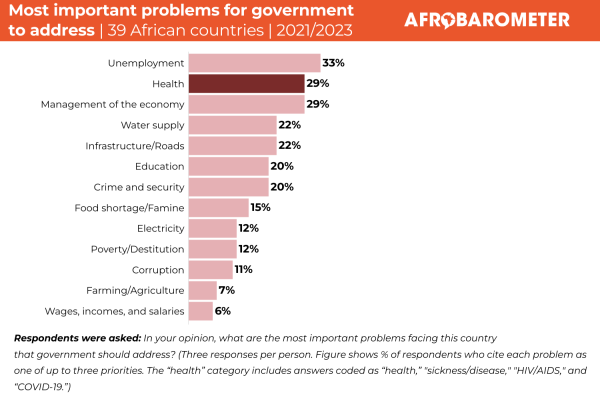
A majority of Africans want their governments to invest more in preparations for future health emergencies, even if doing so will diminish the resources available for other health services, Afrobarometer (www.Afrobarometer.org) surveys show.
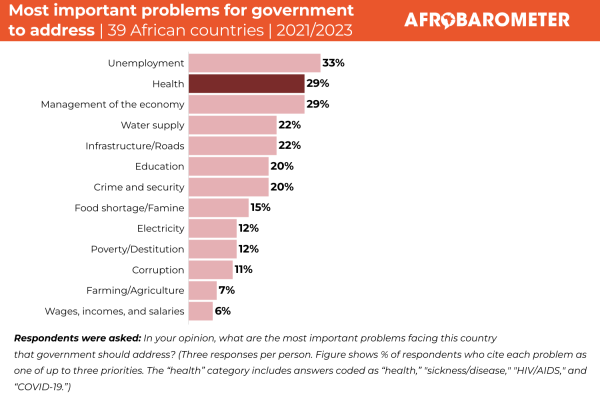
Africans see health as the second-most important problem requiring government intervention, and only half of them think their governments are ready to deal with future public health emergencies like COVID-19.
The World Health Organization (WHO) this week declared mpox a global public health emergency of international concern. The WHO has called for coordinated international action in response to an uptick in mpox cases in the Democratic Republic of the Congo and several other African countries.
Key findings
- Health-related issues (29%) rank second among the most important problems that Africans want their governments to address, following unemployment (33%) (Figure 1).
- Only half (51%) of Africans believe that their government is “somewhat” or “very” prepared for a future public health emergency like COVID-19 (Figure 2).
- Fewer than one-fourth of citizens in Cabo Verde (24%), Lesotho (21%), and Gabon (15%) think their government is ready to deal with a pandemic (Figure 2).
- Almost six in 10 Africans (58%) “agree” or “strongly agree” that their government should invest more in preparations for future health emergencies like COVID-19, even if it means fewer resources are available for other health services (Figure 3).
- Three-fourths or more of citizens support greater investment in pandemic preparedness in Liberia (82%), Tanzania (75%), and Ethiopia (75%).
- But majorities in Gabon (70%) and Congo-Brazzaville (55%) disagree.
Afrobarometer surveys
Afrobarometer is a pan-African, non-partisan survey research network that provides reliable data on African experiences and evaluations of democracy, governance, and quality of life. Nine survey rounds in up to 42 countries have been completed since 1999. Round 9 surveys (2021/2023) cover 39 countries.
Afrobarometer’s national partners conduct face-to-face interviews in the language of the respondent’s choice. National samples of 1,200-2,400 yield country-level results with margins of error of +/-2 to +/-3 percentage points at a 95% confidence level.
Distributed by APO Group on behalf of Afrobarometer.
For more information, please contact:
Josephine Appiah-Nyamekye Sanny
Director of communications
Email: [email protected]
Telephone: +233 243240933
Visit us online at: http://www.Afrobarometer.org/.
Follow us:
Facebook: /Afrobarometer
Twitter: @Afrobarometer
Youtube: @Afrobarometer
Follow our releases on #VoicesAfrica.


 derick.khumalo