Online Reporter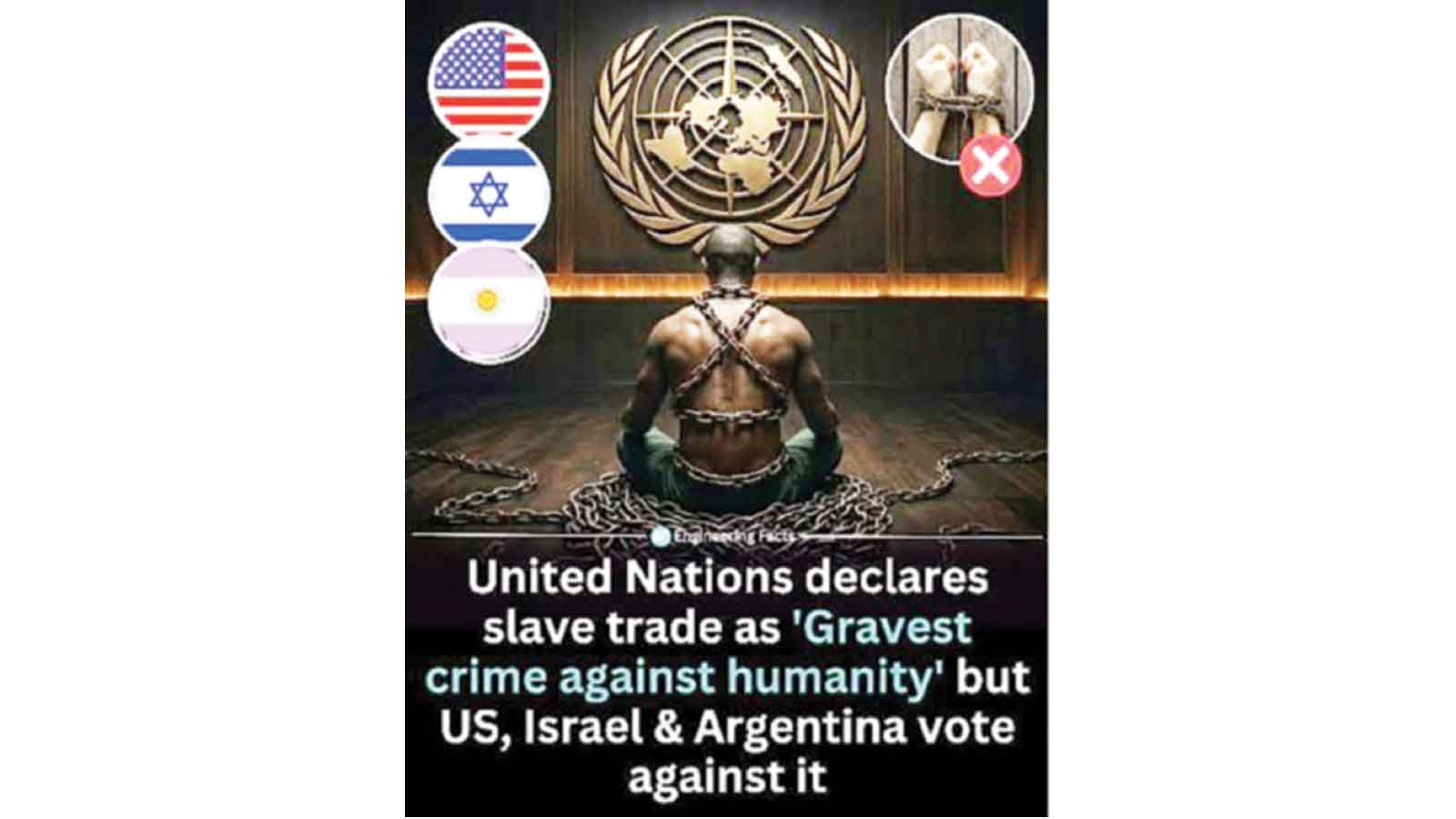
Ranga Mataire
Group Political Editor
ANYONE who ever wished the reparations movement to just fade away like a historical aberration would surely be disappointed with recent developments in New York where the United Nations General Assembly overwhelmingly backed a resolution that declared the transatlantic slave trade “the greatest crime against humanity.”
On March 25, 2026, the United Nations General Assembly made a bold unprecedented resolution acknowledging the scope, gravity and continued impact of the transatlantic trade in enslaved Africans and racialised slavery it underpinned.
It was a historic development as previous attempts to declare the transatlantic slave trade/slavery as a “crime against humanity” had not succeeded. Previous attempts faced opposition and didn’t pass as originally worded. But on March 25 this year, the resolution did pass and it was the first time it got to a vote.
So ironic that the overwhelming vote had to happen on American soil — a country famed for its slavery history and racial dehumanisation of blacks — the majority of whom are descendants of slaves from Africa.
UN Secretary-General Antonio Guterres pointedly said the wealth of many Western nations was “built on stolen lives and stolen labour”. He noted the “barbaric punishments that maintained control, from shackles and iron collars, to flogging and sexual violence.”
“It was a machinery of mass exploitation and deliberate dehumanisation of men, women and children. The wounds run deep and often go unrecognised,” secretary general Guterres told member states.
Although not legally binding, the vote sends a powerful message and enhance the chance of progress on discussions for actual compensations to countries that bore the brunt of slavery.
Spearheaded by Ghana, the resolution received 123 votes in favour. Three countries — Argentina, Israel and the United States voted against the resolutions while the United Kingdom and European member states abstained.
The voting pattern clearly showed that those who bear the historical blame for slavery are not yet prepared to own up to the devastating impact it had on African nations and its people — socially, economically and politically.
Ghanaian President John Dramani said the reparations call was “a route to healing and reparative justice”.
Zimbabwe is one of the 123 countries that voted in favour of the resolution. The country’s position is rooted in its consistent historical consciousness of being a country that has endured and triumphed against colonial repression. It is also a consciousness rooted in a clear understanding of the need for restorative justice.
Zimbabwe’s participation at the high-level consultative conference on the next steps to the landmark United Nations Resolution on the Trafficking Enslaved Africans held in Accra from June 17-19 this year exemplified its commitment for restorative justice.
The attendance by the Minister of Foreign Affairs and International Trade, Prof Amon Murwira signified Zimbabwe’s serious quest to address the enduring legacies of slavery, colonialism and historical injustice.
Unlike other countries that have not come out in the open, Zimbabwe has openly declared its stance. It stands for correcting historical injustices inflicted on the African people during slavery and colonialism.
Prof Murwira clearly articulated Zimbabwe’s position, saying the country’s pursuit of “reparatory justice is not about retribution,” but acknowledging historical wrongs and creating pathways that enable affected communities and nations to recover from centuries of dispossession and marginalisation.
Zimbabwe’s view is that the global community must recognise that the legacy of slavery and colonialism have impacted negatively on the development trajectories across Africa and the African diaspora.
While the actual compensation may be a complicated process, President Mnangagwa believes with unity the global South will be able to convince the world that reparatory justice is not retribution, but restorative justice for a stable global future.
Zimbabwe has not only voted in favour of reparations, but has moved a step further in initiating a study into the impact of colonialism that will culminate in a demand for reparations from former colonial power, Britain.
The study is being conducted by the Zimbabwe National Elders Forum led by Dr Feliz Mukonowengwe and other academics including the clergy. The commissioning of the study came shortly after a meeting of 55 Commonwealth countries held in Samoa late in October last year that ended with a communique that said: “The time has come for a meaningful, truthful and respectful conversation towards forging a common future based on equity.”
President Mnangagwa said the study focuses on colonial injustices suffered from 1890 to 1980, the year that Zimbabwe got its independence.
He said the conclusion of the study will culminate in the compilation of recommendations that will explore options to assist in the long-term healing of affected communities as well as rekindling the recreating goodwill between the Zimbabwean society at large and the former colonial power.
A precedent has already been set in Kenya and Namibia where the United Kingdom apologised to the Mau Mau of Kenya and Germany apologising to the Mbanderu, Herero and Nama people of Namibia. Zimbabwe’s quest for restorative justice is, therefore, not a mirage.
One of the academics leading the initiative to conduct Zimbabwean study, Professor Mandivamba Rukuni said while the question of whether the UK should pay financial reparations for slavery and colonialism is a contested issue, the former colonial power has already acknowledged the need for further dialogue.
Prof Rukuni is of the view that an apology from the UK on slavery and colonialism would send an important signal regarding the UK government’s willingness to seriously engage on this issue as some other former colonial governments, including the Netherlands and Germany, have apologised for slavery and colonial wrongs.
Zimbabwe’s initiative and the one being spearheaded by Ghana at the United Nations, both dovetail into the global reparations movement which seeks to confront history and the need for proper reckoning as a crucial part of restorative justice.
Highlighting the need for reparations is part of re-affirming history for future generations, especially given the fact that many people in countries like Britain are still misinformed about the role slavery played in the dehumanisation of African ancestors.
Sara Hamood, from the UN Office of the High Commissioner for Human Rights, said that such acknowledgment is a crucial part of any restorative justice process.
“The financial side is just part of it. We have repeatedly said that no country has fully reckoned with the legacy of slavery, or comprehensively accounted for the impacts on the lives of people from African descent. From apologies, truth-telling and education are all part of a wide range of measures,” Hamood argued.