Online Reporter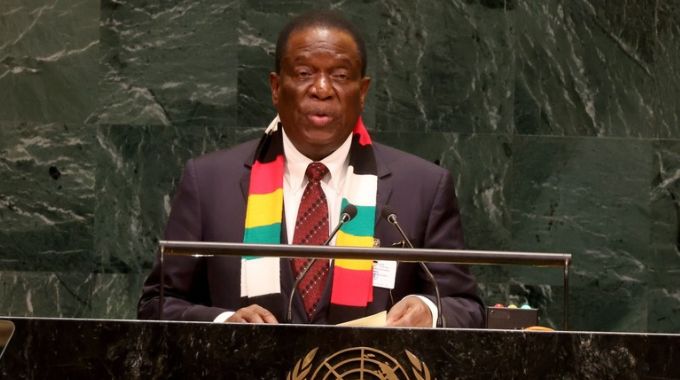
Wallace Ruzvidzo in New York, USA
PRESIDENT Mnangagwa has called for a just and equitable United Nations (UN) and international order anchored on peace and dialogue, while pledging to use Zimbabwe’s new seat on the United Nations Security Council (UNSC) to advance Africa’s interests.
Addressing the 81st Session of the United Nations General Assembly (UNGA81) in New York yesterday, President Mnangagwa said the world needed a multilateral system in which peace, rather than war, and dialogue, rather than confrontation, shaped international relations.
“As the current crop of leaders, it should concern us that today, somewhere, a child is born into war, a family is displaced by conflict, a farmer loses another harvest to drought, and a young person wonders whether technological progress will expand opportunity or deepen inequality.
“Though separated by geography, these experiences reveal a common truth: humanity’s challenges are increasingly interconnected, and no nation can overcome them alone.
“The trust deficit among nations has continued to erode the gains that cooperation fostered within the UN system. We must, therefore, choose between purposeful reform or unmitigated regression.
“Trust will be restored when conflicts are prevented, international law is applied equally, development commitments are fulfilled, and all nations are fairly represented in global institutions,” he said.
President Mnangagwa said Zimbabwe was grateful for the confidence reposed in the country through its election to the UNSC for the 2027-2028 term, assuring the comity of nations that the country would shoulder its responsibilities, promote peace and development while amplifying the voice of developing countries in global decision-making.
“Zimbabwe is grateful for the confidence placed in us through our election to the Security Council for the 2027-2028 term. My country will assume this responsibility in January 2027 with humility, independence, and a readiness to serve, guided by our foreign policy of being “a friend to all and an enemy to none”, said the President.
During its tenure, the President added that Zimbabwe would prioritise four key areas, namely: preventive diplomacy, mediation and peaceful dispute resolution; stronger cooperation between the United Nations and regional organisations; leveraging its rich heritage and natural resource endowments to advance industrialisation, modernisation and the green agenda; and ensuring that women and young people shape peace-building efforts from the outset.
“Firstly, the promotion of preventive diplomacy, mediation and peaceful dispute resolution, while tackling the underlying causes of insecurity. Secondly, we shall advocate for the strengthening of cooperation between the United Nations and regional organisations, such as the African union and its Peace and Security Council. In this respect, we call for the full implementation of Resolution 2719 to ensure predictable, adequate and sustainable financing for authorised African Union-led peace support operations.
“Thirdly, our nation believes that our rich heritage and natural resource endowments must advance industrialisation, modernisation and the green agenda for the prosperity of all and not to finance conflict.
“As such, Zimbabwe shall support ‘Africa’s Silencing the Guns Agenda’ and stronger action against terrorism, organised crime, illicit arms flows and illegal resource trafficking.
“Finally, Women and young people must shape peace from the outset. The support of Zimbabwe will also be extended to the Women and Youth Peace and Security agendas,” he said.
Restoring confidence in collective security, said President Mnangagwa, required the Security Council to move beyond the outdated geopolitical realities of 1945.
He said Africa’s long-standing position, as outlined in the Ezulwini Consensus and Sirte Declaration, should be granted.
“Africa is united, sovereign and independent. Africa is rising; the horse and rider mentality has no place in contemporary international discourse,” he said.
In his address, the President reaffirmed Zimbabwe’s position that institutional legitimacy depends on the consistent application of international law, sovereign equality and the inalienable right to self-determination of nations.
Unilateral coercive measures, which he described as a manipulative foreign policy tool, were outdated in a global era that should instead be anchored on solidarity, mutually beneficial partnerships and shared prosperity.
The developing world was in agreement with the President’s stance, with his Mozambican Counterpart Daniel Chapo also stressing in his address that the time has come for the world to treat Africa as an equal partner.
The President described the current global order as a defining epoch in the history of the UN to protect the United Nations Charter.
“The tendencies where our Resolutions and international law, are ignored, should no longer be excused,” said President Mnangagwa.
He said peace could not be guaranteed without development, calling for equal access to concessional financing to enable developing countries to pursue their development aspirations.
“Peace cannot endure without development. With less than four years to implement the 2030 Agenda, only 36 percent of the Sustainable Development Goals are on track or showing moderate progress, while developing countries face an annual financing gap exceeding US$4 trillion.
“The Sevilla Commitment must now be implemented through greater affordable, long-term and concessional finance; timely, development-oriented debt treatment; and more effective channelling of Special Drawing Rights.
“Development cannot flourish when its financing is prohibitively expensive. Reform must decisively address Africa’s excessive risk premiums and borrowing costs,” said the President.
He said the need to strengthen the voice of developing countries in global financial institutions, curb illicit financial flows and tax abuse, as well as secure fair returns from natural resources, could not be overemphasised.
“Zimbabwe is continuously strengthening its capacity to mobilise domestic resources, enhance public financial management, and foster a favourable environment for productive investment.
“Under our national Vision 2030, we are strengthening the important linkage between mining and agriculture, which is driving growth in Zimbabwe’s manufacturing sector. Bold reforms and other macroeconomic policies have resulted in a three-fold growth in our GDP since 2017. Zimbabwe is indeed ‘Open for Business’,” he said.
The Zimbabwean Government, added President Mnangagwa, was also pursuing food and nutrition security and climate-smart agriculture, leaving no one and no place behind.
“Through our rural industrialisation agenda and the “Invest Rural” policy, we are directing investment towards rural infrastructure, manufacturing hubs and agro-processing facilities.
“More women and youth continue to enter value chain industries for both our local and regional markets. As droughts, floods and declining productivity threaten water, food and energy security, developed countries are called upon to honour their climate-finance commitments, in line with common but differentiated responsibilities,” he said.
Further, President Mnangagwa said Zimbabwe welcomed the recommendations of the Secretary-General’s Panel on Critical Energy Transition Minerals and the Country Support Mechanism.
Critical minerals, he reiterated, must become a foundation for inclusive development, with value addition and beneficiation at source, alongside the development of regional value chains, being highly prioritised.
Zimbabwe has more than 40 critical and rare earth minerals and has made bold decisions towards a mutually beneficial extractive industry.
“This has seen us dispatch the first export of locally produced lithium sulphate during the second quarter of the year, demonstrating that retaining value at the source is possible for shared prosperity,” said President Mnangagwa.
Towards that end, the President said harnessing emerging technologies for national development was a key priority for the country’s industrialisation agenda.
“Zimbabwe’s National Artificial Intelligence Strategy 2026-2030 promotes human-centred, ethical and responsible innovation. Artificial Intelligence must narrow development gaps, while its military use, including in nuclear command and control, must remain subject to human judgement, accountability and international law.
The President also reiterated his call for the unconditional removal of the illegal sanctions imposed on Zimbabwe by some Western states.
“Regrettably, however, my country’s national development initiatives have continued to be undermined by unilateral coercive measures imposed by some Western countries. We call for their immediate and unconditional removal. I reiterate that ‘Zimbabwe is a friend to all and an enemy to none’,” said President Mnangagwa.
He said civil, political, economic, social and cultural rights required equal protection and were best advanced through dialogue, cooperation, capacity-building and national ownership.
“Racism and all forms of discrimination continue to deny millions the equal enjoyment of human rights and development. Accountability, education and awareness as well as support for victims, and engagement on reparatory justice remain critical pathways to truth, healing, restored dignity, and equality.
“My country therefore joins other Member States in calling for the full implementation of the Durban Declaration and Programme of Action,” he said.
President Mnangagwa said Zimbabwe supported reforms that reduce duplication, improve coordination, modernise systems and strengthen field implementation.
At this juncture of global development, he said the success of reforms should be reflected by the conflicts prevented, development advanced, assistance delivered and communities strengthened.
“The selection of the next Secretary-General, therefore, comes at a defining moment. The next holder of the Office should be an impartial custodian of the Charter, an independent voice for peace, a bridge-builder among Member States, and an advocate for those whose voices seldom reach these halls.
“The process should be transparent, inclusive, and guided by merit, equitable geographical
representation, and gender equality. Above all, the next Secretary-General must bring the United Nations closer to the people.
“The Charter begins with ‘We the peoples of the United Nations.’ Those words should guide how the Organisation listens, communicates, and measures success,” he said.
The President congratulated Dr Khalilur Rahman on his election as President of the 81st Session of the General Assembly.
“Zimbabwe is confident that, under your able leadership, the Assembly will advance meaningful transformation under the theme, ‘Restoring Trust, Managing Transformation: A United Nations that Delivers for All.’ You may count on Zimbabwe’s full support,” he said.
“I wish to thank Ms Annalena Baerbock for her effective leadership of the 80th Session and her contribution to the UN80 reform process.
Zimbabwe also paid tribute to Mr António Guterres in his final General Debate as Secretary-General.
“We commend his defence of multilateralism, as well as efforts to advance dialogue for conflict prevention and resolution, sustainable development and the Pact for the Future,” said the President.
President Mnangagwa said this year’s UNGA81 was meeting at a pivotal moment when the world was facing numerous, interconnected and complex crises.
“Conflicts are spreading, climate shocks are intensifying, and technology is advancing faster than the rules that govern it. Multilateralism is a crucial equaliser. It ensures that all have an equal voice under international law and an equal role in shaping our shared future,” said the President.
He said the UN Charter remained the member states’ common compass.
“Sovereign equality, political independence, territorial integrity, non-interference, peaceful settlement of disputes, and international cooperation must be applied universally, not selectively.
“International law cannot be a shield for some and a sword against others. The United Nations has a sacred duty to save succeeding generations from the scourge of war,” said the President.
In the same vein, he said Southern Africa had learnt that dialogue was a shared fortitude and not a weakness.
“In the African tradition, the meeting place is not where courage is abandoned; it is where wisdom is summoned. Lessons can be drawn from the heritage-based approaches to peacebuilding and conflict resolution, from communities across the world, including within Africa.
“Military action may alter the battlefield, but durable peace is built through inclusive political processes that restore confidence, address grievances and allow affected communities to shape their socio-economic and political destinies,” said President Mnangagwa.
The current times, he added, demanded peacekeeping grounded in clear political strategies, realistic mandates and adequate resources.
“Those most affected by the decisions of the Security Council should not be the least heard. There is need, to not only give a voice, but consider the views of the countries and regions on the Security Council agenda, towards our shared aspirations for enduring peace and sustainable development,” he said.
In concluding his address, President Mnangagwa said Zimbabwe would assume its role on the Security Council mindful that membership was not a badge of honour but a commitment to serve the comity of nations.
“We will serve with balance and integrity, defend the sovereign equality of States, advance Africa’s priorities, and work constructively with all regions.
“Let this 81st Session be recorded as the session that closed the gap between the promises of the Charter and the realities of daily life.
“Zimbabwe is ready to play its part in building the future we all want,” he said.
Several Cabinet Ministers and other senior Government officials were in attendance at the UNGA81 General Debate, held under the theme: “Restoring trust, managing transformation: A United Nations that delivers for all.”