Online Reporter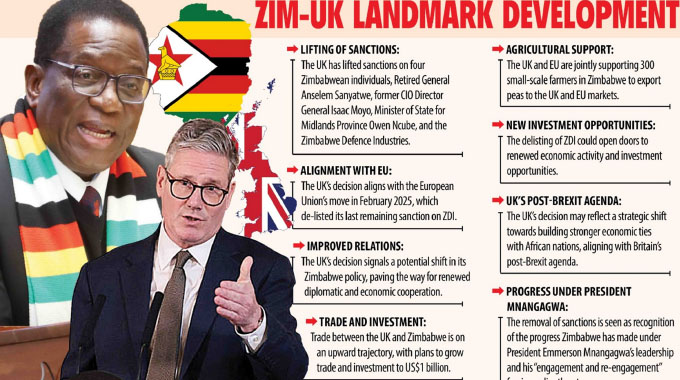
Ranga Mataire, Group Political Editor
The United Kingdom’s decision to lift its remaining sanctions on Zimbabwe marks a significant milestone in the evolution of relations between the two countries. It signals a full-circle moment in diplomatic ties between two historically connected nations.
The UK recently announced the removal of measures targeting Retired General Anselem Sanyatwe, former CIO Director General Isaac Moyo, Minister of State for Midlands Province Owen Ncube, and the Zimbabwe Defence Industries (ZDI).
In its statement, the UK noted that these “revocations align with a similar move from the European Union in February 2025,” when the EU delisted its last remaining sanction on ZDI. While the United States has also lifted some designations, it continues to maintain sanctions on Zimbabwe under a new framework of measures.
Political analysts have described the UK’s decision as a landmark development in Zimbabwe’s long path towards economic and political recovery, after enduring years of hardship attributed, in part, to international sanctions.
The sanctions were originally imposed in the early 2000s by both the European Union and the United States in response to what they cited as human rights abuses.
However, the Zimbabwean Government has consistently argued that the measures were not about human rights but were instead a response to its land reform programme.
Under then Prime Minister Tony Blair, the British government reneged on commitments under the Lancaster House Agreement, which had assigned the UK responsibility for funding land compensation to enable land reform.
Feeling betrayed, the late President Robert Mugabe launched Zimbabwe’s historic land redistribution programme, asserting the nation’s right to reclaim its land. The West responded with unilateral sanctions — seen by many as a form of economic warfare.
In a telling remark while preparing for a Senate debate on the Zimbabwe Democracy and Economic Recovery Act — the basis for US sanctions — US diplomat Chester Crocker urged lawmakers to intensify economic pressure on Zimbabwe:
“To separate the Zimbabwean people from Zanu-PF, we are going to have to make their economy scream, and I hope you, senators, have the stomach for what you have to do,” said Crocker.
While Crocker’s statement came from a US official, historical context makes it clear that it was the UK that initially rallied its European and American allies to impose sanctions on Zimbabwe over the land issue.
The economic impact was devastating, as intended, but the Zanu-PF government remained in power. Many Zimbabweans stood in solidarity with their Government, viewing the land reform as a justified and necessary step towards national sovereignty.
The British government’s May 27 decision to remove sanctions is therefore seen as an acknowledgment that the sanctions achieved little and ultimately benefited no one — including the Western countries that imposed them. It also reflects recognition of the progress Zimbabwe has made under President Emmerson Mnangagwa’s leadership and his administration’s “engagement and re-engagement” foreign policy thrust. President Mnangagwa has consistently reiterated that Zimbabwe is “a friend to all and an enemy to none.”
The delisting of ZDI, a strategic player in Zimbabwe’s industrial landscape, could open doors to renewed economic activity and investment opportunities.
Trade between the UK and Zimbabwe has been on an upward trajectory in recent years. The UK is part of a broader plan to grow trade and investment with Zimbabwe to US$1 billion. Central to this plan are the farmers.
The UK and EU are jointly supporting 300 small-scale farmers in Zimbabwe to export up to 700 tonnes of peas to the UK and EU markets.
Pointedly, many of these farmers are beneficiaries of the land reform programme that once triggered diplomatic fallout.
In addition, the UK is backing the United Green initiative, which aims to inject investment into agriculture, dairy production, and green energy.
After years of sanctions that yielded little in terms of positive outcomes, the lifting of these measures is likely to improve global perceptions of Zimbabwe and strengthen its relations with the UK and other European countries.
The potential for deeper trade, investment, and diplomatic collaboration is now greater than ever.
President Mnangagwa’s leadership has inspired renewed confidence in Zimbabwe’s future. His pragmatic and forward-looking policies are beginning to bear fruit. The removal of sanctions on the five individuals and ZDI is a strong signal of the progress achieved under the Second Republic.
Viewed in the context of Brexit, the UK’s decision may also reflect a strategic shift towards building stronger economic ties with African nations.
It aligns with Britain’s post-Brexit agenda to diversify trade and investment partnerships beyond Europe.