

 admin
admin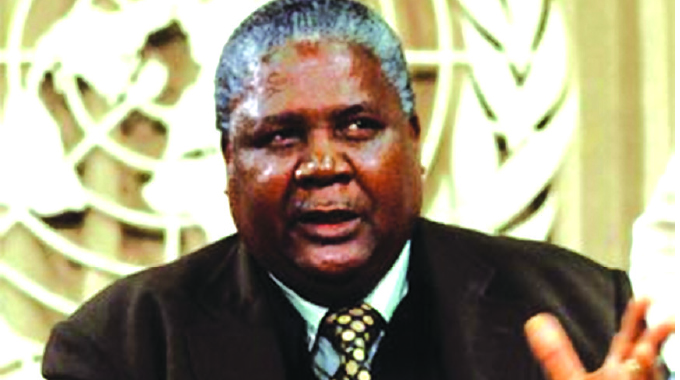
The Herald, December 19, 1979
THE war would end with the signing of the ceasefire agreement at the Lancaster House talks today, the co-leader of the Patriotic Front, Mr Joshua Nkomo, said in a telephone call to Salisbury from his London hotel yesterday.
“This will be the end of the war between the PF and the Rhodesian security forces. This heralds peace in our country, Zimbabwe,” Mr Nkomo told the editor of The Herald, Mr R. J. Fothergill.
Asked if the message about a ceasefire was already going out to the PF’s forces or if it would be sent only after the signing ceremony, Mr Nkomo replied: “It is going out as you talk to me now.”
Before the telephone conversation took place, a PF representative in Salisbury contacted, Mr Fothergill and said Mr Nkomo would like to speak to a senior man at The Herald.
Mr Fothergill booked a call to London and Mr Nkomo read over a statement before answering questions.
The statement said: “We have initialled a ceasefire agreement yesterday. We are going to sign the document on Wednesday. This will be the end of the war between the Patriotic Front and the Rhodesian forces. This heralds peace in our country, Zimbabwe. I would now like to call on all our people, irrespective of colour, race or creed, to forget the past and take the future as a challenge to them all.
“We are a people together. There has been a war which claimed many lives and now that it is over, we have to reconcile and work together for the good of our people and our country. I would like to call especially on the European population of our country that the end of this war means the end of discrimination between us.
“I would like all of them who have decided to make Zimbabwe their home to know that we in the PF regard them as part of the population and not merely as Europeans or white people.
“Colour is not a differentiating factor. We are all human beings. I would like personally to say to everyone that I look forward to coming home to work with everyone for peace, reconciliation and understanding.
“Those who have been thinking of leaving the country because of the advent of majority rule, let me assure them that majority does not mean deprivation of property or anything else that may be theirs.
“I would like to say to all our people, the black people, the Coloured people and the Indian people, that what has happened during the war must be forgotten.
“Let them regard everybody, whether black, white or brown, as a citizen of Southern Rhodesia, now to be Zimbabwe.
“I would like to say to the black people that racism is evil whether practised by black people or white people. And I should also like to emphasise that tribalism is as much an evil as racism.”
He said he planned to return as soon as he could wind up his affairs in London and Zambia. If possible he might come back before Christmas but if not, then immediately after Christmas.
Asked if he and his co-leader in the PF, Mr Robert Mugabe, planned to fight the election as an alliance or as separate parties, he said: “We agreed that we would fight as an alliance during the negotiations and after the negotiations and that is the position.”
He confirmed this would also be the case at the elections.
LESSONS FOR TODAY
- Affectionately known as “Umdala wethu”, former Vice President Joshua Nkomo was a nationalist and politician par excellence who used his political skills and charm to reassure the enemy that all will be well in a majority-ruled Zimbabwe.
- His other nicknames – “Umafukufuku”, “Father Zimbabwe” and “Chibwechitedza” speak volumes of a witty politician who earned respect across board because of the shrewd skills he had learnt over the years to convince people about the end goal in the struggle for self-rule.
- When you have an upper hand in a conflict, it gives you the boldness to call and speak with the editor of the country’s largest selling newspaper. The initiative to speak to the media was from the Patriotic Front, and not The Herald.
- The nation reminisces about those skills as it commemorates the 35th anniversary of the Unity Accord this week. Whereas 1979 saw the end of the war between Patriotic Front forces and Rhodesian forces, the Unity Accord marked the end of fighting between Zimbabwean forces and some ZPRA forces soon after independence.
- The pursuit for peace in any conflict is a paramount, since it enables the nation to prosper and develop.



 Online Reporter