

 admin
admin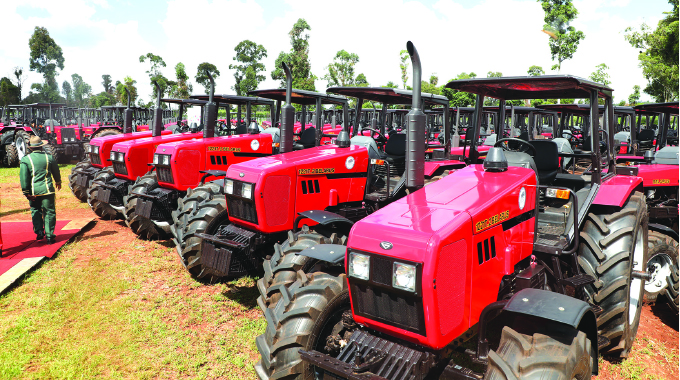
Lovemore Chikova Development Dialogue
The New Dispensation led by President Mnangagwa’s is already past the development take-off stage, and has moved miles ahead within the short period it has been in existence.
The strong pillars of progress have already been laid and these have been pushing the developmental agenda forward.
The agricultural sector is one of those sectors whose transforming has already surpassed the experimental stage and is already bringing results.
A number of issues that dogged the agricultural sector were addressed.
These included defective planning and improper implementation, inadequate credit system, primitive technology and old system of ploughing and irrigation.
The solutions were spot on.
Agriculture Finance Corporation Holdings
After realising the problems of inadequate agriculture financing that affected production, President Mnangagwa spearheaded the transformation of Agribank into an institution specifically targeted at providing the funding.
This saw the birth of the Agricultural Finance Corporation Holdings (AFC), which includes the new Land and Development Bank, in 2021, replacing Agribank that had been widely viewed as not entirely focused on financing farming.
The new financial institution was tasked with boosting and formalising finance for farmers across the full range, from communal land-holders to large commercial farmers.
It is wholly owned by Government, and comprises four subsidiaries: the AFC Commercial Bank, the AFC Land and Development Bank, AFC Insurance and AFC Leasing Company.
After the fast track land reform instituted in 2000, the major debate had been on how to make new farmers more productive and be able to feed the nation, leaving a surplus.
This was after it was noticed that the struggles of the new farmer revolved mainly around financing.
This was worsened by that the farmer had to queue in the bank together the ordinary borrower for financing, when farming is one of the anchors of development in Zimbabwe.
The launch of the new bank was meant to improve the operations of the agriculture sector and align its transformation to the National Development Strategy 1 and Vision 2030.
The illegal sanctions imposed on Zimbabwe by some Western countries had worsened the financing situation for farmers, who became cut off from access to funding from other sources.
The coming in of AFC bridged these financial gaps, ensuring that the local farmers could apply for financing and go back to the field knowing the funding is secured.
Officially opening the new financial institution in 2021, President Mnangagwa said: “This transformation will ensure maximum use of resources Zimbabwe is blessed with including fertile land, skilled human capital, abundant water bodies and beautiful fauna and flora, in order to improve livelihoods.
“The establishment of the AFC will therefore expand the provision of agriculture and rural financial services across the entire agriculture value chain, from communal, old resettlement areas, A1, A2 and large scale commercial farmers.”
And the results are already there for everyone to see.
The 2022/23 summer cropping season is already being touted as a success, with harvesting approaching in the next two months.
But his success cannot pass without mentioning the role played by the AFC in funding the farming activities across the country.
The financial institution targeted to finance over 65 000ha of various crops, including maize, soya beans, sunflower and traditional grains, with the support given to communal farmers, irrigation schemes, A1, A2, contractors and institutional farmers.
To access the funds, the farmers had to submit loan application forms, business plans, cash flow projections, copies of IDs/company registration and proof of land ownership (offer letter, lease or affidavit).
The AFC was also actively involved in the financing of the wheat production success story, which saw the country reaching a record harvest this season.
The AFC’s mandate also includes supporting the agriculture value chain, agro-processing, irrigation and infrastructure development, mechanisation and capacity building of farmers.
Pfumvudza/Intwasa
The New Dispensation launched the Pfumvudza/Intwasa farming practice meant to address low agricultural production, with the major objective being to achieve household food security and national food self-sufficiency.
Pfumvudza/Intwasa has since transformed the lives of many farmers across the country.
The Pfumvudza/Intwasa practice enhanced maize productivity and was aimed at raising maize on designated plot sizes.
Adherence to recommended agronomic Pfumvudza/Intwasa practices have seen many farmers across the country realising higher yields and being able to record a surplus.
The Pfumvudza/Intwasa concept is defined as a climate-proofing farming practice for crop production which emphasises the use of conservation farming.
With this type of farming, the input pack per household is smaller and hence cheaper compared and the Second Republic has been able to avail the inputs to the farmers, mainly those in communal farming.
It has since been proved that the Pfumvudza/Intwasa smallholder farmer achieves a higher yield per hectare compared to the one who uses conventional farming methods.
Pfumvudza/Intwasa has since been extended to include cotton as part of accelerating rural modernisation and industrialisation.
The farming concept is in line with the Second Republic thrust of modernising the country’s pivotal agriculture sector through enhancing production and productivity in line with the Agriculture and Food Systems Transformation Strategy, which seeks to achieve a US$8,2 billion agriculture economy by 2025.
This season alone, at least 2, 3 million farmers were trained under the Pfumvudza/Intwasa programme, with a view to boost food security and income generation.
Mechanisation
The New Dispensation prioritised agricultural mechanisation as it sought to revitalise the sector, obtain self-sufficiency in food supplies and boost exports.
Mechanisation boosts productivity in commercial and smallholder farming sectors and increases the value-added for investment in inputs and labour.
The farm mechanisation programme played a key role in tapping underused agricultural potential, especially where access to labour, rather than land, remained a stumbling block for farmers.
Just last week and during the State visit by Belarusian President Aleksandr Lukashenko, Phase 2 of the Belarus Mechanisation Facility was launched.
The deal will essentially narrow the mechanisation gap in the country’s agriculture industry, as the Government moves to fully automate the sector in line with its drive to modernise agriculture and boost production.
Under the deal, President Mnangagwa last week commissioned 1 635 tractors, 16 combine harvesters and other farming equipment as part of the US$66 million Belarus Phase 2 Mechanisation Facility.
The first phase of the facility saw the delivery of 474 tractors, 60 combine harvesters, 210 planters and five low bed trucks to farmers.
The Government entered into mechanisation deals with several other entities across the world, including John Deere, the world’s largest manufacturer of agricultural equipment.
Under a US$51 million facility, Zimbabwe was offered 1 300 tractors, 80 combine harvesters and other vital agricultural equipment under a new model for equipment sourcing.
To show the seriousness of the New Dispensation in acquiring farming equipment, Government became the main guarantor through various mechanisation deals signed with manufacturers.
Agricultural and Rural Development Authority
The Agricultural and Rural Development Authority (ARDA) recently completed a rebranding exercise to re-align its work with the developmental aspirations being pursued by the New Dispensation.
With the rebranding, and while not reinventing the wheel, ARDA made sure it was going back to basics, ensuring that it delivered on its refocused mandate to guarantee national food, feed, fibre and bio-fuels security.
On the whole, the objective is to empower people in rural areas to banish poverty.
ARDA has irrigation schemes which it intends to run as business units under the management of a resident scheme business manager.
Through these schemes, farmers become shareholders who get dividends once ARDA harvests and markets the produce.
Another important role for ARDA is the training of the farmers so that they adopt the best management practices.
Rural farmers have always struggled with getting markets for their produce, but ARDA has come up with interventions that provide transformative linkages for funding and marketing of produce from the rural irrigation schemes.
To top it up, ARDA decentralises value addition by setting up mini-processing plants across all provinces and this is part of the authority’s rural industrialisation agenda.
By doing this, ARDA is prioritising rural development considering that the majority of people live in the rural areas, yet they have been struggling to ensure they benefit from their farming activities.



 Online Reporter