admin
admin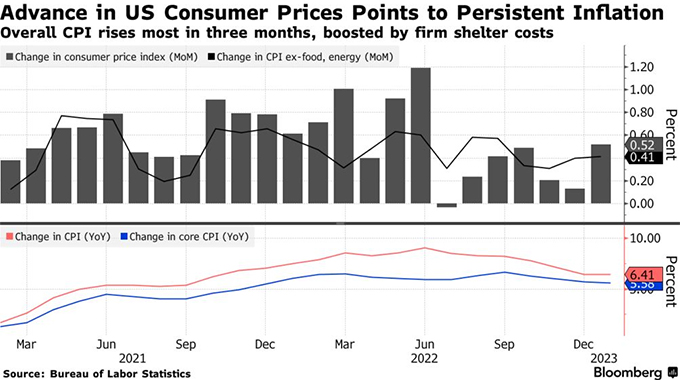
US consumer prices rose briskly at the start of the year, a sign of persistent inflationary pressures that could push the Federal Reserve to raise interest rates even higher than previously expected.
The overall consumer price index climbed 0,5 percent in January, the most in three months and bolstered by energy and shelter costs, according to data out Tuesday from the Bureau of Labour Statistics. The measure was up 6,4 percent from a year earlier.
Excluding food and energy, the so-called core CPI advanced 0,4 percent last month and was up 5,6 percent from a year earlier. Economists see the gauge as a better indicator of underlying inflation than the headline measure.
The median estimates in a Bloomberg survey of economists called for a 0,5 percent monthly advance in the CPI and a 0,4 percent gain in the core measure. US stock futures fell and Treasury yields rose.
Both annual measures came in higher than expected and showed a much slower deceleration than in recent months. The figures remain far higher than the Fed’s 2 percent target, which is based on a separate Commerce Department index.
“It could’ve been worse,” said Stephen Stanley, chief US economist at Santander US Capital Markets LLC, noting declines in used-car prices and airfares. However, “as long as shelter costs are going up as rapidly as they have been, it’s going to be tough to get inflation down anywhere close to where the Fed would like to see it.”
The figures, when paired with January’s blowout jobs report and signs of enduring consumer resilience, underscore the durability of the economy — and price pressures — despite aggressive Fed policy. The data support officials’ recent assertions that they need to hike rates further and keep them elevated for some time, and possibly to a higher peak level than previously expected.
The path to stable prices will likely be both long and bumpy. The goods disinflation that has driven the slide in overall inflation in recent months appears to be losing steam, and the strength of the labour market continues to pose upside risks to wage growth and service prices.
The details of the report showed shelter was “by far” the largest contributor to the monthly advance, accounting for almost half of the rise. Used car prices — a key driver of disinflation in recent months — fell for a seventh month. Energy prices rose for the first time in three months.
Shelter costs, which are the biggest services component and make up about a third of the overall CPI index, rose 0,7 percent last month. Owners’ equivalent rent and rent of primary residence increased by the same amount, while hotel stays also climbed.
Because of the way the housing metrics are calculated, there’s a significant lag between real-time price changes and the government statistics.
The January report incorporated new weights for the consumer basket to try to more accurately capture Americans’ spending habits. The shelter components are now a larger share of the overall index while used cars make up a smaller portion.
What Bloomberg Economics Says…
“January’s CPI report showed the disinflationary momentum in core goods flagging. If inflation is going to fall below 3 percent this year, the disinflationary impulse in months ahead will have to come from services. So far, that’s not looking promising.”
Americans have been shifting more of their spending toward services, and the Fed — particularly Chair Jerome Powell — closely looks at those excluding energy and shelter as a sign of more durable inflation.
So-called core services ex-housing rose 0,3 percent, a slight easing from the prior month, according to Bloomberg calculations. Wages are thought to be a key driver of growth in this category.
That said, a record monthly decline in medical care services weighed on the figure. Excluding that category, services inflation rose 0,8 percent, the most since September.
While a strong jobs market has underpinned wage growth in recent months, inflation eroded those gains at the start of the year. A separate report Tuesday showed inflation-adjusted average hourly earnings fell 0.2% from the prior month, the biggest drop since June. Pay is down 1,8 percent from a year earlier.
Excluding food and energy, goods prices rose by the most since August, following three straight declines. – Bloomberg
Economists largely expect the CPI to fall rather sharply by the end of 2023, but forecasters are split as to whether such a decline can occur without tipping the economy into recession. Much of that hinges on just how far the Fed will go.
Annual revisions released Friday showed slight but notable upward adjustments to the overall CPI and core measure in the closing months of 2022, tempering the narrative of how much inflation is actually cooling.
Bloomberg



 Online Reporter