Online Reporter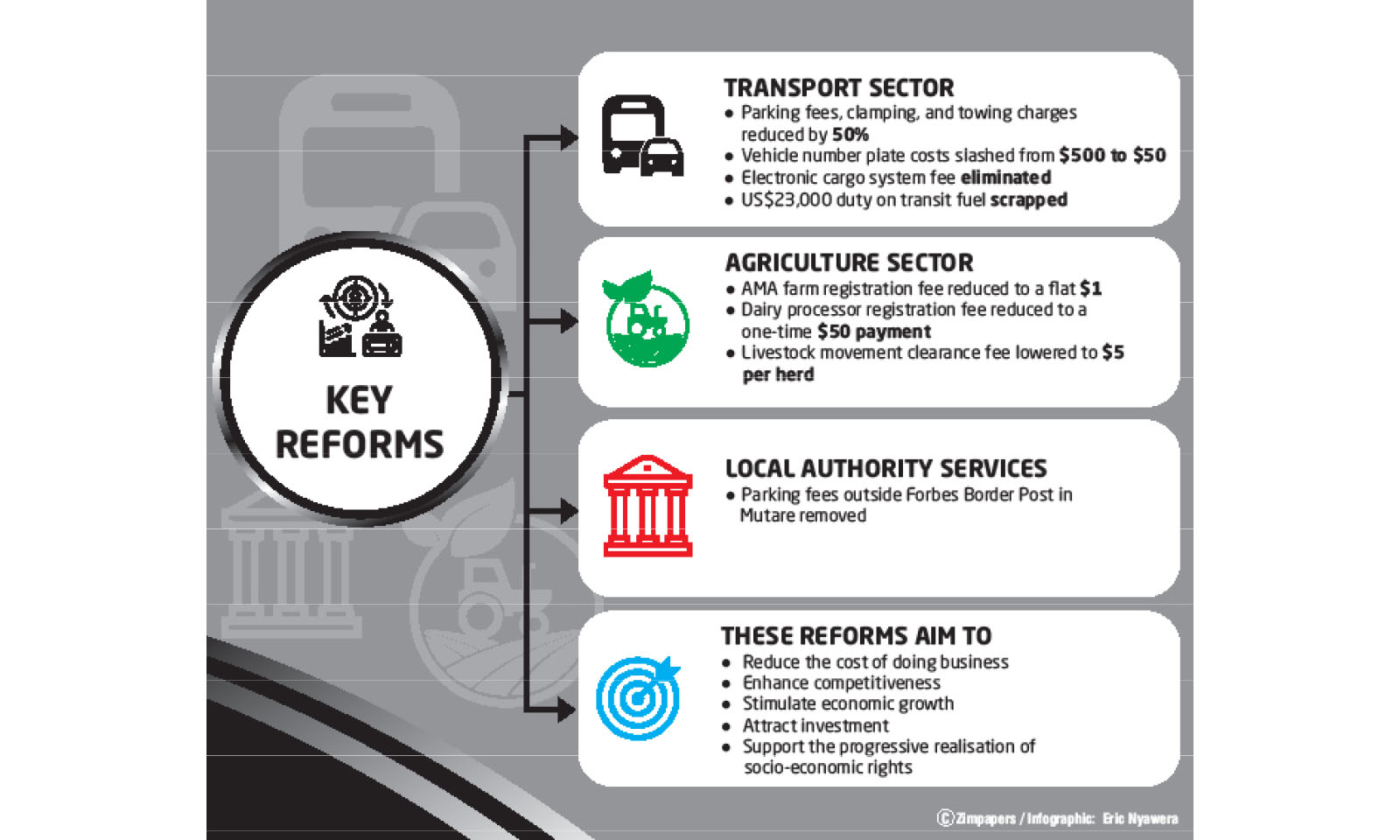
Sunday Mail Reporters
The GOVERNMENT, through the Attorney-General’s Office, has now set in motion plans to gazette the downwardly reviewed licences, permits, levies and fees so far, Justice, Legal and Parliamentary Affairs Minister Ziyambi Ziyambi has said.
The development comes after Cabinet approved the review of licences, permits, levies and fees in the tourism, transport and agriculture sectors, aligning with President Mnangagwa’s directive to implement comprehensive business reforms across 12 sectors of the economy.
Minister Ziyambi told The Sunday Mail that due process is now being followed to make the new fees legally enforceable.
“The Minister of Industry (Mangaliso Ndlovu) presented in Cabinet that we need to look at the ease of doing business because we have duplication of tariffs; we have some rates that are very high that hinder the ease of doing business,” he said.
“So, this is the exercise in general that Government is doing and we have agreed to do it sector by sector. But in order to give effect to that, you recall that rates or levies or these tariffs are governed by statutory instruments or some statutes, so the Attorney-General is now going to look at all this with a view of ensuring that what was approved by Cabinet is given effect through the necessary legislative processes.”
President Mnangagwa’s directive to review of levies, licences, fees and permits across the health, agriculture, retail, tourism, transport, energy, manufacturing, broadcasting, telecommunications, liquor, construction and financial services sectors was meant to increase both competitiveness and promote the ease of doing business.
A fortnight ago, Cabinet approved the slashing of parking fees, including clamping and towing penalty charges, in half in all local authorities as part of the sweeping review of fees and charges.
Further, the cost of vehicle number plates will be cut from US$500 to US$50, considering that they are now produced in Zimbabwe.
The US$23 000 duty on transit fuel payable to the Zimbabwe Revenue Authority (Zimra) will be scrapped while parking fees outside the Forbes Border Post in Mutare will also be removed.
Presumptive tax on the transport sector will be re-examined as the Government seeks to remove the additional financial burden on operators.
In the agriculture sector, major changes will be in the dairy sector, where farmers needed 25 permits across 12 agencies; feed manufacturers (23 from 10 departments), beef cattle farmers (18), abattoirs (20) and dairy processors (21).
The requirements were not only time-consuming, but also came with heavy financial and administrative burdens on businesses.
The Government has since seen it fit to remove duplication, reduce costs and simplify compliance to promote efficiency, competitiveness and formalisation.
By removing burdensome fees and levies, the Government seeks to stimulate economic growth and encourage investment, which will ultimately benefit the broader economy.
In a statement late on Friday, Minister Ziyambi clarified that until Parliament formally amends or repeals the charges, the existing statutory fees, levies and charges remain enforceable.
“All fees, levies and charges prescribed in existing laws in the form of primary and subsidiary legislation shall continue in force and effect until such a time when the statutory provisions providing for the same have been amended or repealed in accordance with set procedures,” he said.
“The ministry, together with the Office of the Attorney-General, is working with all relevant ministries to ensure that the policy position adopted by Government to reduce the various fees, levies and charges is translated into legally binding legal instruments.”
The Government, Minister Ziyambi added, had an obligation to ensure that statutes are drafted to eliminate any gaps in the law, in line with Section 114 of the Constitution.
“It is in public interest that we must draft and enact laws that enhance the investment climate and facilitate the ease of doing business in Zimbabwe,” he said.
Retailers, transporters, ordinary motorists and farmers have praised the decision to reduce levies, fees and charges in their sectors, saying that will reduce their costs of doing business and ultimately benefit consumers in the form or lower prices.