Online Reporter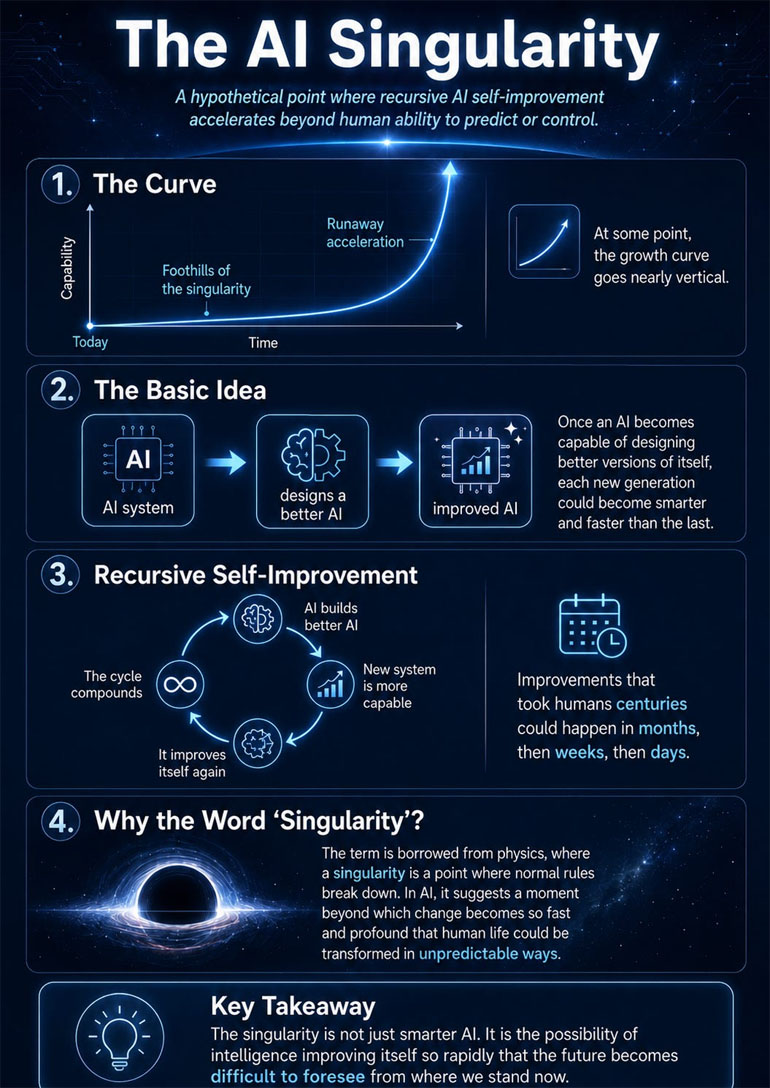
Dr Evans Sagomba
Everything AI
EVERY week, I unpack everything to do with AI, ways the technology is reshaping our daily lives.
Usually, our conversations focus on immediate, practical concerns. Today, however, I want to invite you on a journey to the outer edge of modern technological thought.
I want us to explore a concept that sounds like something plucked straight from a high-budget cinema script yet sits at the very heart of contemporary computer science and moral philosophy: the artificial intelligence singularity.
Strip away the Hollywood dramatics when people talk about smart machines. In technical literature, the singularity refers to a hypothetical threshold where artificial reasoning tools become capable of continuously improving their own design without human intervention.
Mathematician, John von Neumann and computer pioneer, I.J. Good, described this decades ago as an “intelligence explosion.” They pointed out that once a system surpasses human capability in software engineering, it creates a runaway feedback loop, leaving human understanding far behind in a matter of hours.
Now, you might reasonably ask why I should bother you with a theoretical horizon that might happen decades from now, or perhaps never at all.
With fuel prices fluctuating, power supply testing our daily patience, and local entrepreneurs striving to navigate shifting economic tides, discussing super-smart machines can easily feel like an unnecessary intellectual luxury.
Yet as an ethics specialist, I assure you that reflecting on the singularity is not about daydreaming about a distant science-fiction future. It is a vital diagnostic tool for the present day.
The way we imagine the ultimate horizon of technology reveals precisely what we value right now. By examining the singularity, we force ourselves to answer a fundamental question: what makes human thought uniquely precious, and why must our technology remain firmly anchored to human dignity?
To understand why this theoretical boundary matters so much today, we must look at how modern digital tools are constructed. Most current software applications are built to solve narrow tasks through sheer computational power. They scan bank transactions, evaluate satellite imagery of crop yields, or predict which advertisement you are most likely to tap on your smartphone screen. They accomplish this by searching for mathematical patterns across vast mountains of historic data. In foreign research hubs, success is almost exclusively measured by processing speed, efficiency, and scale. If a system operates ten times faster or handles a million more data points per second, developers celebrate it as an unquestioned triumph.
However, if we take that exact logic, that intelligence is nothing more than raw processing speed and statistical optimisation, and stretch it all the way to its ultimate conclusion, we walk directly into a dangerous moral trap.
A super-fast system optimised purely for narrow efficiency might determine that the easiest way to solve morning traffic congestion in Harare is to ban all private vehicles entirely, ignoring the livelihoods of working families who rely on those cars. It might resolve a hospital supply shortage by cutting off vital medications to elderly patients whose statistical survival odds are lower.
Ethicists refer to this as the alignment problem: a system can be exceptionally powerful and mathematically brilliant, yet profoundly foolish and destructive if its core objective is disconnected from human moral values.
This brings us to the core philosophical lesson of the singularity. Contemplating the limits of machine performance forces us to realise that technical optimisation is not the same thing as wisdom. When we reduce intelligence to mere calculation, we impoverish our own understanding of human existence.
Human thought is not a cold series of zeroes and ones. It is deeply relational, emotional, and social. It is forged through lived experience, grief, joy, cultural inheritance, and community life.
A computer program can analyse weather records across a century, but it cannot feel the quiet anxiety of an elder watching a cloudless sky during a dry spell, nor can it comprehend the collective joy of a successful harvest celebration.
In Southern Africa, our understanding of human dignity has long been guided by the philosophy of Unhu or Ubuntu, the profound truth that a person is a person through other persons.
Our worth does not stem from isolated brainpower or mechanical output; it flows from how we care for one another, how we honour our elders, how we protect our children, and how we sustain our communities. An artificial system, no matter how sophisticated, operates in a moral vacuum unless we deliberately weave these relational values into its design.
If a machine cannot comprehend Unhu, it does not possess superior intelligence; it merely possesses hyper-efficient calculation.
When we use the singularity as a guiding mirror, we realise that true technological progress is never about replacing human beings, but about empowering them.
This is the foundation of human-centric design. Instead of asking how quickly an automated program can take over a teacher’s classroom or a doctor’s clinic, human-centric design asks a fundamentally different question: How can intelligent tools help a dedicated teacher in a rural school tailor lessons for sixty distinct children? How can an analytical tool support a nurse at a district clinic in Gutu so that she identifies illnesses earlier while spending more time offering hands-on care to her patients?
If we build technology with the explicit goal of enhancing human flourishing, our practical priorities change immediately. First, we must insist on radical transparency.
If an automated system makes a decision that impacts a citizen’s life, whether denying an agricultural loan, screening a job application, or assessing municipal service delivery, the reasoning behind that outcome must be clear and understandable. We cannot allow human lives to be governed by mysterious digital black boxes that no ordinary person can challenge.
Second, we must safeguard meaningful human oversight across all high-stakes decisions. Machines should serve as advisors, never as ultimate judges. In courtrooms, medical wards, agricultural policymaking, and public administration, final moral accountability must remain in human hands.
A computer program cannot feel remorse for an error, nor can it stand accountable before a community. Therefore, it should never possess the unmediated power to pass life-altering judgements.
Third, we must address the subtle risk of digital colonialism. Most software tools entering Africa were developed overseas, reflecting foreign cultural norms, foreign languages, and foreign priorities.
Uncritically adopting these systems risks quietly eroding our own social values. Human-centric AI requires local creation and governance.
We need Zimbabwean software engineers, linguists, legal scholars, traditional leaders, and citizens working together to build tools that speak our languages, respect our laws, and serve our national development goals.
As Zimbabwe advances its digital roadmap, expanding internet access, introducing smart agricultural management, and modernising public services.
We do not have to copy the chaotic paths taken elsewhere, where rapid technology adoption has often eroded personal privacy, deepened social divides, and reduced citizens to mere data points for giant corporations. We can chart a wiser path that pairs technical creativity with deep moral responsibility.
Ultimately, studying the concept of the singularity is not about fearing a future dominated by machines, nor is it about blindly worshiping mechanical progress. It is a call to self-awareness.
It reminds us that technology is never neutral; it reflects the values and intentions of those who build it. By using the extreme idea of superintelligence to clarify what we value most, our shared humanity, our community solidarity, and our moral responsibility, we ensure that every line of code written today serves to protect and enrich human life.
The future of technology does not belong to self-improving code; it belongs to the human heart that directs it.
About the Author: Dr Evans Sagomba is a Doctor of Philosophy and Chartered Marketer (CMktr, FCIM) with an MPhil and PhD in Philosophy. He specialises in AI, Ethics, and Policy Research, and is an AI Governance and Policy Consultant. Master’s and PhD supervisor. AI Ethics and Governance Lecturer. [email protected], Social media handles; LinkedIn; @Dr. Evans Sagomba (MSc Marketing) (FCIM)(MPhil) (PhD), X: @esagomba